EricSan
Well-Known Member
- Joined
- Dec 28, 2023
- Messages
- 1,439
- Reaction score
- 1,095
- Location
- Central PA
- Country
- United States
- Dash Cam
- There are ALWAYS user serviceable parts inside!
It seems that things have been pretty quiet this year in the context of new dashcam model releases. I wonder to what extent the AI and data center build-outs have driven processor and memory production timelines and costs through the roof. After so many new camera releases last year, I've been a bit bored with no fun new cameras to review for a while...
So, I was curious when Amber from @Mangoal Dash Cam reached out to me a little while ago and asked if I'd review one of their cameras. I hadn't heard of MANGOAL before, so I'm interested in learning about their offerings which are OEM-Style dashcameras that blend in with the car's interior and look like they were factory installed by the automaker. With a very sincere "Thank you!" to Amber, here is a quick intro to the MANGOAL dashcam.
Features:
- Start Recording
- Start Emergency Recording
- Restore Factory Settings
- Turn on time-lapse recording
Maximum Resolutions Are as Follows:
- 3842x2160 @30 fps** (see below)
- 2560x1600 @30 fps
- 1920x1080 @30 fps
Camera angles:
The manual (see image below) indicates 150 degree field of view (FoV) for the front camera and does not specify the FoV for the rear camera. The product webpage (https://mangoal.com/products/mangoa...ash-cam-for-volvo-s60-v60-t5-t6-t8-b5-model-a), however, indicates "To reduce the blind areas it has the front wide angle of 170 degree and rear wide angle of 140 degree." These specs don't match and should be corrected.
Power Consumption Measurements:
I'm not sure if I'll be able to measure power consumption for this camera as uses power cord clips that are intended to interface with the power cable for my rear view mirror. I'll have to investigate a bit further here.
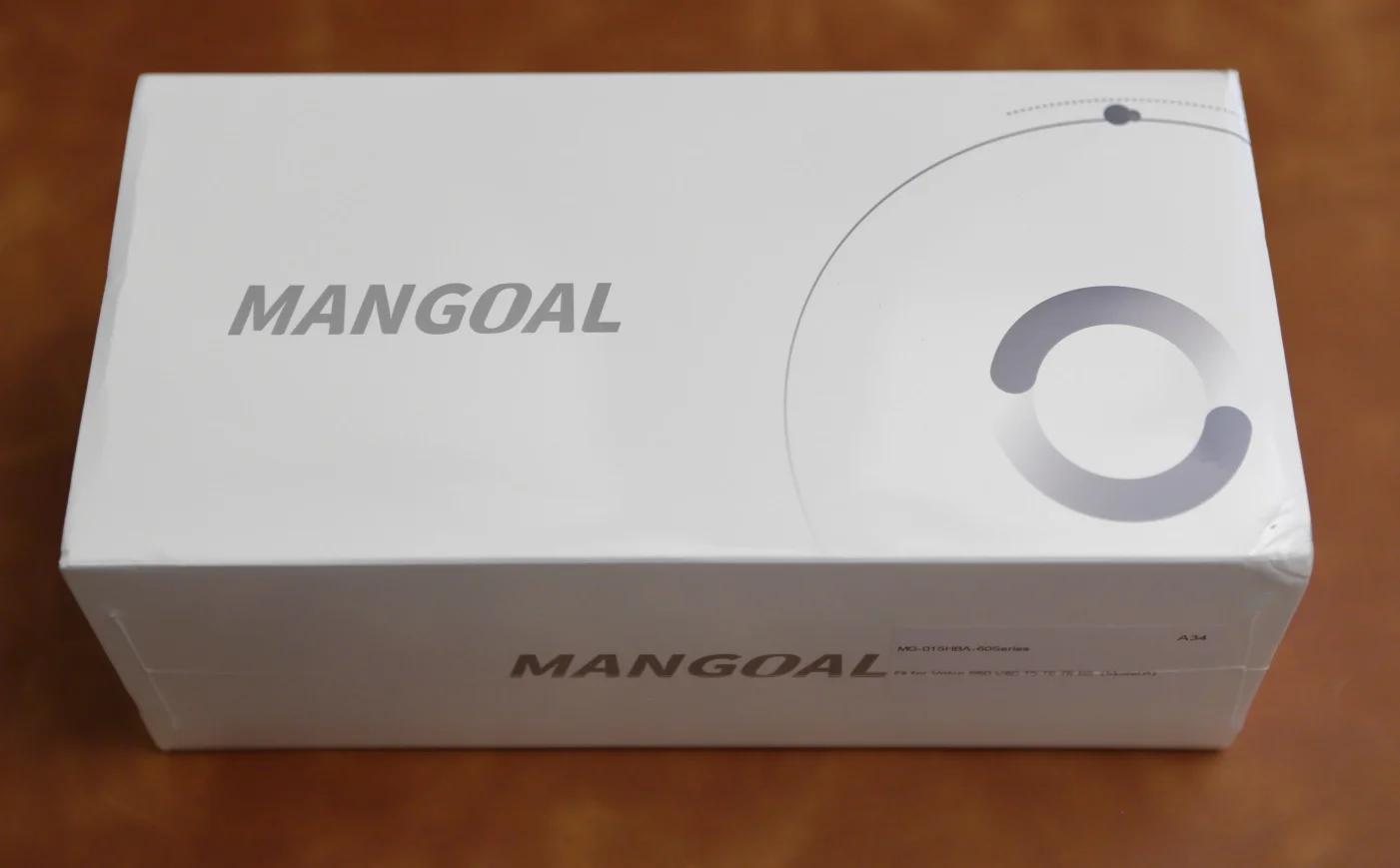
Here is what arrived. The outer box looks like it was dropped once or twice, as evidenced by the mild corner crush in the lower right of the image. The cardboard for the box isn't super heavy or thick.
Opening the outer box reveals some paperwork and two sub-divider boxes. Each of the pieces of paper has some troubleshooting advice and a QR code that links to an installation video. There is one video for the rear camera and one for the GPS unit. I'll have to check them out. This is a nice touch for the first-time installer 👍.

And here is everything that is included in the box. From left to right, we have a printed user's manual, two black zip ties, the front-facing camera, a separate GPS receiver unit, two power harness cables (one for each of Type-A and Type-B rear view wiring configurations, an orange plastic trim tool, a 128GB SD card, and the rear camera & extension cable.

** SOME IMPORTANT DETAILS ABOUT SPECIFICATIONS AND PRODUCT LABELING **
The user's manual indicates two details that caught my eye:
- Sony IMX335 Video Sensor for the front camera
- 4K Ultra-HD 3840x2160 @30 fps
Both of these specifications cannot simultaneously be correct, there is a mismatch in resolutions. Perhaps I have a newer camera that was packaged with an older manual, I'm not sure right now. This prompted me to do some digging that I usually don't perform.
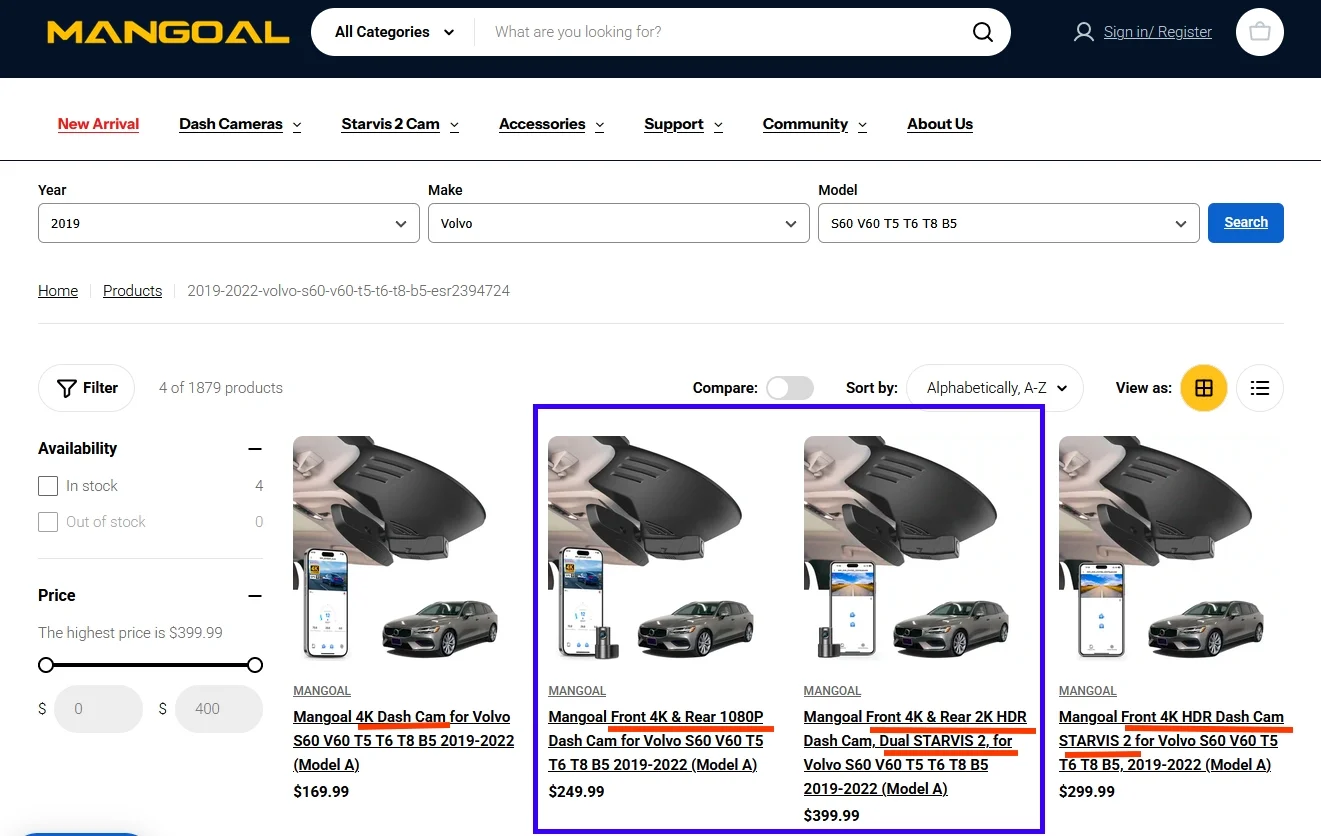
The MANGOAL webpage indicates four available dashcam models for my 2019 Volvo S60 (https://mangoal.com/collections/all/2019-2022-volvo-s60-v60-t5-t6-t8-b5-esr2394724). Each is labelled as a "Front 4K" camera, two of which are also labelled "HRD with Starvis 2." Two are listed as having a rear camera, one of the rear camera models is listed as "1080P" and the other is listed as "Rear 2K HDR and Dual Starvis." Below is a screen capture with red highlights added:
The specs on page 7 of my manual shows the following:
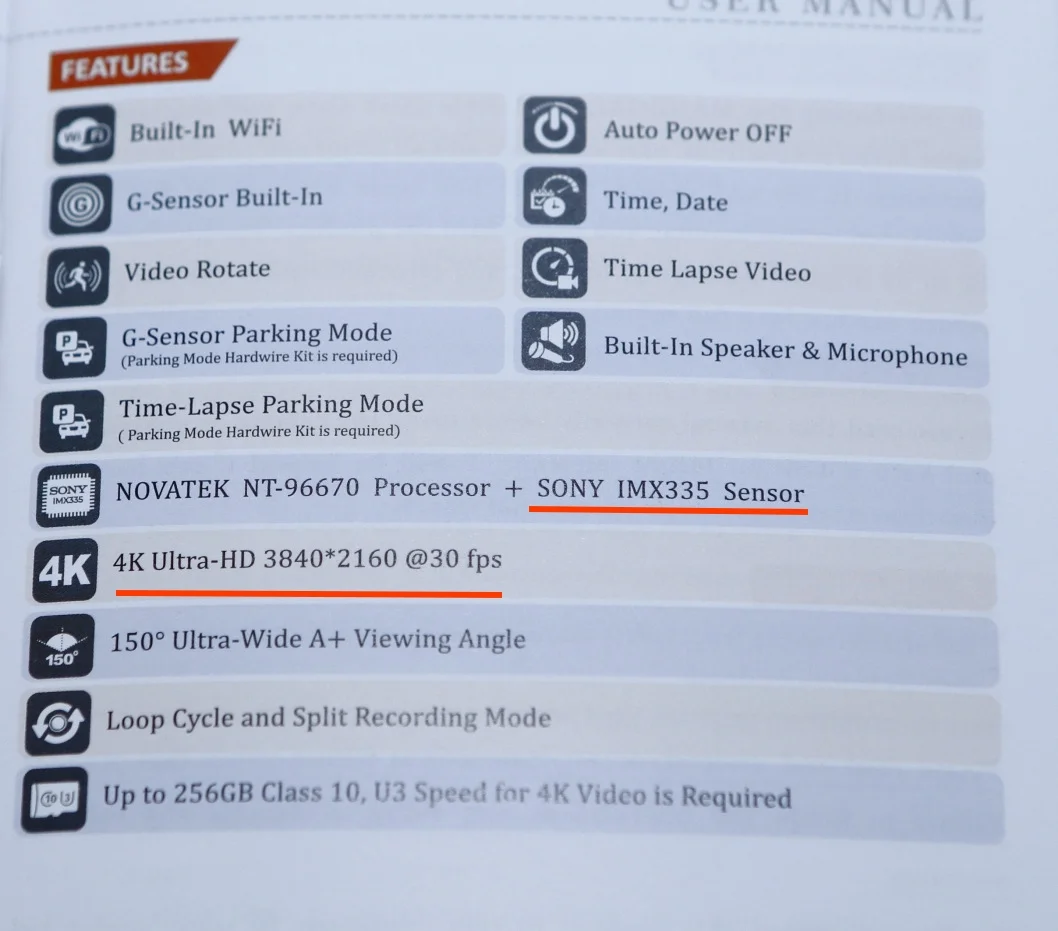
Additional specs are listed on page 12 of the manual:

The MANGOAL camera that I received came with a rear camera, so I'm assuming that I have one of the two models that is inside the blue outline I added to the image above. My manual indicates the presence of a Sony IMX335 sensor (which is not Starvis 2) which has a native resolution of 2616x1964 (often operationalized as 2592x1944), so I'm assuming that I received the model on the left side of the blue box above, though I can't be 100% sure until I get confirmation from Amber.
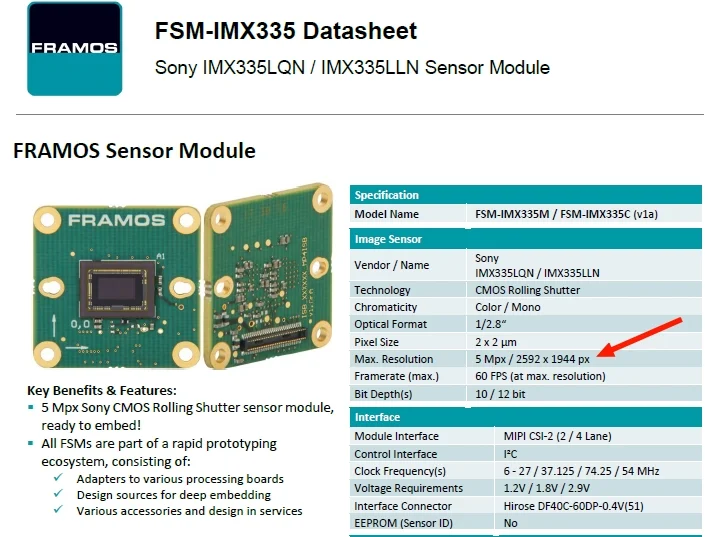
From the Sony IMX335 datasheet:
Naming Conventions:
"4K" is generally defined as having 4096 × 2160 resolution (sometimes operationalized as 3840 × 2160 resolution), or 8,294,400 total pixels that can be read from the sensor.
The Sony IMX 335 spec sheet indicates 2592 x 1944 resolution. This is 5,038,848 total pixels, which is referred to as 2.5K sensor.
A general rule of thumb: 4K means 4096 (or 3840) horizontal lines of resolution, whereas 2.5K resolution means 2592 horizontal lines of resolution.
The difference between a 4K image sensor and the Sony IMX335 2.5K sensor is 3,255,552 pixels.
So, there appears to be a mismatch here (again, perhaps I am incorrect). Each of the four product variants for my 2019 Volvo S60 indicates "4K" front resolution, which means the sensor needs to be able to record at a resolution of 3840 x 2160. Yet, the Sony IMX335 sensor's maximum recording resolution is 2592 x 1944. The only way to achieve the "4K Ultra-HD 3840x2160 @30 fps" specification that appears in the user's manual with an IMX335 sensor is to use an "up-scaling" algorithm in the dashcam's processor. This is a mathematical-based routine that converts and interpolates 2592 x 1944 sensor resolution to a resulting video stream that has 3840 x 2160 resolution.
My First Conclusion / Recommendation:
To the best of my knowledge, based on the information contained in the users' manual , the camera I have received appears to be a 2.5k (2592 x 1944) front camera with a 2K (1920x1080) rear camera. All of the cameras for a Volvo S60 indicate "4K" recording. The product packaging should clearly state these technical details and clearly differentiate among various product lines so customers are not confused or unintentionally misled in any way.
Specsmanship, accuracy of printed materials, and product labeling are important elements of building consumer confidence. At present, I'm not certain which camera I have...
So, I was curious when Amber from @Mangoal Dash Cam reached out to me a little while ago and asked if I'd review one of their cameras. I hadn't heard of MANGOAL before, so I'm interested in learning about their offerings which are OEM-Style dashcameras that blend in with the car's interior and look like they were factory installed by the automaker. With a very sincere "Thank you!" to Amber, here is a quick intro to the MANGOAL dashcam.
Features:
- Built-in WiFi
- Built-in G-Sensor
- Video Rotate
- Time-Lapse Parking Mode (parking mode hardwire kit is required)
- G-Sensor Parking Mode (parking mode hardwire kit is required)
- Novatek 96670 Processor, Sony IMX335 Video Sensor for the front camera** (see below)
- Novatek 96671 Processor, Galaxycore Microelectronics GC2093 (1920x1080) Video Sensor for the rear camera
- 4K Ultra-HD 3840x2160 @30 fps** (see below)
- Loop cycle and Split Recording Mode
- Supports up to 256GB micro-SD cards
- Auto Power Off
- Time, Date
- Time Lapse Video
- Built-in Speaker and Microphone
- Start Recording
- Start Emergency Recording
- Restore Factory Settings
- Turn on time-lapse recording
Maximum Resolutions Are as Follows:
- 3842x2160 @30 fps** (see below)
- 2560x1600 @30 fps
- 1920x1080 @30 fps
Camera angles:
The manual (see image below) indicates 150 degree field of view (FoV) for the front camera and does not specify the FoV for the rear camera. The product webpage (https://mangoal.com/products/mangoa...ash-cam-for-volvo-s60-v60-t5-t6-t8-b5-model-a), however, indicates "To reduce the blind areas it has the front wide angle of 170 degree and rear wide angle of 140 degree." These specs don't match and should be corrected.
Power Consumption Measurements:
I'm not sure if I'll be able to measure power consumption for this camera as uses power cord clips that are intended to interface with the power cable for my rear view mirror. I'll have to investigate a bit further here.
Here is what arrived. The outer box looks like it was dropped once or twice, as evidenced by the mild corner crush in the lower right of the image. The cardboard for the box isn't super heavy or thick.
Opening the outer box reveals some paperwork and two sub-divider boxes. Each of the pieces of paper has some troubleshooting advice and a QR code that links to an installation video. There is one video for the rear camera and one for the GPS unit. I'll have to check them out. This is a nice touch for the first-time installer 👍.
And here is everything that is included in the box. From left to right, we have a printed user's manual, two black zip ties, the front-facing camera, a separate GPS receiver unit, two power harness cables (one for each of Type-A and Type-B rear view wiring configurations, an orange plastic trim tool, a 128GB SD card, and the rear camera & extension cable.
** SOME IMPORTANT DETAILS ABOUT SPECIFICATIONS AND PRODUCT LABELING **
The user's manual indicates two details that caught my eye:
- Sony IMX335 Video Sensor for the front camera
- 4K Ultra-HD 3840x2160 @30 fps
Both of these specifications cannot simultaneously be correct, there is a mismatch in resolutions. Perhaps I have a newer camera that was packaged with an older manual, I'm not sure right now. This prompted me to do some digging that I usually don't perform.
The MANGOAL webpage indicates four available dashcam models for my 2019 Volvo S60 (https://mangoal.com/collections/all/2019-2022-volvo-s60-v60-t5-t6-t8-b5-esr2394724). Each is labelled as a "Front 4K" camera, two of which are also labelled "HRD with Starvis 2." Two are listed as having a rear camera, one of the rear camera models is listed as "1080P" and the other is listed as "Rear 2K HDR and Dual Starvis." Below is a screen capture with red highlights added:
The specs on page 7 of my manual shows the following:
Additional specs are listed on page 12 of the manual:
The MANGOAL camera that I received came with a rear camera, so I'm assuming that I have one of the two models that is inside the blue outline I added to the image above. My manual indicates the presence of a Sony IMX335 sensor (which is not Starvis 2) which has a native resolution of 2616x1964 (often operationalized as 2592x1944), so I'm assuming that I received the model on the left side of the blue box above, though I can't be 100% sure until I get confirmation from Amber.
From the Sony IMX335 datasheet:
Naming Conventions:
"4K" is generally defined as having 4096 × 2160 resolution (sometimes operationalized as 3840 × 2160 resolution), or 8,294,400 total pixels that can be read from the sensor.
The Sony IMX 335 spec sheet indicates 2592 x 1944 resolution. This is 5,038,848 total pixels, which is referred to as 2.5K sensor.
A general rule of thumb: 4K means 4096 (or 3840) horizontal lines of resolution, whereas 2.5K resolution means 2592 horizontal lines of resolution.
The difference between a 4K image sensor and the Sony IMX335 2.5K sensor is 3,255,552 pixels.
So, there appears to be a mismatch here (again, perhaps I am incorrect). Each of the four product variants for my 2019 Volvo S60 indicates "4K" front resolution, which means the sensor needs to be able to record at a resolution of 3840 x 2160. Yet, the Sony IMX335 sensor's maximum recording resolution is 2592 x 1944. The only way to achieve the "4K Ultra-HD 3840x2160 @30 fps" specification that appears in the user's manual with an IMX335 sensor is to use an "up-scaling" algorithm in the dashcam's processor. This is a mathematical-based routine that converts and interpolates 2592 x 1944 sensor resolution to a resulting video stream that has 3840 x 2160 resolution.
My First Conclusion / Recommendation:
To the best of my knowledge, based on the information contained in the users' manual , the camera I have received appears to be a 2.5k (2592 x 1944) front camera with a 2K (1920x1080) rear camera. All of the cameras for a Volvo S60 indicate "4K" recording. The product packaging should clearly state these technical details and clearly differentiate among various product lines so customers are not confused or unintentionally misled in any way.
Specsmanship, accuracy of printed materials, and product labeling are important elements of building consumer confidence. At present, I'm not certain which camera I have...
Last edited: