
You are using an out of date browser. It may not display this or other websites correctly.
You should upgrade or use an alternative browser.
You should upgrade or use an alternative browser.
70mai Dashcam Battery Pack - Unboxing & Review
- Thread starter Julian23
- Start date

EricSan
Well-Known Member
- Joined
- Dec 28, 2023
- Messages
- 1,527
- Reaction score
- 1,207
- Location
- Central PA
- Country
- United States
- Dash Cam
- There are ALWAYS user serviceable parts inside!
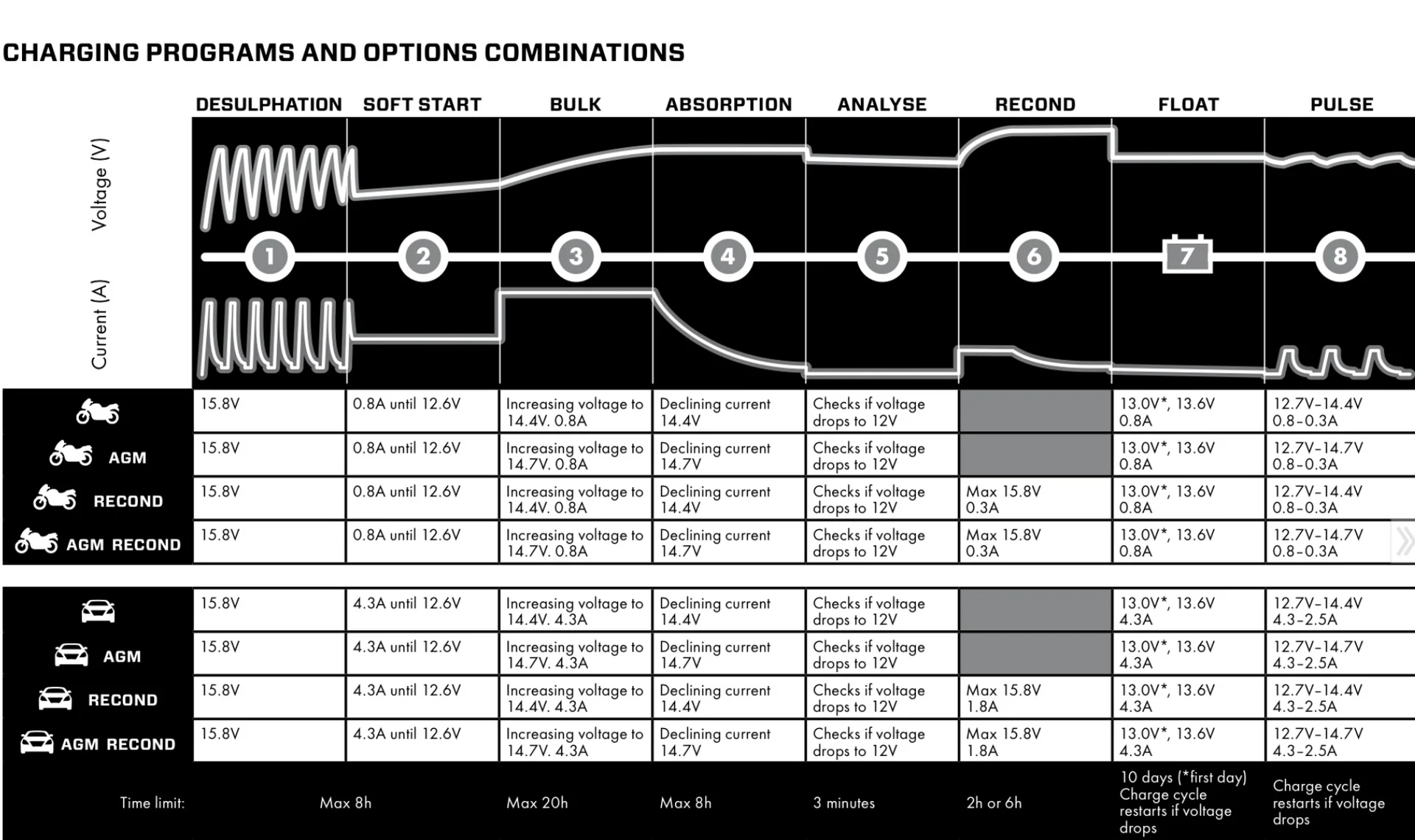
I would imagine the various charging stages are closely tied to fixed voltage levels for the battery. For comparison, here is the charging mode chart from the C-Tek charger. When charging my car’s start battery, stages 3 (constant current) & 4 (constant voltage) take the longest amount of time.

Hack_man
Well-Known Member
Those are really interesting, I'm getting a better idea what is meant by a "smart charger". They are evidently trying to charge the battery as quickly as possible without compromising (too much) of the battery life.
ujsc
Member
Corrected: Li ion not LTO batteries are a fire risk in cars. That is why I don't use them. I use LiFePO4 in cars even with their temp range limitations for the following reasons:It’s got nothing to do with which brand of battery box you have. It has everything to do with what type of battery chemistry is inside the box. LiFePo batteries cannot accept a charge when temps are below 32F/0C or above 113F/45C- that’s the end of the story for them.
LTO chemistry batteries charge and discharge down to about -22F/-30C and work well up to about 130F/55C. They are a MUCH better option.
The operational question is: “Which dashcam battery company will be first to the table with an LTO battery?”
LTO vs LiPO4. I don't know cost benefit of these two. This is what I know
- LTO has a lower nominal voltage and lower energy density, which can make it tricky to match with a standard 12 V automotive charging system without custom configuration.
- LiFePO₄ packs are much more common, easier to pair with automotive alternators/BMS systems, and still very stable for everyday use.
Last edited:
EricSan
Well-Known Member
- Joined
- Dec 28, 2023
- Messages
- 1,527
- Reaction score
- 1,207
- Location
- Central PA
- Country
- United States
- Dash Cam
- There are ALWAYS user serviceable parts inside!
I’d like to see references for this claim. It is exactly the opposite of everything I have seen. LTO batteries feature the most stable chemistry that is available for batteries that I am aware of. LiFePo batteries are far less stable than LTO when punctures, shorts, and crush happens.LTO batteries are a fire risk in cars.
Last edited:
ujsc
Member
I corrected my post.I’d like to see references for this claim. It is exactly the opposite of everything I have seen. LTO batteries feature the most stable chemistry that is available for batteries that I am aware of. LiFePo batteries are far less stable than LTO when punctures, shorts, and crush happens.
onkasongbi
Member
If you can only recommend one to someone else, which would it be and why? I am guessing the smart charger because it charges faster and it's "smart"? (@Hack_man said something interesting about the smart charger being able to charge faster without compromising too much on battery life.)I have both options, and they work for charging Ecoflow River portable power stations and my DIY LTO batteries.
Many other similar converters are also available on Amazon.
How much faster does it charge btw?

GPak
Well-Known Member
In the case of the 70mai or any other dedicated battery with a built-in charge controller, the AC-to-DC Charger works as a regular converter.
There is nothing "smart" about it in this case, and it will not charge the 70mai battery any faster.
It is only "smart" and works as a Charger when directly charging an LiFePO4 battery without any intermediate charge controllers.
(reference my post #78)
When I mentioned faster charging, I meant the Ecoflow River3, which charges from a car at up-to 100W max and from a Solar Panel with the higher voltage output at up-to 110W max.
When this AC/DC Charger is connected to the Ecoflow River3, it also works as a regular converter (not as a Charger), but the higher output voltage is perceived by the Ecoflow as input from a Solar Panel, and it charges at approximately 107W instead of approximately 98W from the car's cigarette lighter.
I specifically purchased these two devices for my new 2026 Honda Passport TS Elite, which only has a 115V AC household outlet in the back and no 12V DC cigarette lighter outlet.
Therefore, for the 70mai battery, the AC/DC converter linked in post #74 (not the Charger) is a more affordable option, as you won't need to buy a cigarette lighter extension cord.
There is nothing "smart" about it in this case, and it will not charge the 70mai battery any faster.
It is only "smart" and works as a Charger when directly charging an LiFePO4 battery without any intermediate charge controllers.
(reference my post #78)
When I mentioned faster charging, I meant the Ecoflow River3, which charges from a car at up-to 100W max and from a Solar Panel with the higher voltage output at up-to 110W max.
When this AC/DC Charger is connected to the Ecoflow River3, it also works as a regular converter (not as a Charger), but the higher output voltage is perceived by the Ecoflow as input from a Solar Panel, and it charges at approximately 107W instead of approximately 98W from the car's cigarette lighter.
I specifically purchased these two devices for my new 2026 Honda Passport TS Elite, which only has a 115V AC household outlet in the back and no 12V DC cigarette lighter outlet.
Therefore, for the 70mai battery, the AC/DC converter linked in post #74 (not the Charger) is a more affordable option, as you won't need to buy a cigarette lighter extension cord.
Last edited:
onkasongbi
Member
Thanks, GPak. The 70mai cigarette lighter just arrived yesterday and I tested the charger about 30 minutes ago. In your personal experience, is it normal for the charger (the blocky rectangular part of it) to get pretty warm during use? It's not super hot to the touch but more similar to a hand warmer. I only used it where the battery was already 3 of 4 green dots charged (around 75%) so I'm wondering how much hotter it can get if I had to charge this for longer at a lower starting point. Luckily these batteries don't take too long to charge so I will definitely only charge it where it's within sight and reach for me.Therefore, for the 70mai battery, the AC/DC converter linked in post #74 (not the Charger) is a more affordable option, as you won't need to buy a cigarette lighter extension cord.
GPak
Well-Known Member
Yes, it's common for converters/chargers to get hot.
These are very inexpensive converters, and the claimed 10A current is probably overstated.
However, I think that in a controlled home environment, this is acceptable when charging at about half the rated current (I think the 70mai charges at about 5A through the cigarette lighter).
I don't think it will get much hotter if you charge the 70mai from flat. You can try and see, I think it will reach a certain temperature and then stay at that level; a full charge of the 70mai will take about 1.5 hours.
If you are not comfortable with the converter getting too hot, you can purchase a version with a higher current rating, 15A or even 20A rated.
I also have a 15A version, it has built-in fans that run constantly, it's a bit more expensive, larger in size and noisier. (the same brand and the same Amazon link)
It also gets hot, but definitely not as much as the 10A version without a fan.
It's easy to return and replace items on Amazon (I love Amazon for their return policy).
By the way, I specifically looked for converters with a two-prong plug because my car has a two-prong socket (these are harder to find).
Amazon offers a much wider selection of AC to 12V DC converters with a three-prong plug.
Keep in mind that some of this converters/chargers provide exactly 12V, which farther drops under the load and some dedicated batteries may not charge due to built in low voltage protection (not sure if 70mai battery has one).
The only way to find out is to buy it and see if it works.
Once again thanks to Amazon return policy it is easy to return, if it does not work.
These are very inexpensive converters, and the claimed 10A current is probably overstated.
However, I think that in a controlled home environment, this is acceptable when charging at about half the rated current (I think the 70mai charges at about 5A through the cigarette lighter).
I don't think it will get much hotter if you charge the 70mai from flat. You can try and see, I think it will reach a certain temperature and then stay at that level; a full charge of the 70mai will take about 1.5 hours.
If you are not comfortable with the converter getting too hot, you can purchase a version with a higher current rating, 15A or even 20A rated.
I also have a 15A version, it has built-in fans that run constantly, it's a bit more expensive, larger in size and noisier. (the same brand and the same Amazon link)
It also gets hot, but definitely not as much as the 10A version without a fan.
It's easy to return and replace items on Amazon (I love Amazon for their return policy).
By the way, I specifically looked for converters with a two-prong plug because my car has a two-prong socket (these are harder to find).
Amazon offers a much wider selection of AC to 12V DC converters with a three-prong plug.
Keep in mind that some of this converters/chargers provide exactly 12V, which farther drops under the load and some dedicated batteries may not charge due to built in low voltage protection (not sure if 70mai battery has one).
The only way to find out is to buy it and see if it works.
Once again thanks to Amazon return policy it is easy to return, if it does not work.
onkasongbi
Member
I probably should have read the earliest posts in this discussion because it seems like my 70mai battery does not last very long with a 3-channel setup (front+rear+interior) for my Viofo A229 Pro. I changed the parking mode from low bitrate to timelapse 1fps night vision to see if that helps. I might consider downgrading from maximum bitrate during regular recording to either high or just normal. Does higher resolution of video recording drain the battery faster? If so, I might consider downgrading from 4k to 2k (I tested 2k on a GKU600 dash cam, and honestly the quality isn't too bad, and I can still read the license plates which is very important for any setup).
OP
OP

Julian23
Well-Known Member
- Joined
- Nov 16, 2016
- Messages
- 1,348
- Reaction score
- 2,003
- Country
- Germany
- Dash Cam
- Several brands :)
I swapped the 70mai Battery Pack to a different car.
Previously, it was powered by the fuse box. Now it uses the 12V socket.
Since the fuse box method was used previously, it now needs to be switched to cigarette lighter charging mode.
Otherwise, the battery won't charge and will not power a dashcam.
The dashcam will briefly turn on but then go into parking mode.
70mai provides a guide on how to change the mode:
Previously, it was powered by the fuse box. Now it uses the 12V socket.
Since the fuse box method was used previously, it now needs to be switched to cigarette lighter charging mode.
Otherwise, the battery won't charge and will not power a dashcam.
The dashcam will briefly turn on but then go into parking mode.
70mai provides a guide on how to change the mode:
Switching charging method
If the battery pack was previously charged using the fuse box method, follow these steps to unlock it and switch to the cigarette lighter charging method:- Connect the cable according to the “Connecting to the vehicle cigarette lighter” procedure.
- Turn on the battery pack and start the vehicle’s engine.
- Pull out the charging connector from the cigarette lighter socket, wait approximately 10 seconds, then reinsert it into the socket for 5 seconds. Repeat this pull out-and-insert sequence 3 times.
- Once successfully unlocked, insert the charging cable into the cigarette lighter socket again. After an approximate 20-second delay, the battery pack will begin charging, and the indicator light will show the charging status, indicating the successful unlocking.
Hack_man
Well-Known Member
Wow what a crazy procedure to enable lower current CLA charging mode. If you measured the current draw, it would probably be >6A during this procedure for a few seconds during the unlock process.
It was cheaper to switch modes purely using Firmware rather than configure using a sense pin on the connector. This procedure reminds me of enabling parking brake maintenance mode on a Toyota to service the rear brakes.
I guess I don't understand, if there are two signals in the Fuse Block connection (+12V constant and switched ACC) which evidently is what commands fast current mode, why can't the lack of constant +12V in the CLA adapter cable be used to put the CLA charger into low current mode?
It was cheaper to switch modes purely using Firmware rather than configure using a sense pin on the connector. This procedure reminds me of enabling parking brake maintenance mode on a Toyota to service the rear brakes.
I guess I don't understand, if there are two signals in the Fuse Block connection (+12V constant and switched ACC) which evidently is what commands fast current mode, why can't the lack of constant +12V in the CLA adapter cable be used to put the CLA charger into low current mode?
Last edited:
OP
OP
Julian23
Well-Known Member
- Joined
- Nov 16, 2016
- Messages
- 1,348
- Reaction score
- 2,003
- Country
- Germany
- Dash Cam
- Several brands :)
It's a bit weird but that's exactly why I decided to post about it.Wow what a crazy procedure to enable lower current CLA charging mode. If you measured the current draw, it would probably be >6A during this procedure for a few seconds during the unlock process.
It was cheaper to switch modes purely using Firmware rather than configure using a sense pin on the connector. This procedure reminds me of enabling parking brake maintenance mode on a Toyota to service the rear brakes.
This is the downside of not having an app.
That's a question for 70mai.I guess I don't understand, if there are two signals in the Fuse Block connection (+12V constant and switched ACC) which evidently is what commands fast current mode, why can't the lack of constant +12V in the CLA adapter cable be used to put the CLA charger into low current mode?
I don't really have a good reply for you.
Maybe they don't want to risk any wrongful current draw when using the battery hardwired?

rcg530
Well-Known Member
- Joined
- Jan 23, 2021
- Messages
- 2,818
- Reaction score
- 4,667
- Location
- California
- Country
- United States
- Dash Cam
- 70mai, BlackVue, Thinkware, Vantrue, Vueroid, VIOFO
A single loss of the vehicle's constant battery power to the 70mai battery pack can occur if the vehicle battery fails, the vehicle battery is replaced or a fuse in the vehicle charging power circuit blows.I guess I don't understand, if there are two signals in the Fuse Block connection (+12V constant and switched ACC) which evidently is what commands fast current mode, why can't the lack of constant +12V in the CLA adapter cable be used to put the CLA charger into low current mode?
If the 70mai battery pack is wired using the 3-wire charging cable and one of those loss of vehicle constant power situations occurs, the 70mai battery pack would switch to low amp charging mode and the 70mai battery pack would begin charging when the vehicle constant battery power was restored with or without the vehicle's charging system being on which is not good.
Using a repetitive pulsing of the input charging power within a specified period of time is a better way for the 70mai BMS to determine the user is consciously trying to change the charging mode. It would be nice if there were a switch on the 70mai battery pack to make that charging choice, but the charging cable power pulsing approach is simple enough.