$300 Blackbox battery vs $25 Amazon battery bank

I should probably have researched at least prices, but i have this horrible thing that also manifest in target fixation, so got a little carried away.
Probably also what is to blame for my expertise of going off topic.

PS: i am not diagnosed with ADHD or OCD, but the head doctor did mention schizophrenia and paranoia ,,,,, though to be honest with my meager knowledge of that trade i have to disagree wit that doctor, at least it is my understanding it could be much worse.
I feel like i have a very valid wish to not getting too close to other people, but its not like i shun people, i could easy go shopping at peak hours, but i dont, having about 2 million Japanese or Aussie people within stone throw of me do not at all bother me, 200 Fellow Danes i am a bit more apprehensive about.

My brother married a Dane, you are not crazy...just Danish. 🙂
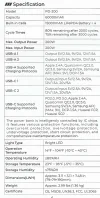
 
Has reasonably good specs, just understand that you still have to be aware of temperature requirements. Buy two, keep one in the house charged and rotate them out as needed.


batt.webp
 
I online diagnose you as Denmark
 
Has reasonably good specs, just understand that you still have to be aware of temperature requirements. Buy two, keep one in the house charged and rotate them out as needed.


View attachment 79080
I'm trying to understand something. How is it that the operating temperature is rated higher than storage temperature? Says store at max 95F but you can operate it up to 104F... I thought it would be the other way around or both things should be the same. What makes it safe so when it operates that it can take an extra 9F degrees of heat?
I was planning on putting the cig lighter charger in a fireproof bag and another fireproof bag for this battery bank. Would that make heat go higher? I'm not sure if these electronics generate heat themselves and need the open air?
 
Storage temperature is the temperature when the battery is not powering anything at all, except maybe a BT (Bluetooth) on the BMS (battery management system), if applicable. Thus, the internal temperature of the battery cells and the external temperature should (in theory) be the same and that should not exceed the 95F maximum. Lithium batteries, in fact all batteries have a 'happy range' temperature they operate in. The max operating range they specify as 104F and in this case, it is presumed they are speaking of external temperatures, the same as with the storage range, that is an external temperature. Now, even if it is 104F in your car, it is a good bet that if the battery pack is providing power to the camera, the battery pack will be somewhat hotter. That 'somewhat' depends on battery chemistry, cell construction and case venting. Now, if that battery pack is not providing power to your car, and the car is 104F, the battery pack is now being stored at a temp above its rating.

Looking at this chart are some standard temp ranges for lithium batteries. These ranges can vary some depending on the manufacturer. One needs to do the mental gymnastics to understand the specs given by the manufacturer as compared to the below specs. There is a range you store in so the battery does not degrade quickly due to extreme temperatures and a range you operate in so you get the maximum supply from the battery but at the same time do not degrade the battery.

STATUSTEMPERATURE RANGE
Discharge Temperature-4° F to 130° F
Charge Temperature32° F to 114° F
Storage Temperature20° F to 95° F
 
I'm trying to understand something. How is it that the operating temperature is rated higher than storage temperature? Says store at max 95F but you can operate it up to 104F... I thought it would be the other way around or both things should be the same. What makes it safe so when it operates that it can take an extra 9F degrees of heat?
I was planning on putting the cig lighter charger in a fireproof bag and another fireproof bag for this battery bank. Would that make heat go higher? I'm not sure if these electronics generate heat themselves and need the open air?
Do also note that this is a good solution on paper, but not all dashcams will support this method of operating. Viofo has always been good in the five or so models I've tested over the years, as they aren't picky with USB-C/USB-A support.

While other brands such as Wolfbox and 70mai are funny and only want their own power supplies before they actually work. If you're sticking with Viofo brand, you'll be ok. But bear this in mind for others as then you may need dedicated dashcam battery pack that have the relevant connections for hardwire/cigarette lighter etc.
 
While the battery might be cheap and power can be provided, it does not have a 3 wire setup like dashcam batteries will have.
It will not switch with ignition to the according mode.
 
While the battery might be cheap and power can be provided, it does not have a 3 wire setup like dashcam batteries will have.
It will not switch with ignition to the according mode.
This. Absolutely this.
 
I'm trying to understand something. How is it that the operating temperature is rated higher than storage temperature? Says store at max 95F but you can operate it up to 104F... I thought it would be the other way around or both things should be the same. What makes it safe so when it operates that it can take an extra 9F degrees of heat?
The storage temperature is really a specification for pre-sale storage, so that when delivered to the customer within 6 months of manufacture, it still has "100%" capacity. If you store it outside that specification then you can expect some loss of capacity over time.

The operating temperature is a specification where if you keep within the range, you will achieve the specified number of charge cycles before capacity drops to 80% of the specified capacity, or 500 charge cycles if not specified.

I was planning on putting the cig lighter charger in a fireproof bag and another fireproof bag for this battery bank. Would that make heat go higher? I'm not sure if these electronics generate heat themselves and need the open air?
That would increase the heat and is not a good idea. For the charger, it will have over temperature protection built in, and will reduce its output as it gets hot, so should never need a fireproof bag. For a LiFePO4 powerbank, the risk of fire is so small that it is not worth bothering with a fireproof bag, and the extra insulation will likely cause more problems than it solves. Fireproof bags are used for lipo batteries, normally drone batteries and the like, where spontaneous combustion is, or used to be, fairly common. Normal USB powerbanks can also catch fire, although they don't normally get exposed to the same stresses and temperatures, so it is uncommon.

Fireproof bags are not always fireproof, if you are going to use one, make sure it is a decent one that someone has tested and proved to work! These big batteries have a lot of energy (heat) inside, and stopping all that heat from setting fire to your car, when they are located in a very enclosed space, is not a simple task!
 
I'm trying to understand something. How is it that the operating temperature is rated higher than storage temperature? Says store at max 95F but you can operate it up to 104F... I thought it would be the other way around or both things should be the same. What makes it safe so when it operates that it can take an extra 9F degrees of heat?
I was planning on putting the cig lighter charger in a fireproof bag and another fireproof bag for this battery bank. Would that make heat go higher? I'm not sure if these electronics generate heat themselves and need the open air?
Also, though lithium batteries are rated at a minimum of 500 charge cycles retaining 80% of capacity, this differs for the product you are listing which is lithium iron phosphate which as it says can go up to 2000 cycles for example.

Different battery tech in phones in recent years even for lithium ion batteries has meant that this arbitrary 500 cycles can be something like 800/900 cycles now or even higher.
 
Also, though lithium batteries are rated at a minimum of 500 charge cycles retaining 80% of capacity, this differs for the product you are listing which is lithium iron phosphate which as it says can go up to 2000 cycles for example.
While LiFePO4 bare cells may be rated for 2000 or more charge cycles, that is with careful use, while dashcam batteries tend to have fast charge times, rarely at optimal temperatures, so I'm not convinced you actually get 2000 charge cycles from dashcam batteries? The larger capacity ones may be better, since they tend to have longer charge times.

Need some real data, but there do seem to be a few people having issues with dashcam powerbanks after less than 2000 cycles (6+ years).
 
While LiFePO4 bare cells may be rated for 2000 or more charge cycles, that is with careful use, while dashcam batteries tend to have fast charge times, rarely at optimal temperatures, so I'm not convinced you actually get 2000 charge cycles from dashcam batteries? The larger capacity ones may be better, since they tend to have longer charge times.

Need some real data, but there do seem to be a few people having issues with dashcam powerbanks after less than 2000 cycles (6+ years).
2000 is a theoretical, no different from what other specs are listed for a tech product. It's still better than lithium, having lithium iron phosphate. Sodium also seems to be mentioned lately.

Either way not fussed as the capacities are getting larger, the charge times are getting shorter every year. Technology is a great thing.
 
the charge times are getting shorter every year.
They appear to be getting longer to me, the early Cellink Neo took 40 minutes, these days we often see 1 hour charge times specified, 70mai for example, which has 90 minutes for accessory socket charging.
 
They appear to be getting longer to me, the early Cellink Neo took 40 minutes, these days we often see 1 hour charge times specified, 70mai for example, which has 90 minutes for accessory socket charging.
Hmmmm strange then for dashcam batteries at least, phones and tablets and laptops are decreasing. Thought it was the storage capacity but apparently not
 
Hmmmm strange then for dashcam batteries at least, phones and tablets and laptops are decreasing. Thought it was the storage capacity but apparently not
I think lipo batteries have improved significantly in lifespan and reliability, even if not capacity/weight, and they now tend not to be charged to absolute maximum in phones and laptops in order to get sufficient performance, because phones and laptops have improved power efficiency. Not charging to 101% gives the batteries a much longer lifespan and also means that you don't need to trickle charge the last bit, so charging to "100%" is faster, because it is really only 95% and you can charge at full speed up to 80%.

I haven't noticed much improvement in LiFePO4 batteries, and the trend is to other types, such as the sodium you mentioned. There is a lot of work being done on batteries, a huge amount of money in them!
 
The storage temperature is really a specification for pre-sale storage, so that when delivered to the customer within 6 months of manufacture, it still has "100%" capacity. If you store it outside that specification then you can expect some loss of capacity over time.

The operating temperature is a specification where if you keep within the range, you will achieve the specified number of charge cycles before capacity drops to 80% of the specified capacity, or 500 charge cycles if not specified.


That would increase the heat and is not a good idea. For the charger, it will have over temperature protection built in, and will reduce its output as it gets hot, so should never need a fireproof bag. For a LiFePO4 powerbank, the risk of fire is so small that it is not worth bothering with a fireproof bag, and the extra insulation will likely cause more problems than it solves. Fireproof bags are used for lipo batteries, normally drone batteries and the like, where spontaneous combustion is, or used to be, fairly common. Normal USB powerbanks can also catch fire, although they don't normally get exposed to the same stresses and temperatures, so it is uncommon.

Fireproof bags are not always fireproof, if you are going to use one, make sure it is a decent one that someone has tested and proved to work! These big batteries have a lot of energy (heat) inside, and stopping all that heat from setting fire to your car, when they are located in a very enclosed space, is not a simple task!

Really Nigel? That is the only reason for storage temperature? That storage temperature is for all storage scenarios, regardless of ownership or pre-sale shelf life.

As for extra insulation causing problems, that is not accurate.

As for spontaneous combustion of LiPo batteries, that is seldom the case. However, charging a LiPo at the incorrect voltage, or charging or using a LiPo that has physical damage can cause the LiPo to erupt and cause surrounding fire damage. A undamaged LiPo left on a shelf at its storage charge will not combust, a undamaged LiPo at full charge on a shelf for months may possibly combust but it more likely to swell first which of course could then lead to a rupture. In testing I have left fully charged LiPo batteries on shelves for 6 months without any swelling. However, the IR of the cells went up trememdouslly which rendered the batteries near useless. A LiPo can combust for a few reasons, the most common is shorting at the juncture where the cells leads, and if applicable, balance leads are soldered and that is generaly due to damage by the user.

As for batteries having a lot of energy or heat, that is not accurate. That potential for that energy to become heat does not occur until there is draw demand from the device, in this case a dash cam. A normally functioning dash cam and battery pack of various makes, will seldom be an issue for someone. Any thing can fail, a BMS can fail and this is why it is important for owners of 'power bank' type devices need to routinely check that power bank. I tell anyone with a power bank of any sort that is in their car to ensure they have it locacte so it can easily and quickly be thrown from the car should the bank begin to hiss, smell, or smoke.
 
While LiFePO4 bare cells may be rated for 2000 or more charge cycles, that is with careful use, while dashcam batteries tend to have fast charge times, rarely at optimal temperatures, so I'm not convinced you actually get 2000 charge cycles from dashcam batteries? The larger capacity ones may be better, since they tend to have longer charge times.

Need some real data, but there do seem to be a few people having issues with dashcam powerbanks after less than 2000 cycles (6+ years).

I think lipo batteries have improved significantly in lifespan and reliability, even if not capacity/weight, and they now tend not to be charged to absolute maximum in phones and laptops in order to get sufficient performance, because phones and laptops have improved power efficiency. Not charging to 101% gives the batteries a much longer lifespan and also means that you don't need to trickle charge the last bit, so charging to "100%" is faster, because it is really only 95% and you can charge at full speed up to 80%.

I haven't noticed much improvement in LiFePO4 batteries, and the trend is to other types, such as the sodium you mentioned. There is a lot of work being done on batteries, a huge amount of money in them!

Essentially correct. When one looks at the setup for solar power for home or commercial use, these are controlled environments with charging and rectifier equipment that will trickle charge, float charge and if needed perform run down tests on battery packs.

Power banks for dash cams are no where near as exquisite a setup as a home or commercial venture for providing power. One can not talk about 'fast charging' unless one knows what the C rate, or charge rate of the battery pack is. I do not recall seeing that rate mentioned in any literature for these dash cam power banks, but I seriously doubt the rate is more than C1. The higher the charge rate, the more expensive the battery pack will be simply because the cell chemistry is different and manufacturing and testing is a bit more.

Despite the hype, I do not consider these power banks designed for dash cams to be expected to last more than two years. The power banks are always in a wide range of temperature environments and charging issues related to temperature and drive time. If we think about a delivery driver for Domino's Pizza and consider how many times a day he may start and stop his automobile and the temperatures they work in, the battery pack may get 2000 cycles rather quickly. This driver may stop and start a car 15 or more times a day, 75 times a week, and continue on with the math.
 
If we think about a delivery driver for Domino's Pizza and consider how many times a day he may start and stop his automobile and the temperatures they work in, the battery pack may get 2000 cycles rather quickly. This driver may stop and start a car 15 or more times a day, 75 times a week, and continue on with the math.
A charge cycle involves charging to 100%, then discharging to 0%. If you only charge to 50%, then discharge to 0% then you need two of those cycles to count as 1 full charge cycle. Since a dashcam powerbank can normally last about 23 hours after a 1 hour charge, it is impossible to put it through more than about 1 full charge cycle per day, however many short journeys you make in the day, and 2000 charge cycles will give you nearly 6 years as a minimum.

I don't think people are actually getting 6 years, but there is a lack of data that I am aware of, so I don't know the truth.

One can not talk about 'fast charging' unless one knows what the C rate, or charge rate of the battery pack is. I do not recall seeing that rate mentioned in any literature for these dash cam power banks, but I seriously doubt the rate is more than C1.
If we take a Cellink Neo 5, the specifications say "Charging Time : – Cigarette lighter plug (standard 5A charging): Approx. 60/80 mins – Hardwired (rapid 9A charging): Approx. 40 mins", so since the definition of 1C is that the battery fully charges in 1 hour, clearly the cigarette lighter charge is done at 1C, and the hardwired charge is done at 60/40 = 1.5C, which is indeed more than 1C, despite your serious doubts. The larger battery packs tend to be charged at a lower C rate due to the limited amount of power available from an accessory socket before it starts smoking and becomes a lighter socket!
 
A charge cycle involves charging to 100%, then discharging to 0%. If you only charge to 50%, then discharge to 0% then you need two of those cycles to count as 1 full charge cycle. Since a dashcam powerbank can normally last about 23 hours after a 1 hour charge, it is impossible to put it through more than about 1 full charge cycle per day, however many short journeys you make in the day, and 2000 charge cycles will give you nearly 6 years as a minimum.

I don't think people are actually getting 6 years, but there is a lack of data that I am aware of, so I don't know the truth.

I see your point in that and by that explanation, it is likely a dash cam specific power bank would seldom achieve an manufacturer's full charge cycle. This is due to the fact that most users seldom leave their car unattended for a number of days, which if unattended in parking mode, it would deplete the power bank to its specified cut-off voltage. In such a case, a full cycle could happen depending on BMS and the car were driven long enough. As it is, manufacturers have a definition for a charge cycle which is technical, and correct for their usage and most usage such as e-bikes where there is a expected high drain to the cells on a daily basis. What a BMS on a power bank does is more of a mystery. Does the BMS not charge until it has reached a predetermined SoC, or at car ignition does it begin a 'top off' charge? This act of charging of course is driven by temperatures as well. If too cold or too hot the BMS should not permit charging or discharging. These power banks for dash cams take a lot of abuse.

While manufactures are correct in their definition of charge cycle, and for marketing and sales, it is what is used by everyone, but the fact remains that every time a battery goes under a charge it is some form of a cycle. That charging cycle may only be 20 percent that time, and 50 percent the next time. Ultimately, every discharge and charge cycle is wear on the battery and those cycles are the ones that are important. The case use for these dash cam power banks puts them in a situation where they are prone to 'early' failure. The user tends to think he never got his 2000 charge cycles because he is figuring one cycle a day so assumes he should be getting 5 or so years out of that pack. Technically he is correct, realistically his expectations are incorrect. As we know, some people get 1 year out of a bank and some get 3 or 4 years. A lot of factors come into play for the longevity of a power bank. Counting on manufacturer charge cycles, for the sake of being technically correct, is likely erroneous.


If we take a Cellink Neo 5, the specifications say "Charging Time : – Cigarette lighter plug (standard 5A charging): Approx. 60/80 mins – Hardwired (rapid 9A charging): Approx. 40 mins", so since the definition of 1C is that the battery fully charges in 1 hour, clearly the cigarette lighter charge is done at 1C, and the hardwired charge is done at 60/40 = 1.5C, which is indeed more than 1C, despite your serious doubts. The larger battery packs tend to be charged at a lower C rate due to the limited amount of power available from an accessory socket before it starts smoking and becomes a lighter socket!

My usage of C1 was a typo/brain fart, your 1C is the more correct usage. As for 'fast charging', 1.5C has never really been considered fast charging...ever. I will almost bet that the cells are a 1C chemistry and the manufacturer is fudging the overhead built into the cell chemistry. Fast charging normally starts at 2C, and requires a more expensive chemistry. But, fast charging could be 3C, 4C, 5C, hitting 5C gets one into what we termed 'extreme charge rate', or something similar.
 
Despite the hype, I do not consider these power banks designed for dash cams to be expected to last more than two years.
Have you had some fail after 2 years? I just went to go check, and I got my B-124 back in 2018 and I'm still running it to this day, lol.
 
Back
Top