Crimping - Insulated Connectors

joe384

Well-Known Member
Joined
Aug 29, 2019
Messages
691
Reaction score
325
Location
Essex
Country
United Kingdom
Dash Cam
Viofo A139 3CH, A139 2CH, Mobius w/ Varifocal Zoom
Hi all,

I've been looking into crimping again after I was looking at splicing some wiring together, but I've kinda gone down a rabbit hole and I'm more confused then ever now!

There will probably be a few more threads with questions, looking at non-insulated connectors is a whole other minefield.

I have a crimping tool that I bought some years ago which came with a selection of connectors. (this one: https://www.amazon.co.uk/gp/B07JFK58R3)

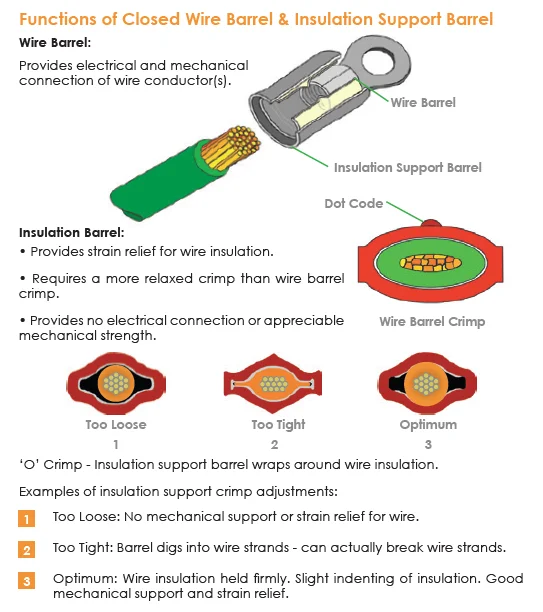
I found the cablecraft document on crimping which has a section on insulated connectors. It suggests that insulated connectors typically have insulation support barrel:
1761129441677.webp


However that all the insulated connectors I have seem to just have the wire barrel and no additional insulation barrel.

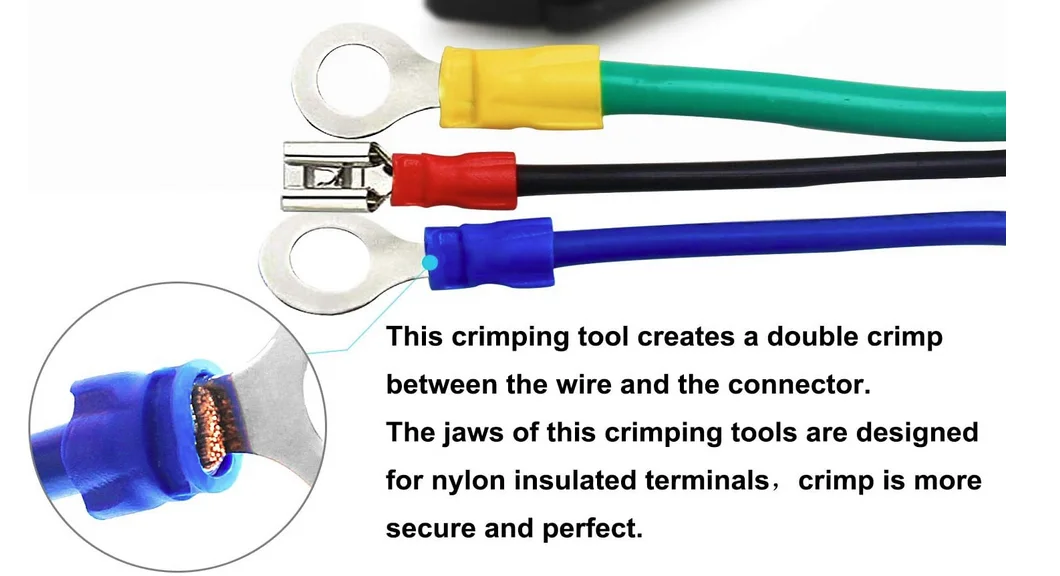
Looking at the tool it has a kind of ledge bit meaning it does the actual crimp and also does a more relaxed crimp on the nylon insulation at the same time. You can see this, the 'wing' part is the more relaxed crimp on the insulation.
1761129934674.webp


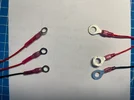
I looked at some my fuse taps to see what type of crimps were used:

The one on the right was done by a similar tool (maybe even me), the others done by a one crimp tool (either a ratching tool or the more basic type)

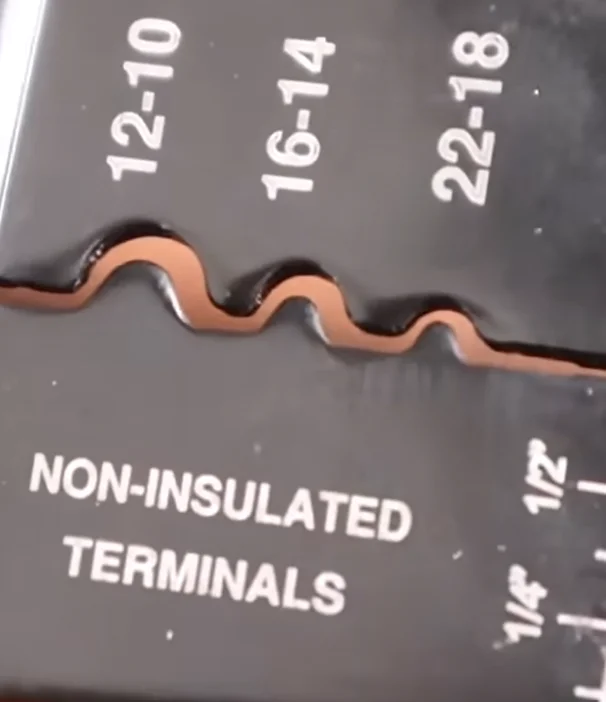
But it looks like they maybe used the a non-insulated tool like this:
1761138307715.webp


Also note the ones on the left and right are bullet terminals, which is why they look slightly bigger at the ends

IMG_20251022_121736.webp


I guess my questions/observations are:
  • Does there actually exist any insulated terminals that actually have an insulation support barrel?
  • If I wanted to use insulated heat shrink type of terminals, the tool I have would be useless as it's going to crush the heatshrink bit.
  • Having the insulation crimped with the "wing" doesn't really seem to add anything at all
 
The world is your oyster when it comes to connectors.

TE documentation

Take a look at the Documents Tab, then select Product Drawings, and Product Specifications.

Most non-bare crimp connectors have some form of wire insulation support, which serves to:

  • Support the wire at the crimp point to avoid flexing, which could weaken it where it is already crimped and lying against an edge.
  • Provide insulation for exposed wire that may have been stripped too short.
There are probably thousands of varieties, and one must select the connector and crimp tool for the task at hand.

In some applications where I am wiring with smaller-gauge wire, I use heat-shrink butt connectors. After the crimp, I apply heat, and the connector's ends shrink to provide insulation from the elements and support for the wire. Some 'wings' are due to incorrect crimping, using the wrong crimper die, using a too-large connector, over-crimping, etc. Some may be due to factory crimps providing 'strain relief' for the wire and the crimp area.

Crimping is a whole other world, and people get passionate about it. If you really want to shake up someone who is 'pro' crimping, tell them soldering is better. πŸ™‚
 
I use these set of tools:
Wire Stripper and Crimping Tool, AWG 24-10 Automatic Stripper Tool with AWG 22-10 Ratchet Wire Crimper For Heat Shrink Connectors

And these terminals, or similar, available on Amazon in any combination, quantity and price range:
Heat Shrink Wire Connectors Kit, Crimp, Electrical, Waterproof, Insulated

The crimping and heat-shrinking process is shown in the videos at the links

Sometimes I trim/shorten the heat shrink tubing to minimize the length of the stiff section if necessary, helping with a sharper bend in the wire, (shown in the picture on the right).

It works great, no complaints.
 

Attachments

  • IMG_8814.webp
    IMG_8814.webp
    127.2 KB · Views: 88
Good thread.

For a long time (and a long time ago) I didn't know there was Single and Double insulated crimp connectors and how to identify them...Plenty of info out there these days though to help you along...

Whilst I know it's of lower importance than having a good quality mechanical termination, I've never been all that keen on the 'aesthetics' of Insulated Crimp Connectors, even with the best of/factory crimps...Just something about them I find a little ugly.

I actually tend to prefer non-insulated connectors – find them cleaner visually and they also have the added advantage over most opaque plastic insulated connectors in that you can see the crimps, especially useful if a double crimp, and allows you to visually place the stripped wire and sheath in the connector and inspect the quality of the final crimp(s)...
I also find the '2nd' crimp, for the wire sheath, to be a better design – clamping around the sheath as opposed to the 'compression' of the metal barrel inside a insulated connector...

If I really want to have insulation to the end of the connector, I put ~ 50mm of shrink tube over the wire before crimping, slide it over and then shrink down...But often it's not really needed...
I also find a lot of factory/OEM cables often come with non-insulated connectors...Here's a couple to hand from iRoad:

Pro12 Battery Input Cable
IMG_6198.webp


In-line Fuse Holder
IMG_6197.webp


The clear 'moulded' sleeve that slides over the f-bullet connector in the above pic leads me to the Heat Shrink Sleeve Connectors such as the type mentioned by @GPak ...
I've never really used any I don't think (though I do plenty of heat-shrink applications in other cabling work I do)....But I like the look of them and they make for a nice 'seamless' finish, plus the obvious benefits re insulation, water tightness etc....Another benefit of that heat-shrink section is also the inherent strain relief and protection it additional provides at the junction to the connector.....

Question: Why are the heat-shrink sleeves typically always translucent with these connectors?

@GPak – Those Kuject connectors you have linked to look good. Hugely cheaper than anything similar available here in Australia (at the Car stores anyway)...
Nice to see a range of sizes in each colour, which often doesn't happen with standard insulated crimp connectors. Great they do so many pack options also – might have to try some..! πŸ‘
 
Last edited:
@GPak -- Yes that tool only crimps the wire bit which is what you need with the heat shrink connector

@SC@AU - Yes I agree, the non-insulated crimps look better, and I believe that's what is mostly used in OEM automotive wiring. And you can always use heatshrink if you want the extra insulation.

I have started looking at the non-insulated connectors and crimps for a few reasons. I want to properly crimp Molex Micro-fit connectors and I also want to be able to crimp the non-insulated spade / bullet connectors typically used with automotive wiring. I also want to be able to do some open-barrel splice crimps.

I believe most non-insulated connectors use some sort of F or B type crimp, but I'm currently spending a lot of time watching videos and reviews trying to work out what I need. I've seen the SN-48B gets used for automotive crimps at lot but for some of the smaller connectors I may need some different dies.
 
@GPak -- Yes that tool only crimps the wire bit which is what you need with the heat shrink connector

@SC@AU - Yes I agree, the non-insulated crimps look better, and I believe that's what is mostly used in OEM automotive wiring. And you can always use heatshrink if you want the extra insulation.

I have started looking at the non-insulated connectors and crimps for a few reasons. I want to properly crimp Molex Micro-fit connectors and I also want to be able to crimp the non-insulated spade / bullet connectors typically used with automotive wiring. I also want to be able to do some open-barrel splice crimps.

I believe most non-insulated connectors use some sort of F or B type crimp, but I'm currently spending a lot of time watching videos and reviews trying to work out what I need. I've seen the SN-48B gets used for automotive crimps at lot but for some of the smaller connectors I may need some different dies.
Yeah, Molex isn’t something I’ve done much of…though actually, may have need to in the near future….

This is the Crimp tool I use for 12v/crimp connectors etc…It has the interchangeable heads to suit a variety of connector types…This is from one of the main local brands here, but there’s lots of very similar crimpers available worldwide….
IMG_6200.webp

IMG_6201.webp
 
Yes, that has a good selection πŸ‘

I believe most non-insulated connectors use some sort of F or B type crimp, but I'm currently spending a lot of time watching videos and reviews trying to work out what I need. I've seen the SN-48B gets used for automotive crimps at lot but for some of the smaller connectors I may need some different dies.

I'm slightly wrong here, you can get non-insulated closed barrel connectors (Head B on your crimper)
 
I found a video where he uses an indent crimper on an insulated terminal:


Some of the comments are saying that is incorrect - I thought insulated terminals should always use an oval type crimp?
 
To further add to my confusion from post 1 - here is (what I'd call the indent tool) being used to make insulated closed barrel crimps:


Even says so on the tool πŸ€”

But a quick google and you will find similar non-ratching tools which clearly have an insulated section which is an oval crimp. Most of the ratching tools do an oval crimp as well.
 
To further add to my confusion from post 1 - here is (what I'd call the indent tool) being used to make insulated closed barrel crimps:


Even says so on the tool πŸ€”

But a quick google and you will find similar non-ratching tools which clearly have an insulated section which is an oval crimp. Most of the ratching tools do an oval crimp as well.
The problem with the "indent tool" for insulated crimps, is that for a lot of crimps, you need to put the crimp into the tool the correct way around, with the indent on the "back" side, and if there is insulation over the crimp then you can't see to put it the correct way around. So I guess that works for crimps that are full tubes, but if they are shaped from flat metal then it will make a mess of them!

That tool is probably made for a specific brand/range of crimp connectors, for which it will work.
 
Keep in mind that barrel connectors or butt-end connectors can be seamed or unseamed. The cheaper ones are seamed, and probably the seam is not soldered. The more expensive ones are an extruded tube and lack that seam. These two differences can determine which crimper you may want to use.

Here is a pretty good video on crimp tools, terminals and which to use.


I think the choice of tool depends on the use case.
It’s one thing if you're doing occasional DIY projects, and quite another if you're working professionally every day.
If a tool performs well for its intended purpose, the next most important criteria for DIYs are convenience/ease of use and low cost.
For example, I use Ryobi power tools for DIY projects. They perform almost as well as professional Milwaukee, Makita, and Dewalt tools, but Ryobi is considerably cheaper.
Ryobi might not last thousands of cycles, but I'm not sure I need them even for hundreds of cycles, and some tools are used just few times for specific project.

@joe384 - Check out this kit (not sure if it's available in the UK).
It may not be as robust as some expensive professional variations, but it's relatively cost-effective and suitable for DIY enthusiasts:
6 in 1 Crimping Tool Kit and Wire Stripper, Ratcheting Wire Crimper with 6 PCS Interchangeable Dies for Heat Shrink,Non-Insulated,Ferrule,Open Barrel,Insulated Connectors

For my DIY LTO batteries, I need everything inside the aluminum case to be as insulated as possible, hence the choice of connectors.
 
........
Question: Why are the heat-shrink sleeves typically always translucent with these connectors?
I am not sure why they're kind of semi-transparent, but I see the advantage of being able to visually assess the quality of the crimping.

@GPak – Those Kuject connectors you have linked to look good. Hugely cheaper than anything similar available here in Australia (at the Car stores anyway)...
Nice to see a range of sizes in each colour, which often doesn't happen with standard insulated crimp connectors. Great they do so many pack options also – might have to try some..! πŸ‘
Yes, we in the US are lucky that we don't have significant import duties, VAT, etc.
But with all this talk of tariffs, things could change (and in some cases already are), and I think we could end up paying as much as the rest of the world.
 
Thanks for the replies and the video @lufa6977 - It's making sense now! πŸ™‚
 
Back
Top