OmniVision Sensor Delivers Superior Night Vision

Redtiger

Member
Manufacturer
Joined
Mar 23, 2025
Messages
34
Reaction score
19
Location
CA
Country
United States
This is a special introduction for forum members, revealing the core technology behind Redtiger’s new ViewClear70 dashcam.


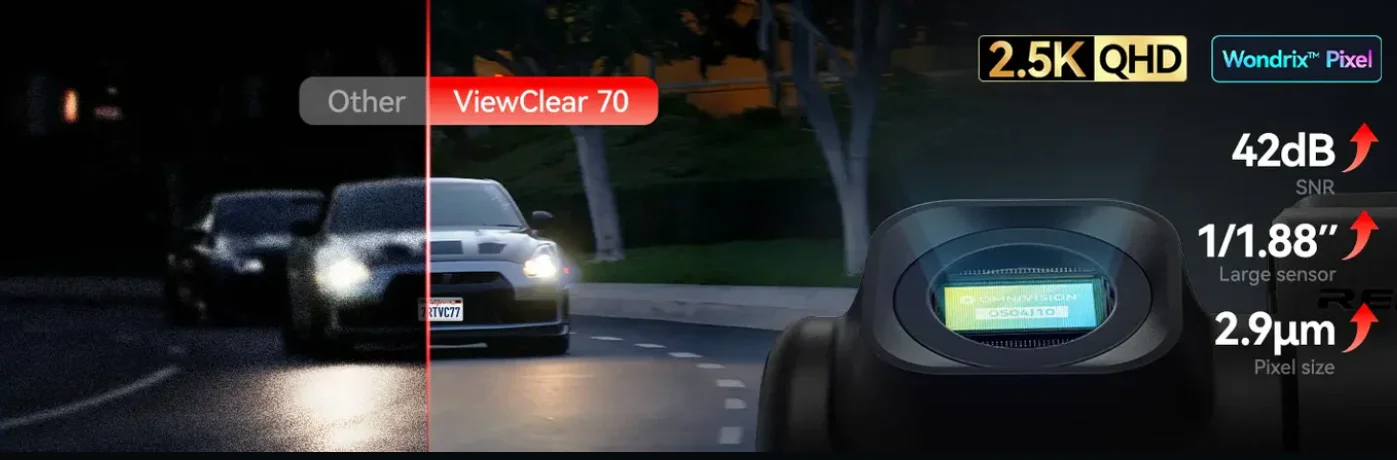
The ViewClear 70 is a dual-channel dash cam (4K front + 2.5K rear), both with HDR, and it comes with 5.8GHz Wi-Fi 6 for smooth connectivity. What makes it stand out is how it handles night driving, with the rear camera powered by an OmniVision sensor built for low-light conditions.


The OmniVision sensor brings two innovative technologies that optimize performance for low-light driving.
  1. In low-light conditions, PureCel® Plus pixel technology picks up more light by significantly enhancing sensor sensitivity and the maximum number of electrons each pixel can store, allowing pixels to capture more photons in dark environments, which boosts low-light performance with higher dynamic range.
  2. Nyxel® NIR (Near Infrared) Sensor Technology achieves up to threefold quantum efficiency improvements, capturing more usable light signals in the near-infrared spectrum to produce sharp, bright images and deliver optimum image data, enabling image sensors to see better and farther while using less power.

In low-light conditions, the pairing of the VC70’s IMX678 and OmniVision sensors captures greater detail with less noise, ensuring you won’t miss anything when it matters most. On dark roads, the VC70 can be a truly helpful companion.

屏幕截图 2025-09-08 094135.webp
 
Last edited:
How does the OS04J10 compare to the IMX678 or IMX675 in terms of low light performance? Do you have any sample footage or a head-to-head comparison?

I saw some daytime sample footage from the VC 70 and was pretty unimpressed, so hopefully the nighttime footage is better.
I have one of these under evaluation, the OS04J10 is a 1/1.8" sensor, same size as the IMX678, a size bigger than the little IMX675 at 1/2.8". The size difference makes up for the inferior Omnivision technology compared to the Sony, and I believe they are around the same price, so if you like big sensors, it is a reasonable choice, but for dashcam use, it doesn't make much difference, the two sensors appear to be about equal, and of course with the Sony sensor on the front, you only have this new PureCel® Plus , Nyxel® NIR etc. technology on the rear, the front performs like all the other IMX678 dashcams, which is good, and they have done a decent job with the HDR on both sensors, which I think puts them ahead of most brands.

The VC70 has been optimised quite well for dark night time use, on both sensors. Significantly better than the Vantrue E1 Pro I had next to it, and they have done a good job with the colour and HDR. Doesn't really compare to a Viofo because of half the bitrate, which I guess is due to using a cheaper processor, and inferior quality lens, but compared to the other brands, it is pretty good. There are a few issues that could be improved, such as vibration in the mount and lack of a CPL (not sure if there will be an optional CPL?), but as a non-premium dashcam, it works well and is easy to use. I'll post a review soon...
 
Here are some preview images, front Sony camera followed by rear Omnivision camera (visible at the bottom of the front camera image), with one of the VC70 issues rather obvious - the rear camera is mirrored, I can un-mirror it in the setup, but I need a rotate 180°, it only gives me a flip, which mirrors, and there is no rotate option! Also the lack of a CPL is causing reflection issues on the second example, but the HDR is working really well in daylight on both cameras, nice sky and full shadow under the trees, and it does read plates.

My trees are giving it a hard time on bitrate, but it is doing quite well, and using H265, which is the only option:

1756887246039.webp
1756887277655.webp


1756886448540.webp
1756887340610.webp


Ahh, Microsoft have disabled my photo hosting, so these will be resized by the forum, need to find a better photo host...
 
Last edited:
How does the OS04J10 compare to the IMX678 or IMX675 in terms of low light performance? Do you have any sample footage or a head-to-head comparison?

Front, Sony IMX678:
1756983779413.webp


Rear, Omnivision OS04J10:
1756983603724.webp


Vantrue E1 Pro (Sony IMX678):
1756983831624.webp


The amount of motion blur tends to be identical, the only consistent difference is that the Omnivision is 2K, not 4K (Or 2.5K as RedTiger call it), with the result that the digital sharpening is more obvious on the Omnivision, it looks sharper but doesn't have more detail. The E1 Pro is always darker, a result of the PlatePix TM feature.
 
How does the OS04J10 compare to the IMX678 or IMX675 in terms of low light performance? Do you have any sample footage or a head-to-head comparison?

I saw some daytime sample footage from the VC 70 and was pretty unimpressed, so hopefully the nighttime footage is better.
I think the Wolfbox G900 TriPro I tried out a while ago had the same OmniVision sensor, I recall from memory being excited that on paper the new OV sensor seemed to be the catch-up to Sony that it should have been.

Expectations vs. reality is of course a different thing though, and it was also crippled by a rather low bitrate on that model. Competition is what's needed in this space, and it's good to see that finally OmniVision is trying again - I think Sony with Starvis is safe for now....
 
I think the Wolfbox G900 TriPro I tried out a while ago had the same OmniVision sensor, I recall from memory being excited that on paper the new OV sensor seemed to be the catch-up to Sony that it should have been.

Expectations vs. reality is of course a different thing though, and it was also crippled by a rather low bitrate on that model. Competition is what's needed in this space, and it's good to see that finally OmniVision is trying again - I think Sony with Starvis is safe for now....
if use low bitrate..... that bad news
 
if use low bitrate..... that bad news
It is, I'm not sure whether it's also because it was in three channel mode but honestly it should have been running at least double the bitrate that it was...
 
if use low bitrate..... that bad news
And low frame rate on the front, it is another of the 24fps 4K dashcams!

Nothing really wrong with 24fps for accident recording, it does the job fine, but it is not a dashcam for making 60fps road movies.
It would be better if both front and rear used the same frame rate, 24fps on the front and 30fps on the rear doesn't make a lot of sense. For accident recording, I would be happy with 24fps front and back, as long as the price reflects the specifications, not everyone wants to pay for a premium 60fps dashcam such as the Viofo A329.
 
24 fps with some global shutter super high shutter speed for ultra sharpness at road speeds would be more useful than 60 fps.
 
Back
Top