Parking Battery-Power Station, 3X capacity and 3X cheaper than dedicated options + extra functionality

The differences (for our purposes) between the EcoFlow River units is primarily in their battery capacities:
River 2 is 256Wh
River 2 Max is 499Wh
River 2 Pro is 768Wh

For reference, the River2 provides about 40 hours of parking mode for me with a two-camera setup. Given this, I would expect the River 2 Max to be closer to 80hrs and the River 2 Pro to be closer to 120hrs (just going by battery capacity alone). Real differences in run time may vary a bit...

Check their webpage for additional differences (diff number of outlets, etc).
Hello, Regarding the River 2, River 2 Max, River 2 Pro, would their self discharge rates be any different if we are only using USB / 12V outlets?

The reason I ask is that I am using Thinkware U3000 dashcam in radar mode and it uses negligible power (~0.2 Watt) during parking mode so the run time of the whole setup is primarily dependent on how quickly the power station discharges itself when left on. I currently use a River 2. If the self discharge rate of River 2 pro is the same as River 2, then it would give me a much longer parking mode time (Weeks). However if due to their "heavier" electronics their self discharge rates are considerably higher, then there would not be any point in upgrading from River 2 to River 2 pro.
 
Given that these are all from the same series (variants of the River 2), I would expect a very high degree of similarity for the internal (discharge) circuitry. As a result, I would expect a very uniform self discharge rate across these models, especially for the USB and 12v utility ports). My guess is that the primary difference is in the battery capacity and charging circuits (mostly in their current handling capabilities). Of course, I have no way to verify any of this, as I only have the River 2.
 
Given that these are all from the same series (variants of the River 2), I would expect a very high degree of similarity for the internal (discharge) circuitry. As a result, I would expect a very uniform self discharge rate across these models, especially for the USB and 12v utility ports). My guess is that the primary difference is in the battery capacity and charging circuits (mostly in their current handling capabilities). Of course, I have no way to verify any of this, as I only have the River 2.

Thanks. Yes that, makes sense. AC outlet would definitely have a lot more power draw as it supports a much higher wattage. I too have a river 2 but I am of thinking of buying a max or pro as it has DC 2.5 mm outlets that I want to use for something I have in mind. If I do so I will update here.
 
I made a couple of observations on my CTECHI GT200 during a weekend away that comprised 6 hours driving each way, and overnight parking mode whilst at a hotel.

After the second night of parking, the battery was down to 1%. It was still powering 2No cameras, but only just. After a very short drive to refuel the car and then park for 15 minutes buying provisions for the return trip, the battery was depleted. When it is completely empty, it does not automatically power the USB-C output when the 12V input is turned on with the ignition. I had seen this during bench testing at home so I knew to expect it. However, even after another short drive that charged the PS to 3%, it still would not start up automatically or even manually. Perhaps it was due to the hot weather, but the PS would not pass-through to my hardwired cameras whilst the car was driving. I charged the PS with no external load for 5-10 minutes and finally it was working again. Obviously this is not ideal. I usually manage things by charging the PS at home each weekend, but the weekend away was a useful test of how this PS is not suited to being a dashcam battery.

Another issue is the relatively slow charge rate using the 12V CLA adapter. After the 6-hour drive home, I noticed the battery charge was only 31%.

It was a nice idea to repurpose my existing power station in this way, but I think I will go back to using my dashcam battery once I figure out how to do the hardwire connections in this car.
 
That’s a shame that it doesn’t work well as a parking battery. It has a nice and clean form factor that looks easy to secure in your car.
 
Here is the suitable option - the EcoFlow River3 (230Wh version) at the lowest price yet on Temu.
The River3 has been running in my Jeep for around 6 months now, and I am still waiting for a 100°F+ days to test it.

Ecoflow River 3 (230Wh version)

Capture.webp
 
Last edited:
Works fine for me even at 40°C inside my trunk, but at this stage in summer and Sun, I try everything to darken my car, which could or does potentially eliminate the usefulness of a dash cam anyway. Front and rear full window covers on the outside for the front and pitch black tint on the rear and side windows. But still, I have two Tapo c120 security cameras looking out at the rear triangle windows, which cover the side of the car that is exposed to danger and notifies me when a person is detected close by. Rear dashcam can still see outside but its set to collision detection because first they tell you to use collision in hot summer and I have to manage the power usage anyway.

One day I messed up so badly that I tried to run a fan inside, pointing at one of the cameras exposed to the sun, but this didn’t work out since it created a hot wind inside the trunk and heated it up to 50°C. At this point, the EcoFlow and the Cellink Neo still worked, but I turned them off manually and I also didnt use any kind of window covers then.
 
Works fine for me even at 40°C inside my trunk
The River 2 has a temp limit of 45c and they mean it. Mine failed above this limit and needed to be repaired. It seems the temp limit on the River3 has been improved.
 
They were so hot to touch that you couldn't hold your hand on any of them. Officially, it still has such a limit, I guess. I was running the dash cam in the cigarette port, and the security cameras were also plugged into the USB port of the Dashcam cigarette cord. The fan was plugged into the cellink neo when it reached over 50°C also in the ciggarette socket extension because the USB port was to weak to power it.

Realistically, I can only run up to a little over a 5W load because of my short driving distance during the week, so I also have some USB WiFi switches and nowadays selectively turn on the security cameras depending on how the car is parked. Only the collision detection runs full time, and since it's a Vantrue E360, it also has a lot of draw in that mode compared to others. I will most likely exchange it for the Thinkware u3000 once I manage to find a store.
 
Last edited:
Reading about various dash cameras and their parking modes, it can last so many weeks in collision, but how true is that actually?

I have a Cellink Neo 8+, Solix C300 DC, EcoFlow River 3, yet none of these batteries display above 3 days with nothing connected. Neo drops about 10% a day also running nothing.

Just wondering. Have yet to get a dashcam with low consumtion in parking.
 
This will all depend on the self-discharge rate of the specific battery that you are using. Some of the commercial batteries will likely discharge more quickly than others, it's hard to know/predict until you have one in hand.

DIY batteries will likely have the lowest self-discharge rate because the ONLY draw will be the 5v regulator and the camera. The low power collision detection mode on some cameras are VERY low, on the order of 0.1w or so.
 
Of course, makes sense. I will test the 4 now. Left the EcoFlow with Vantrue 360 on G-force parking mode (fast startup) , also left a Wyze V4 in the car connected to a simple Anker 20k power bank. This one consumes about 0.5-1W when it's not connected to WiFi, and at home I will just leave the Solix C300 and Cellink on without anything connected and check on them in 2 days.

I also have a very cheap 80k Lition powerbank but Im not trusting it just now. Plugged in a small 1W fan and its running on my desk for days hehe.
At the end of the day it doesnt really matter because you have to make due with what you have right. But still wanna know. Should get the u3000 soon to which will most likely be my last dashcam and probably the one I will stick with in my personal car and E1 for my work car which has to be portable.

The u3000 has radar, low consumption in a low traffic area should run happily on the car battery via OBD2, right? Well, a man can still dream....
 
Last edited:
Well, some surprising findings just 15 hours later. The Cellink Neo dropped an astonishing 26% (dont even see how this is possible) and the Solix C300 not even 1%!

Granted, the Solix is just on with Wi-Fi/Bluetooth off, which doesn't seem possible on the Cellink Neo, but still, 26% is huge if the numbers are correct and can be trusted. Last I heard not so much. Anyway as much as I disliked the Solix at first, it seems to be good for some things. IF the numbers are correct it could be acting as regular power banks when not powering stuff and turning everything off which would mean once something so sligtly connected it could drop.
 
Im gonna charge and retest the Neo because abolutly nothing connceted was not true. I had this one plugged in to its outgoing contacts so dunno if it matters.
1753945559783.webp

However after recharging I dont think I can really trust its display because its 100% after just some few minutes which shouldnt be possible and looking at my tapo power plugs it never gone above 7W so there is that. Fully fake display.
 
Last edited:
well, when my cellink neo 8+ is fully charged, its flat in like 12 hours

i have a blackview 970x LTE (sim card included) 2CH

i also have a river 2 pro and that goes flat in like 4 days
 
Just installed the U3000. It came with everything you could wish for—except a hardwire cable. Now I’m waiting for that. 😬


I know you can cut the OBD2 cable to make it into a hardwire kit, but I don’t want to do that because I want to keep the OBD2 as an option. Another one of those cameras that won’t do parking mode unless it’s connected via OBD2 or hardwire.


Other than that, it’s already my favorite camera, but I’m not sure if I should trust it to run on the car battery since I have zero knowledge about what’s safe and what’s not at the moment. I know it only consumes 10mA in radar mode—but still. It has battery voltage protection, but it’s still directly connected to the battery, so I dunno.

Also the single Wyze cam run for 37h45min on the anker 20k powerbank. Had a chit chat with chatgpt about it and it suggested to run tricle charge which could even more extend it if it turns off some chipsets. However Wyzes are kind of a pain because if they dont have internet, motion triggering doesnt work so replaced it with the Tapo c120 now.

Solix C300 on the other hand still shows 100% with bluetooth on now for 1 day and DC port. This cant be right anymore or?
 
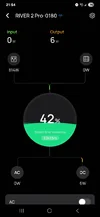
All of a sudden this is happening

814W but not charging ? I'm confused
 

Attachments

  • Screenshot_20250803_215440.webp
    Screenshot_20250803_215440.webp
    31.1 KB · Views: 111
Bug. By the way, Anker Solix C300 looks impressive so far in my test running 1W load. It's even beating the stupid 80k Liteon power bank. Still 91% after more than 24 hours. So the zero drop when on for 24+ with no load was not a joke.

Can't say much for Celllink as % and time left don't really match. So maybe because the Soliox has no AC electronic, its only DC more likee a powerbank. Maybe I should get tthe explorer 100.
 
iv got an anker C300 DC too, but i run the eco flow river 2 pro (768 WH) to the Solix (268 ? WH)
i just use the solix to charge the ecoflow with the car charging cable from the ecoflow
 
Yes, that was my logic too, but it all falls apart when you realize you have to carry that thing about 2 km every second day or so, or possibly each day depending on the load, and it gets tiring. If you can charge a big station at home, this isn’t a problem, but I can’t, so there are two solutions to this problem. Get a dashcam that consumes 0.1W power in parking mode and a dedicated battery, or keep carrying the bricks each day. I have spent a lot on various dashcams and power stations now and realized that option 1 seems to be the way to go for me. Sure, this EcoFlow 3 or Solix 300 DC isn't that big; of course, you could easily carry that in a backpack each day, but even the connecting and disconnecting gets annoying fast.

Like I said I'm at my last stage with dashcams now and since I basically have everything needed for a normal dashcam installation minus the HW cable and now a dash cam with low consumption and superfast reaction in parking mode (u3000) with radar sensing and internet support, best in class or maybe second best anyway. Wish I had gone for this one in the beginning but it was expensive and hard to get. Well now I paid lots more of course but oh well.

Still have 2 small power stations and I will use that only at work for the security camera most likely for 8 hours a day or so and since I have 2 I can interchange them and refill at my office.

There are more optimal solutions possible like the Ugreen LIFEPO4 batteries or Jackery Explorer 100 which would also work and be smaller nad have neough power especially if you use 2, maybe in next life.
 
Back
Top