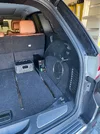
Parking Battery-Power Station, 3X capacity and 3X cheaper than dedicated options + extra functionality

All power stations, all dedicated dashcam batteries, all battery management systems (BMS) I've used for my DIY batteries, etc., are unable to accurately reflect the state of charge (SoC).
This is due to the wide range in charge and discharge currents and the accumulation of measurement errors, which requires constant recalibration.
The most accurate is the Ecoflow River 3.
 
It’s been over 9.5 months since I installed Ecoflow River3 in my Jeep, powering two Viofo Mini2 dash cams via two USB-A ports using HK4 cables with removed voltage regulators (my original 5V direct connection system).
It worked flawlessly the entire time.
It survived both winter and summer, with sub-freezing charge protection tripping once and overheat charge protection tripping twice, while still powering the dash cams in both cases.

I love features like Wi-Fi and Bluetooth and app, the ability to remotely turn off the battery and the dash cam(s) when not needed, the ability to change the charging current on the fly via app, time-out, port memory, and the pretty accurate state of charge indication.
It is easy to install and maintain.
Overall, this is an excellent power station for a dash cam, much better than any dedicated battery on the market in my opinion.

Now the time has come, and today I replaced it with my DIY, LTO battery.

It's a simple drop-in replacement.
I didn't change anything in the car's wiring.
The LTO battery is powered via the same CLA-XT60-I cable, and the same two USB-A dash cam cables are connected via a Y-splitter to the USB-A (QC3.0) port on the LTO.
 

Attachments

  • IMG_8816.webp
    IMG_8816.webp
    387.2 KB · Views: 196
Looking nice. I'm waiting to see if maybe the new sodium-ion power stations or 12V batteries start showing up, but I'm not going for the outdated Bluetti. I can't quite decide which has served me better, the Solix C300 or the River 3, because both have advantages and disadvantages for my use case. Neither is perfect, but if you could combine them, I’d have the perfect one.
 
Yes, it's difficult to find the perfect option for every situation.
Solix has much better USB ports, but I prefer the River3 app and its functionality.
The new Bluetti Elite 30 V2 looks good - a sort of combination of Solix and River - but it has high self-consumption.
Standby DC power consumption is about 5W — about 3 times that of the River3.

It's interesting that you mentioned Sodium-Ion (Na+) batteries.
And the only Bluetti power station that uses these cells is, frankly, a joke.
Currently, Na+ cells are inferior to LFP cells in every way except the ability to charge at sub-zero temperatures.

I even considered building a battery using these cells:
3.1V 10Ah Sodium-Ion battery

They are drop-in replacements for the similarly sized LFP batteries I used here:
 
My current setup is is a viofo a229 pro in 3ch mode with LBR that I can typically get about 50-60 hours of parking mode in and recharges in about an hour.

The setup is as follows:

2x power taps
\\\///
2x Ugreen 150 watt car chargers (140 watt outputs)
\\\///
Anker Solix c300 DC (288 watt hours LFP)
\\\///
Zoupw 188 Wh LFP Battery
\\\///
USB C Trigger with adjustable voltage set to 12v
\\\///
HK4 hardwire kit w/ custom relay to car ACC
\\\///
Viofo A229 Pro

Overall, the setup works relatively well. The 2x power taps and chargers give a theoretical 280 watt charging capacity for the system, which means an hour of driving gives about 25 hours worth of run time (viofo a229 pro is not very efficient in LBR). A relay is needed with the HK4 kit to prevent cross talk between the car 12v system and the battery 12v system since it uses the same negative line across both.

I ran into trouble with the anker solix battery with the trigger because for some reason at around 24 hours, it would flicker power to the usb c trigger causing the camera to shut off, but since it was in parking mode it would not turn back on until you restart the car. Putting an intermediary battery (ZOUPW) fixed this (but is more conversion losses).

The 150 watt chargers required m.2 heatsinks to keep cool as they would overheat from the power draw despite overall car power system voltage staying at 13.1. I also occasionally have issues with the dual input charging. At lower temperature with low charge state, the anker battery seems to limit to low current on one charger, and then on charge state greater than 85% it also shuts off the second charger.

Now that we approach winter, the biggest challenge is that in cold temperatures, I have to wait an extraordinarily long time for the batteries to start charging. I am working on building a temperature regulated heater with some insulation to try and keep the batteries warm.

All said and done, it does what I want it to do with some TLC, but definitely not care free.
 
......
Now that we approach winter, the biggest challenge is that in cold temperatures, I have to wait an extraordinarily long time for the batteries to start charging. I am working on building a temperature regulated heater with some insulation to try and keep the batteries warm....
Nice setup, @halomstr !
Cold weather charging and performance are the main drawbacks of LFP batteries.
It seems you're quite a hands-on DIYer; Check out this thread on DIY LTO batteries; it might inspire you:

https://dashcamtalk.com/forum/threa...-battery-for-dash-cam-parking-mode-diy.50484/
 
I went ahead and bought the 140Ah Litime smart battery, mostly for my security cameras. For what it’s worth, the smart part of the battery is not really useful for the kind of work we put them through, since the smart sensor isn’t able to register anything under 1.5A at 12V, which means anything under 18–20W. Learning the hard way again, even though they confirmed it would still show the % and voltage correctly. Well, I can now report that it doesn’t, but I’m learning a lot as I go.


It’s very hard to tell what the battery percentage is anyway for LiFePO4, so I got myself a Victron smart shunt, which is reported to show usage over time correctly. However, people don’t usually put such batteries on such small loads. At last, I can now see more realistic usage, which is nice, and it detects amps down to 0.010A, so all seems good now, other than the fact that it looks like a freaking homemade bomb.


The only useful thing from the smart part of the battery is that I can turn it off and on via Bluetooth, but then again, this probably consumes some power that a dumb battery wouldn’t. You could also just get a killswitch for a dumb battery too, so…


I also finally hardwired my dashcam Cellink battery to an empty fusebox slot, and I have no freaking idea how much this slot can take, so I left the battery at a 5A fixed position. Since the battery has only power and minus cables, and my car seems to only have low-voltage ACC-controlled fuses, and I don’t know what the wiring behind it is, I probably shouldn’t risk more than 5A.

If anybody wanna take a look at my fusebox. Only the green circled row is ACC controlled and has live contacts in my Skoda Kamiq. picture
 
Glad you got it to work!

all seems good now, other than the fact that it looks like a freaking homemade bomb.
Over this past summer, my wife and I took our daughter to the American Ballet Theater in New York City. As we entered the underground parking lot, the attendant made me open the trunk (looking for explosives or other threatening items). He was a bit hesitant to let us park after seeing my DIY battery box with wires coming out of it. He looked a little more at ease after I showed him the array of cameras on my windows that are powered by the battery he was looking at 🤣
 
Here is a link to my post in the "Ecoflow and Viofo" thread—just in case anyone needs it.


Attachments

  • IMG_9197.webp
    IMG_9197.webp
    128.5 KB · Views: 15
Another link to my post in the "Ecoflow and Viofo" thread—just in case anyone needs it.


Attachments

  • IMG_9237.webp
    IMG_9237.webp
    187.5 KB · Views: 0
Back
Top