
Sensor Showdown: Sony STARVIS 2 IMX675 vs. OmniVision OS04J10 - The Low-Light King?

WOLFBOX

Member
Manufacturer
Joined
Feb 24, 2025
Messages
40
Reaction score
25
Location
CA
Country
United States
Hey everyone,

We often talk about dash cam resolution, but the sensor inside is the real hero, especially when driving at night. This article breaks down the differences between two major players: the Sony STARVIS 2 IMX675 and the OmniVision OS04J10. The findings challenge the common belief that more megapixels automatically means a better image.
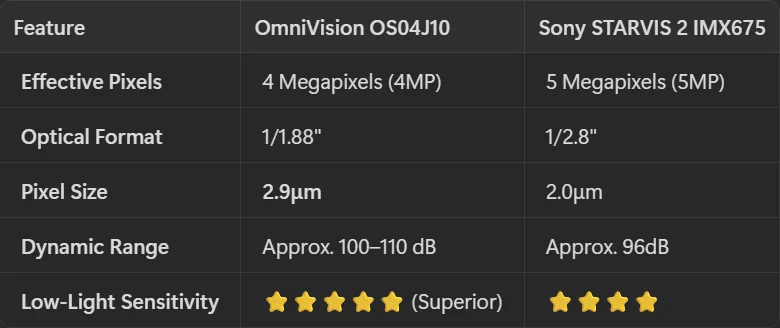
Here is a quick summary of the core specifications:
core specs.webp


The Critical Factor: Pixel Size

While the IMX675 boasts a higher 5MP resolution, the analysis points to the OmniVision OS04J10's significantly larger pixel size (2.9μm vs. 2.0μm) as the key differentiator for dash cam performance.
Think of each pixel as a container collecting light (photons). In low-light conditions, the size of the container (pixel size) is more important than the total number of containers (total pixels). The larger 2.9μm pixels on the OS04J10 can capture more photons per unit of time, leading to three major advantages:
1.Brighter Images: For the same exposure time, the OS04J10 achieves a higher signal strength.
2.Reduced Motion Blur: To achieve the same brightness, the OS04J10 can use a shorter exposure time, which helps freeze motion and reduce blur from moving vehicles or your own speed.
3.Superior Signal-to-Noise Ratio (SNR): More signal and less noise means a cleaner image, especially in shadow areas. This is crucial for identifying details in dark corners of a parking garage or restoring license plate information in backlit scenarios (like a car with bright headlights).
The article suggests that the OS04J10's design prioritizes light sensitivity and dynamic range (up to 110 dB) over raw pixel count, making it a potentially superior choice for the challenging, high-contrast, and low-light environments typical of dash cam use.

What are your thoughts?

Have any of you used dash cams with these specific sensors? Does this technical breakdown align with your real-world experience?
For the full, in-depth comparison, including visual examples and a more detailed explanation of the physics, check out the original blog post here:
Click here to read the full article: Sony Starvis 2 IMX675 vs OmniVision OS04J10 for Dash Cams
Let's discuss!
 
That was an interesting article. You didn't specifically say whether the OS04J10 has HDR or not - you only mentioned HDR in conjunction with the IMX675.

Obviously the strengths of the OS04J10 need to be partnered with a good processor and firmware to deliver the best results. Have you tuned your video processing to suit the output from this sensor?

In my low light testing I have observed similar results with a 2mp sensor that has even larger 4.2μm BSI pixels. It is excellent for rear facing use or for low light parking.
 
STARVIS and STARVIS 2 are excellent CMOS, but they are not the 'end all - be all' of 2K and 4K CMOS. Software and Lens are equally, probably more important in some aspects.

Dashcam manufacturers tend to lean towards their own line of thinking and sometimes towards propaganda. Here is a link to Omnivision for balance.

OmniVision OS04J10

Might as well post the specs....

OS04j10.webp
 
Hey everyone,

We often talk about dash cam resolution, but the sensor inside is the real hero, especially when driving at night. This article breaks down the differences between two major players: the Sony STARVIS 2 IMX675 and the OmniVision OS04J10. The findings challenge the common belief that more megapixels automatically means a better image.
Here is a quick summary of the core specifications:
View attachment 88485

The Critical Factor: Pixel Size

While the IMX675 boasts a higher 5MP resolution, the analysis points to the OmniVision OS04J10's significantly larger pixel size (2.9μm vs. 2.0μm) as the key differentiator for dash cam performance.
Think of each pixel as a container collecting light (photons). In low-light conditions, the size of the container (pixel size) is more important than the total number of containers (total pixels). The larger 2.9μm pixels on the OS04J10 can capture more photons per unit of time, leading to three major advantages:
1.Brighter Images: For the same exposure time, the OS04J10 achieves a higher signal strength.
2.Reduced Motion Blur: To achieve the same brightness, the OS04J10 can use a shorter exposure time, which helps freeze motion and reduce blur from moving vehicles or your own speed.
3.Superior Signal-to-Noise Ratio (SNR): More signal and less noise means a cleaner image, especially in shadow areas. This is crucial for identifying details in dark corners of a parking garage or restoring license plate information in backlit scenarios (like a car with bright headlights).
The article suggests that the OS04J10's design prioritizes light sensitivity and dynamic range (up to 110 dB) over raw pixel count, making it a potentially superior choice for the challenging, high-contrast, and low-light environments typical of dash cam use.

What are your thoughts?

Have any of you used dash cams with these specific sensors? Does this technical breakdown align with your real-world experience?
For the full, in-depth comparison, including visual examples and a more detailed explanation of the physics, check out the original blog post here:
Click here to read the full article: Sony Starvis 2 IMX675 vs OmniVision OS04J10 for Dash Cams
Let's discuss!

Can you provide images comparing these two CMOS? First, post some daytime and nighttime static images, such as a parked vehicle imaging other parked cars, then images from a moving vehicle.
 
Last edited:
While the IMX675 boasts a higher 5MP resolution, the analysis points to the OmniVision OS04J10's significantly larger pixel size (2.9μm vs. 2.0μm) as the key differentiator for dash cam performance.
Sony IMX664 has these specs: Diagonal 9.02 mm (Type 1/1.8) approx. 4.16 M pixels
 

Attachments

Back in the day the OV4689 sensor was very popular in dashcams, it would be nice if omnivision once again could pull a rabbit out of the hat.

Not too long ago i was looking at the technical specs of some OV sensors and a few looked interesting.
 
  • Like
Reactions: Mtz
Obviously the strengths of the OS04J10 need to be partnered with a good processor and firmware to deliver the best results. Have you tuned your video processing to suit the output from this sensor?
Agree. Yes, our engineers have tuned the processing system.
 
Can you provide images comparing these two CMOS? First, post some daytime and nighttime static images, such as a parked vehicle imaging other parked cars, then images from a moving vehicle.
Yes, if you look at the original blog, you will find the pictures.
 
Hey everyone,

We often talk about dash cam resolution, but the sensor inside is the real hero, especially when driving at night. This article breaks down the differences between two major players: the Sony STARVIS 2 IMX675 and the OmniVision OS04J10. The findings challenge the common belief that more megapixels automatically means a better image.
Here is a quick summary of the core specifications:
View attachment 88485

The Critical Factor: Pixel Size

While the IMX675 boasts a higher 5MP resolution, the analysis points to the OmniVision OS04J10's significantly larger pixel size (2.9μm vs. 2.0μm) as the key differentiator for dash cam performance.
Think of each pixel as a container collecting light (photons). In low-light conditions, the size of the container (pixel size) is more important than the total number of containers (total pixels). The larger 2.9μm pixels on the OS04J10 can capture more photons per unit of time, leading to three major advantages:
1.Brighter Images: For the same exposure time, the OS04J10 achieves a higher signal strength.
2.Reduced Motion Blur: To achieve the same brightness, the OS04J10 can use a shorter exposure time, which helps freeze motion and reduce blur from moving vehicles or your own speed.
3.Superior Signal-to-Noise Ratio (SNR): More signal and less noise means a cleaner image, especially in shadow areas. This is crucial for identifying details in dark corners of a parking garage or restoring license plate information in backlit scenarios (like a car with bright headlights).
The article suggests that the OS04J10's design prioritizes light sensitivity and dynamic range (up to 110 dB) over raw pixel count, making it a potentially superior choice for the challenging, high-contrast, and low-light environments typical of dash cam use.

What are your thoughts?

Have any of you used dash cams with these specific sensors? Does this technical breakdown align with your real-world experience?
For the full, in-depth comparison, including visual examples and a more detailed explanation of the physics, check out the original blog post here:
Click here to read the full article: Sony Starvis 2 IMX675 vs OmniVision OS04J10 for Dash Cams
Let's discuss!
I can’t agree more. I really miss the time when Viofo gave us an interior cabin camera with a glorious 165° FOV and an Omnivision sensor. That 1080p cabin camera still performs better than all the 2K Starvis 2 sensors I’ve tested, including the IMX675 and IMX662. I’ve bought three models from other brands and tested them recently, but I returned all of them because, for commercial and safety reasons, I need to be able to recognize a face 20 ft away under harsh, changing lighting conditions. The Omnivision sensor with ULL, no noise, and a 2.9 μm pixel size still delivers crisp, clear results without any oversharpening or weird AI/artificial layers.
The 70Mai 4K Omni is the only one with an Omnivision main sensor that can also be used as a cabin camera. I specifically look for Omnivision sensor cameras for cabin use. Starvis 2 is nowhere near the ULL or noise levels of, for example, the OS02C10 sensor (released in 2018, implemented by Viofo in 2022).
All we get nowadays is a small 120–150° FOV in the rear, which doesn’t function well through tinted glass, so people end up writing bad reviews. I would buy more dash cams for my company’s fleet if we could get an Omnivision sensor better than the OS02C10 in 2.5K with a 170° FOV—but no. It’s amazing how rarely people turn off the IR LEDs when testing cameras with family or clients to see the dash camera's real low‑noise performance. Ninety‑nine percent of reviewers test with that ugly infrared “demon eye” effect.
Meanwhile, RedTiger just introduced color night vision, but with a small FOV—a deal breaker. I’ve written to other brands that are considering Omnivision’s potential (it’s also used in medical devices for its ultra‑low‑light performance and minimal to no noise in pitch-black conditions). Starvis 2 in 2025 has barely caught up with an Omnivision 2018 sensor. I can’t say enough about how amazing Omnivision performs in pitch-black to ambient-light conditions. I would prefer it for my cabin camera, with the goal of identifying objects or faces in ambient light to pitch dark, 20 ft away in the back of buses. SNR1 (signal-to-noise ratio of 1) at 0.16 lux, i literally have Color night vision with barely any noise in all situations. Until this is properly implemented, I am holding on to the previous generation of reliable dash cameras with natural colors, no crushing shadow details, and not recommending them to clients, friends, or family.
I am new member so i am holding on from posting my samples of IMX 675 or 662. I am waiting on one more brand to hear back to see if anything can be fixed via software support in terms of shutter speed.
 
Thank You.
The 70mai 4K Omni uses excellent low‑light noise management without relying on IR LEDs, and delivers almost full‑color night vision as long as it’s not completely dark. It’s the only dash cam I’ve seen that consistently provides usable image quality in low light in both directions. If the footage I saw was really from the IMX678 sensor, then 70mai has tuned it to perform almost on par with Omnivision’s low‑light sensors. Omnivision sensors can capture video where faces remain recognizable even in near‑total darkness with only faint ambient or HUD lighting, while sensors like the IMX675 and IMX662 often fail to show facial detail at all. My old dashcam with Omnivision sensor is missing hdr wdr and still it performs better for making out faces towards the center of image. This makes top tier Omnivision sensors or in dash cam 70mai 4K Omni very important for safety at night, for transport businesses such as charter buses that run long distances without interior lights on, or simply for recording funny and memorable family moments.

70mai.com claim their 4K Omni users a Sony sensor the imx678.

I wouldn't be surprised if 70mai has two versions of the 4K Omni also known as the x800.

 
Back
Top