
You are using an out of date browser. It may not display this or other websites correctly.
You should upgrade or use an alternative browser.
You should upgrade or use an alternative browser.
What is the expected zero-load self discharge rate of the BBMC PC8?
- Thread starter Hack_man
- Start date
OP
OP

Hack_man
Well-Known Member
Update:
BBMC has agreed to accept a warranty return. They will repair or replace the unit.
I requested their test data for zero load discharge rate but they would/could not provide it. I don't want to go thru the RMA process to find out my battery was "performing as designed".
I know for a fact the discharge rate has degraded recently and that it previously behaved similar to Panzer's PC8.
Thank you @Panzer Platform for providing comparison test results!
I performed some additional testing as follows:
1. Fully charge battery
2. Disconnect all cables from unit
2. Power unit ON just long enough to record charge level at various time intervals.

These results were repeatable. The battery strangly drops 19% for the initial measurement (T = 23 hours) but stabilizes afterwards. This indicates that my excessive 8% discharge rate is due to the BMS/Bluetooth circuitry or other internal electronics, and not from the decay of the actual battery cells. I have no explanation for why the charge level dropped 19% the first time I checked it at t = 23 hours. I repeated the 23 hour (approx) initial test and the battery again dropped 18% upon first-time power up. This appears to be another anomaly different from my 8% discharge issue.
I think I will run the discharge test again at room temperature to eliminate temperature as a variable. My battery has been mostly around 42F during this testing. I would hate for BBMC to test at 70F and get a completely different result, although I think Panzer tested around 55F.
BBMC has agreed to accept a warranty return. They will repair or replace the unit.
I requested their test data for zero load discharge rate but they would/could not provide it. I don't want to go thru the RMA process to find out my battery was "performing as designed".
I know for a fact the discharge rate has degraded recently and that it previously behaved similar to Panzer's PC8.
Thank you @Panzer Platform for providing comparison test results!
I performed some additional testing as follows:
1. Fully charge battery
2. Disconnect all cables from unit
2. Power unit ON just long enough to record charge level at various time intervals.
These results were repeatable. The battery strangly drops 19% for the initial measurement (T = 23 hours) but stabilizes afterwards. This indicates that my excessive 8% discharge rate is due to the BMS/Bluetooth circuitry or other internal electronics, and not from the decay of the actual battery cells. I have no explanation for why the charge level dropped 19% the first time I checked it at t = 23 hours. I repeated the 23 hour (approx) initial test and the battery again dropped 18% upon first-time power up. This appears to be another anomaly different from my 8% discharge issue.
I think I will run the discharge test again at room temperature to eliminate temperature as a variable. My battery has been mostly around 42F during this testing. I would hate for BBMC to test at 70F and get a completely different result, although I think Panzer tested around 55F.
Last edited:

GPak
Well-Known Member
It's great that BBMC acknowledged the fault and agreed to fix or replace it.
While there will be some difference in the test results between 42°F and 70°F, I don't think it will be significant.
The initial drop can be explained by how the state of charge (SoC) is measured.
When the battery reaches a fully charged state during charging, the battery voltage is around 14.4V, however, once charging stops, the voltage immediately begins to drop to so called fully charged resting voltage, which can be as low as 14V or lower.
So if the voltage is used to display the SoC, you may see an initial drop, although 19% seams too high.
For my DIY batteries I adjust the voltmeter settings to show 100% at resting voltage.
I have tested many power stations and BMS and almost all of them are not that accurate, with the exception of Ecoflow.
I believe people here at DCT have reported that most, if not all, dedicated batteries also do not display SoC that accurately, however, testing the rate of change of SoC is perfectly acceptable.
While there will be some difference in the test results between 42°F and 70°F, I don't think it will be significant.
The initial drop can be explained by how the state of charge (SoC) is measured.
When the battery reaches a fully charged state during charging, the battery voltage is around 14.4V, however, once charging stops, the voltage immediately begins to drop to so called fully charged resting voltage, which can be as low as 14V or lower.
So if the voltage is used to display the SoC, you may see an initial drop, although 19% seams too high.
For my DIY batteries I adjust the voltmeter settings to show 100% at resting voltage.
I have tested many power stations and BMS and almost all of them are not that accurate, with the exception of Ecoflow.
I believe people here at DCT have reported that most, if not all, dedicated batteries also do not display SoC that accurately, however, testing the rate of change of SoC is perfectly acceptable.

lufa6977
Well-Known Member
- Joined
- Jul 22, 2024
- Messages
- 1,744
- Reaction score
- 2,038
- Location
- Virginia, Shenandoah Valley
- Country
- United States
- Dash Cam
- Vueroid S1-4K, Viofo A129 Pro Duo, A229 Pro, IR, Telephoto
Generally speaking, and depending on chemistry, the LIFEPO4 100 percent charging voltage is 14.6, the resting voltage will be 13.6 volts. As a rule, testing measurements start at the usable capacity of 13.6 volts when doing a run down test or static (no load) discharge test. Your %81 would be roughly 13.3 volts. As is already known, these BMS have skippy voltage readings some times, and you have to know if it considers %100 to be the 13.6 volts.
The pack is often considered to be 'in the green' down to 12.9 volts, LIFE can take some abuse and people often run them lower, though it puts a stress on them and the BMS/charging system to bring them back up.
The pack is often considered to be 'in the green' down to 12.9 volts, LIFE can take some abuse and people often run them lower, though it puts a stress on them and the BMS/charging system to bring them back up.
Last edited:
OP
OP
Hack_man
Well-Known Member
Where are you getting your above statement from? I am claiming my observed discharge rate of 8% in 24 hours is degraded performance relative to 6 months ago. We have actual data from @Panzer Platform which shows discharge rate with bluetooth on closer to 2% which also agrees with what I previously experienced.The BBMC PC8 has an observed self-discharge rate of around 8% over 24 hours with features like Bluetooth and USB enabled. Disabling these can help reduce discharge. For LiFePO₄ batteries, the typical self-discharge rate is about 3% per month.
Please provide data or a source.
Last edited:
OP
OP
Hack_man
Well-Known Member
I have an update.
My PC8 after 24 hours has been discharging by about 2% lately rather than the 8% rate I experienced during the Winter months. This 2% rate is pretty much identical to @Chuck McCoy 's readings on Jan 31.
I am seriously wondering if the discharge rate is highly dependent on temperature.
My battery temperature is 23 C or 73.4 F while discharging at 2% in 24 hrs.
It was 7 C or 44.6 F when discharging at 8% in 24 hrs.
I suspect when Chuck ran his tests, his temperature was much higher than mine. Temperature is the most significant variable I can think of.
My PC8 after 24 hours has been discharging by about 2% lately rather than the 8% rate I experienced during the Winter months. This 2% rate is pretty much identical to @Chuck McCoy 's readings on Jan 31.
I am seriously wondering if the discharge rate is highly dependent on temperature.
My battery temperature is 23 C or 73.4 F while discharging at 2% in 24 hrs.
It was 7 C or 44.6 F when discharging at 8% in 24 hrs.
I suspect when Chuck ran his tests, his temperature was much higher than mine. Temperature is the most significant variable I can think of.

Nigel
Well-Known Member
- Joined
- Jul 7, 2014
- Messages
- 18,998
- Reaction score
- 10,017
- Location
- Wales
- Country
- United Kingdom
- Dash Cam
- Gitup F1+G3ꞈꞈꞈꞈꞈ Viofo A229ꞈꞈꞈꞈꞈ Blueskysea B4K
Maybe it has an internal heater, so that you can safely use it in sub-freezing temperatures?I am seriously wondering if the discharge rate is highly dependent on temperature.
OP
OP
Hack_man
Well-Known Member
Interesting thought. Now I need thermal imagining equipment 🤓Maybe it has an internal heater, so that you can safely use it in sub-freezing temperatures?
Last edited:

- Joined
- Jun 2, 2023
- Messages
- 1,294
- Reaction score
- 1,946
- Location
- Mission
- Country
- Canada
- Dash Cam
- Viofo A329S, Vueroid S1, U3000 Pro & more....
here are my results on 5 battery packsInteresting thought. Now I need thermal imagining equipment 🤓
jordanphillipis0111
New Member
The BBMC PC8’s self-discharge rate is crucial for long-term storage. Has anyone tested its performance over extended periods without use to see how it holds up?s
OP
OP
Hack_man
Well-Known Member
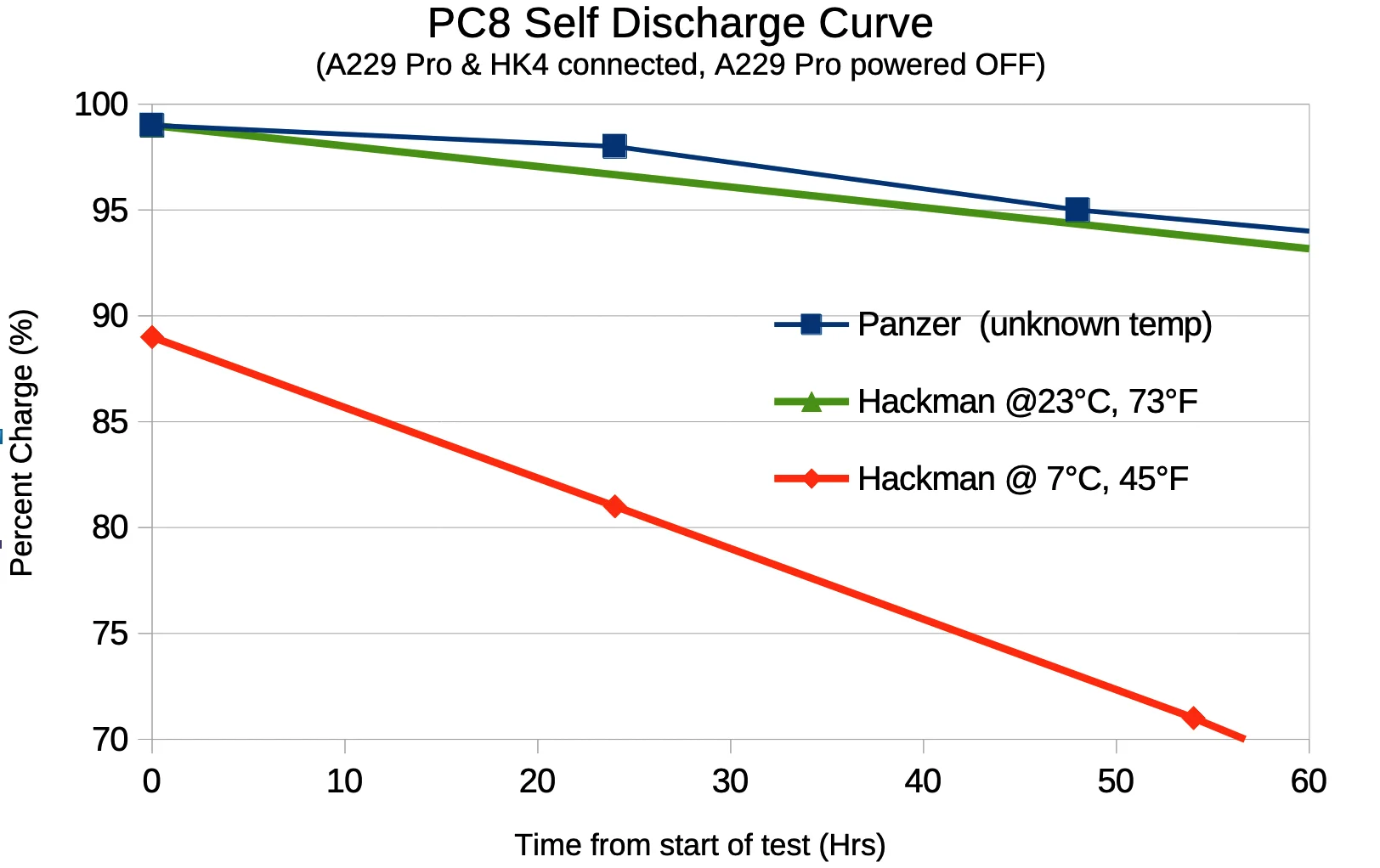
I'm updating my plots to include testing at 23°C (73°F) in addition to testing previously performed at 7° C (45° F). @Chuck McCoy's (Panzer) test temperature was unknown.
My 73° F results were very close to Panzer's leading me to conclude he tested at a similar temperature and that my PC8 possibly does not have a self discharge problem. I suspect other PC8's tested at a lower temperature would behave similarly.
Conclusion: Lower temperature appears to cause the PC8 to self discharge faster
My 73° F results were very close to Panzer's leading me to conclude he tested at a similar temperature and that my PC8 possibly does not have a self discharge problem. I suspect other PC8's tested at a lower temperature would behave similarly.
Conclusion: Lower temperature appears to cause the PC8 to self discharge faster
Attachments
Last edited: