BP-100 HK vs HK6 (No Cut-Off Version)

SC@AU

Active Member
Joined
Aug 5, 2025
Messages
188
Reaction score
127
Location
WA
Country
Australia
So whilst waiting for Viofo to finally push the Go button on their BP-100 battery, I was pondering on hardwire connection options…

I have a HK6 ‘No Cut-Off Version’ in hand and obviously the BP-100 comes with its own hardwire/power module kit….
Is there any reason to use the HK6 instead of the cable/module that’s supplied with the BP-100…?
I can’t really see any large benefit, but something may have escaped me…?

Some thoughts:
– Guess the main drawback (no pun!) of the HK6 would be the minor constant power consumption due to its BT, therefore reducing total battery capacity, however small…​

– Voltage status of the battery could be checked, if required, via Viofo App (If it’s a BP-100 installed), so no need for HK6?​

– Would lose Voltage Cut-off option setting in Hybrid Parking Mode if using BP-100 HW (?), but is this an issue when using dedicated battery…?​

– BP-100 HK module easier* to hide away behind trim..? *I’m presuming it may not be as heat sensitive..?​
– Cabling: I think, from pics that Chuck posted, that they both have the same 18AWG on the 12v side..? I’m almost certainly going to need to extend/replace this for longer overall length – not sure there’s anything different between the two modules in this aspect? Does the white BP-100 12v plug accept a larger gauge than 18AWG or same as the HK6 plug..?​

– Future proofing: Not sure which (if) is better in the event of potential future camera or battery change(s)..? I believe they both have the same plug on the 5v Output side…Though the 12v Input plug does differ between them – I guess this would be an issue in the event of a module change, say if there was a future HK7 etc that had any new functionality….Obviously a plug could be chopped and spliced etc, but I’d like to keep any future work in situ on the car to a minimum, same for re-cabling and lifting trim across the car.​

I’m thinking the main reason to choose the HK6, even if set to No Cut-Off, would be to retain the option of voltage setting as a trigger within Hybrid Parking Mode….Not sure if there’s any advantage in that over Timer when using a battery, but I guess the option would be there…perhaps useful if you are not familiar with how long the battery sustains etc…?

Appreciate any thoughts…
Perhaps one for @Chuck McCoy ?

Cheers,
 
Not sure if there’s any advantage in that over Timer when using a battery, but I guess the option would be there…perhaps useful if you are not familiar with how long the battery sustains etc…?
The advantage over a timer is that if you make short journeys, then your battery may not be 100% charged when you park, which means that every time you park, you need to check your battery SoC and set your timer appropriately. With the HK6, you just set it once to switch to low power parking mode when the battery gets low and then forget about it, then you will always have at least low power parking protection, while with the timer, you will sometimes run out of battery power and have zero protection.

I imagine that a most people do not 100% charge their battery on every drive, so the HK6 is the better option?

It would be even better, if the BP-100 reported SoC to the dashcam, instead of having to use voltage. Voltage is a bit inconsistent, especially in very cold weather.
 
That’s a good point re HK6 actually Nigel…and fairly relevant to how we mostly use the car….smaller journeys and certainly not used every day….
The upcoming Geofence option on the A329x will take care of auto switching off at home and perhaps a couple additional regular locations, but otherwise the voltage based switch over perhaps would be the better safety net setting….

Agree re better communication between battery and dashcam, would make much more sense…..I’m not sure, but perhaps it’s something that Viofo could implement in the near future all under the hood of the App – if the BP-100 is to be able to report its status within the App, then a logical use would be to use that info and communicate and control the connected dashcam – though I guess this is only viable if the App is within proximity to the devices, in light of there being no Viofo cloud…..

Thanks for the thoughts..!
 
Hello,

I just purchased a Viofo battery. I am also interested in the new HK6 with no voltage cut off as my daily commute is only 5 minutes and I would like to have the option of using Hybrid parking mode when my battery is not fully charged up on those days.
My question is i know that Viofo battery pack has a dedicated output from the battery to the dashcam and it appears to be some sort of pin that pushes in. Is the HK6 wire with no voltage have that correct input to the battery pack or is it 3 wires. If it is 3 wires how does it get installed in the battery pack. I dont have the battery pack as of yet. I just ordered it.

Thank you in advance,
 
Hello,

I just purchased a Viofo battery. I am also interested in the new HK6 with no voltage cut off as my daily commute is only 5 minutes and I would like to have the option of using Hybrid parking mode when my battery is not fully charged up on those days.
My question is i know that Viofo battery pack has a dedicated output from the battery to the dashcam and it appears to be some sort of pin that pushes in. Is the HK6 wire with no voltage have that correct input to the battery pack or is it 3 wires. If it is 3 wires how does it get installed in the battery pack. I dont have the battery pack as of yet. I just ordered it.

Thank you in advance,
 
I want to make sure I understand. If I install the hardwire that comes the battery pack wii I have all the parking mode available to me with the exception of hybrid parking mode. Or will I also have the hybrid parking lmode available if I get HK6 no volt cut off.

Another words with a regular battery pack hardwire will I have a low power impact protection as a parking mode option without the HK6. Will I have all the parking modes available.

Sorry for my confusion I just wanted to try to get the right instructions to the installer so I don’t end up paying a lot of money to have it installed for options that I don’t want or need

If the above is assumptions are accurate Can you just confirm what additional benefit will I get if I was tonuse the HK6 hardwire with the battery pack.

Thank you
 
I want to make sure I understand. If I install the hardwire that comes the battery pack wii I have all the parking mode available to me with the exception of hybrid parking mode. Or will I also have the hybrid parking lmode available if I get HK6 no volt cut off.

Another words with a regular battery pack hardwire will I have a low power impact protection as a parking mode option without the HK6. Will I have all the parking modes available.

Sorry for my confusion I just wanted to try to get the right instructions to the installer so I don’t end up paying a lot of money to have it installed for options that I don’t want or need
Using the BP100 supplied dash camera power cable will give you all of the parking modes available in the A329S. The one thing it won't do is provide the voltage level being output by the BP100 like the HK6 would provide. The HK6 uses Bluetooth to broadcast the input voltage level observed by the HK6 to the dash camera. The A329S can present that voltage level in the video status line and it can use that voltage info for the "Vehicle Battery Protection" feature for the "Cutoff Voltage" feature. No using the HK6, you will still have hybrid parking mode available to you, but you can only use the "Cutoff Timer" feature to switch from AED,Time-Lapse,Low Bitrate to LPID parking mode.
If the above is assumptions are accurate Can you just confirm what additional benefit will I get if I was tonuse the HK6 hardwire with the battery pack.
If you obtain an HK6 with a setting for no low voltage cutoff, that will allow you to take advantage of the largest amount of the stored charge in the BP100 [like the 12V power cable supplied with the BP100]. The HK6 will broadcast the voltage level provided by the BP100 to the A329S and you can then take advantage of the "Cutoff Voltage" feature in the A329S in addition to the "Cutoff Timer" feature. The installer will need to splice the hardwire cable [the cable with just 3-wires] provided with the BP100 with the wires from the HK6 so it can plug directly into the BP100 dash camera output power port.
 
Using the BP100 supplied dash camera power cable will give you all of the parking modes available in the A329S. The one thing it won't do is provide the voltage level being output by the BP100 like the HK6 would provide. The HK6 uses Bluetooth to broadcast the input voltage level observed by the HK6 to the dash camera. The A329S can present that voltage level in the video status line and it can use that voltage info for the "Vehicle Battery Protection" feature for the "Cutoff Voltage" feature. No using the HK6, you will still have hybrid parking mode available to you, but you can only use the "Cutoff Timer" feature to switch from AED,Time-Lapse,Low Bitrate to LPID parking mode.

If you obtain an HK6 with a setting for no low voltage cutoff, that will allow you to take advantage of the largest amount of the stored charge in the BP100 [like the 12V power cable supplied with the BP100]. The HK6 will broadcast the voltage level provided by the BP100 to the A329S and you can then take advantage of the "Cutoff Voltage" feature in the A329S in addition to the "Cutoff Timer" feature. The installer will need to splice the hardwire cable [the cable with just 3-wires] provided with the BP100 with the wires from the HK6 so it can plug directly into the BP100 dash camera output power port.
Thank you for the insightful explanation. I understand and appreciate the information.
You indicate with the HK6 I will have access to the voltage information. I assume that is for the battery pack voltage since the battery pack only. Do you know what is the lowest voltage that it can go down to. SInce it is battery pack what would be the benefit of using the low cut off. I believe so that the battery pack is not fully depleted, but wouldn't that only be beneficial if it allows for it to go really far below the voltage is usually is setup with to protect the main battery. Will it allow it to go all the way down to 3 volts. I am not sure that is feasible or even desired. Sorry, I don't have the tech background to really to know if my question make sense.

Lastly, my usual trip every day is about 25 minutes roundtrip from house to work. Under those circumstances would you see the benefit of using the HK6?

Thank you again. I just want to make sure that I have the installer set it up so that it is functioning the best for me. As of now, since my car needs the additinal voltage I have it set to 12.4 cut off and due to my commute, I can only get 1/2 hour of Hybrid before LPID kicking in and that only last addtionl 2 hours before I fall below the 12.4 cut off. Hence that is why I bought the battery pack.

Thank you again!!
 
Last edited:
You indicate with the HK6 I will have access to the voltage information. I assume that is for the battery pack voltage since the battery pack only.

Do you know what is the lowest voltage that it can go down to. SInce it is battery pack what would be the benefit of using the low cut off. I believe so that the battery pack is not fully depleted, but wouldn't that only be beneficial if it allows for it to go really far below the voltage is usually is setup with to protect the main battery. Will it allow it to go all the way down to 3 volts. I am not sure that is feasible or even desired. Sorry, I don't have the tech background to really to know if my question make sense.
Using the HK6 with the BP100 or having the HK6 connected to a vehicle fuse box, there's no difference in how the HK6 operates. It receives 12V power [10.1V to 15V] from what ever power source it's connected to and it converts the 12V power to 5V power to power the dash camera. The HK6 requires a 3-wire connection [constant power (red), accessory/switched power (yellow), and ground (black)]. The yellow wire (accessory/switched power) is used to determine when the HK6 should toggle the wire on the USB-C connection to the dash camera so the dash camera knows when to enter/exit parking mode. The voltage level present on the constant power (red) wire is broadcast over Bluetooth to the A329S [or other compatible VIOFO dash camera it's connected to].

The low voltage selection slide switch on the HK6 [or any other VIOFO hardwire kit], allow you to define when the hardwire kit will turn off the constant power to the dash camera. When the input accessory/switched power is turned off [meaning parking mode only], the HK6 will monitor the voltage level on the constant power wire (red). When the voltage level drops and stays below the selected voltage level, the HK6 will turn off the constant power on the 5V dash camera side so the dash camera powers down. That same operational description can be applied to the older HK4 hardwire kit, minus the broadcasting of the input voltage level via Bluetooth.

Since the low voltage cutoff setting on the HK6/HK4 only goes down to 11.8V, using a HK6/HK4 with the VIOFO BP100 battery pack works, but it leaves a non-trivial amount of the battery pack's stored charge unused when powering the dash camera in parking mode. That's why the BP100 includes a stripped down hardwire kit [12V output] cable with no low voltage cutoff slide switch. The voltage converters in the VIOFO hardwire kits can accept input voltage down to the low 10V range without a problem converting it to 5V power for the dash camera. The 12V output power cable supplied with the BP100 allows the dash camera to remain in parking mode as long as the BP100 continues to output power. When the BP100's internal charge level gets low, it will turn off the 12V output power. That will result in the dash camera powering down.

The A329S when powered by the HK4 or the BP100's 12V output cable doesn't see any difference in how it's being powered. The advantage of using the HK6 [for parking mode] is that the HK6 broadcasts the input voltage level [constant power (red)] to the dash camera so it can take advantage of the "Cutoff Voltage" feature. If you intend on using the hybrid parking mode option for the A329S, then you can use the "Cutoff Voltage" feature to be one of the things that will switch from normal [AED, Time-Lapse, Low Bitrate] parking mode to low power impact detection [LPID] parking mode. The voltage level selections for the "Cutoff Voltage" setting are fairly high values, so they're intended to be a switchover voltage from normal parking mode to LPID parking mode [when using hybrid parking mode].
Lastly, my usual trip every day is about 25 minutes roundtrip from house to work. Under those circumstances would you see the benefit of using the HK6.
That question is again answered by what parking mode(s) you want to use while parked. Only 25 minutes of driving time, will tend to not fully charge the BP100 if its charge level is fully depleted. It sounds like you might want to use a hybrid parking mode or use LPID by itself to help reduce the power draw on the BP100.

Thank you again. I just want to make sure that I have the installer set it up so that it is functioning the best for me. As of now, since my car needs the additinal voltage I have it set to 12.4 cut off and due to my commute, I can only get 1/2 hour of Hybrid before LPID kicking in and that only last addtionl 2 hours before I fall below the 12.4 cut off. Hence that is why I bought the battery pack.
When used with hybrid parking mode, the "Cutoff Voltage" setting should be set to something higher than the low voltage cutoff on the hardwire kit via the slide switch. The "Cutoff Voltage" threshold is when the dash camera should switch from normal parking mode to LPID parking mode. The voltage difference between the "Cutoff Voltage" and the hardwire kit's low voltage cutoff setting should provide some reasonable amount of time for the A329S to operate in LPID mode. When the hardwire kit's low voltage cutoff level is breached, the hardwire kit will turn off the power to the dash camera and it powers down [fully].

If you want to use hybrid parking mode and have the voltage level be one of the deciding factors when to switch from normal parking mode to LPID parking mode, you'll need to use the HK6.

1765304959863.webp
 
Using the HK6 with the BP100 or having the HK6 connected to a vehicle fuse box, there's no difference in how the HK6 operates. It receives 12V power [10.1V to 15V] from what ever power source it's connected to and it converts the 12V power to 5V power to power the dash camera. The HK6 requires a 3-wire connection [constant power (red), accessory/switched power (yellow), and ground (black)]. The yellow wire (accessory/switched power) is used to determine when the HK6 should toggle the wire on the USB-C connection to the dash camera so the dash camera knows when to enter/exit parking mode. The voltage level present on the constant power (red) wire is broadcast over Bluetooth to the A329S [or other compatible VIOFO dash camera it's connected to].

The low voltage selection slide switch on the HK6 [or any other VIOFO hardwire kit], allow you to define when the hardwire kit will turn off the constant power to the dash camera. When the input accessory/switched power is turned off [meaning parking mode only], the HK6 will monitor the voltage level on the constant power wire (red). When the voltage level drops and stays below the selected voltage level, the HK6 will turn off the constant power on the 5V dash camera side so the dash camera powers down. That same operational description can be applied to the older HK4 hardwire kit, minus the broadcasting of the input voltage level via Bluetooth.

Since the low voltage cutoff setting on the HK6/HK4 only goes down to 11.8V, using a HK6/HK4 with the VIOFO BP100 battery pack works, but it leaves a non-trivial amount of the battery pack's stored charge unused when powering the dash camera in parking mode. That's why the BP100 includes a stripped down hardwire kit [12V output] cable with no low voltage cutoff slide switch. The voltage converters in the VIOFO hardwire kits can accept input voltage down to the low 10V range without a problem converting it to 5V power for the dash camera. The 12V output power cable supplied with the BP100 allows the dash camera to remain in parking mode as long as the BP100 continues to output power. When the BP100's internal charge level gets low, it will turn off the 12V output power. That will result in the dash camera powering down.

The A329S when powered by the HK4 or the BP100's 12V output cable doesn't see any difference in how it's being powered. The advantage of using the HK6 [for parking mode] is that the HK6 broadcasts the input voltage level [constant power (red)] to the dash camera so it can take advantage of the "Cutoff Voltage" feature. If you intend on using the hybrid parking mode option for the A329S, then you can use the "Cutoff Voltage" feature to be one of the things that will switch from normal [AED, Time-Lapse, Low Bitrate] parking mode to low power impact detection [LPID] parking mode. The voltage level selections for the "Cutoff Voltage" setting are fairly high values, so they're intended to be a switchover voltage from normal parking mode to LPID parking mode [when using hybrid parking mode].

That question is again answered by what parking mode(s) you want to use while parked. Only 25 minutes of driving time, will tend to not fully charge the BP100 if its charge level is fully depleted. It sounds like you might want to use a hybrid parking mode or use LPID by itself to help reduce the power draw on the BP100.


When used with hybrid parking mode, the "Cutoff Voltage" setting should be set to something higher than the low voltage cutoff on the hardwire kit via the slide switch. The "Cutoff Voltage" threshold is when the dash camera should switch from normal parking mode to LPID parking mode. The voltage difference between the "Cutoff Voltage" and the hardwire kit's low voltage cutoff setting should provide some reasonable amount of time for the A329S to operate in LPID mode. When the hardwire kit's low voltage cutoff level is breached, the hardwire kit will turn off the power to the dash camera and it powers down [fully].

If you want to use hybrid parking mode and have the voltage level be one of the deciding factors when to switch from normal parking mode to LPID parking mode, you'll need to use the HK6.

View attachment 88607
Wow this is extremely impressive. This answers all of my questions and then some. I am sure it will be very informative to others who will ultimately getting a battery pack. I really appreciate your insight and time to write such a detailed explanation.

Thank you again!!!
 
We plan to implement the A329S to read the capacity of the BP100 in future firmware update.
Does this mean that it will not be necessary to hook up the hk6 to the battery pack if in the future firmware update with battery pack I'm allowed to use hybrid parking mode with the voltage being used to switch to LPID mode?

I guess what's confusing is that when you say it will allow you to read does it also mean it will allow the 329s to utilize the voltage reading with the hybrid parking to make a switch to LPID.
 
Does this mean that it will not be necessary to hook up the hk6 to the battery pack if in the future firmware update with battery pack I'm allowed to use hybrid parking mode with the voltage being used to switch to LPID mode?

I guess what's confusing is that when you say it will allow you to read does it also mean it will allow the 329s to utilize the voltage reading with the hybrid parking to make a switch to LPID.
It will utilize the BP100 capacity reading instead of the voltage, like if the battery pack capacity less than 5%, the camera can switch to LPID.
 
It will utilize the BP100 capacity reading instead of the voltage, like if the battery pack capacity less than 5%, the camera can switch to LPID.
Thats fantastic. It will read the percentage of battery left and allow you to then switch it to LPID?
To have this feature work all I need to do for now is to utilize this wire that comes with the battery pack to connect it to the dashcam?

1765429042970.webp


Can you give us an idea as to when this firmware update will happen?
 
Last edited:
Thats fantastic. It will read the percentage of battery left and allow you to then switch it to LPID?
To have this feature work all I need to do for now is to utilize this wire that comes with the battery pack to connect it to the dashcam?

View attachment 88652


Can you give us an idea as to when this firmware update will happen?
We will release the V2.0 firmware via OTA update with new app soon.

This new feature will be implemented in V2.1 version.
 
It will utilize the BP100 capacity reading instead of the voltage, like if the battery pack capacity less than 5%, the camera can switch to LPID.
@VIOFO-Support

1. Can you please explain how the battery pack capacity meter measures capacity? Does it use an algorithm to calculate capacity based purely on voltage level?
2. Am I correct in saying after V2.1 firmware is released, The HK6 Hardwire kit will not be needed when a BP100 and compatible dashcam are integrated? Only the hardwire Output Cable (Type-C) (4M) would be required for hybrid parking mode and to display battery voltage level on video footage, and to provide dashcam cutoff protection?

 
The new V2.1 firmware reads the battery pack capacity instead of the voltage, like you can set if the battery capacity less than 10%, then switch to impact mode only, the HK6 is not required.
 
The new V2.1 firmware reads the battery pack capacity instead of the voltage, like you can set if the battery capacity less than 10%, then switch to impact mode only, the HK6 is not required.
Thank you but my question is how does the battery pack actually determine remaining battery pack capacity?

The only electrical measurements that I know of are voltage and current, so it seems like battery pack capacity is calculated from voltage.
 
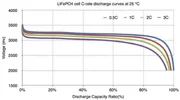
Unlike the lead-acid battery, the LFP (LiFePO4) battery's discharge curve is almost flat, so the voltage difference between roughly 90% and 20% state of charge (SoC) is very small, especially with the miniscule power consumption of the dashcam in parking mode.
Therefore, determining the state of charge (SoC) of the LFP battery based solely on voltage is practically impossible; consequently, the HK6 may switch between hybrid parking modes inconsistently and not very accurately relative to the actual state of charge (SoC).
So it's best to use the cable that comes with the battery.

A more accurate method is to count Ah, but in the case of a dashcam, this is also difficult due to the huge difference between the charging current and the discharge current, requiring complicated calibration process.
Furthermore, the self-consumption of the battery/BMS and other losses, which are comparable to the very low power consumption of the dashcam, are not helping either.

Attached is a typical LFP discharge chart, blue curve is for 0.5C discharge rate, with dachcam we are discharging at about 10 times less rate (about 0.05C) which will result in even flatter chart:

*****
On the other hand, LTO batteries have a discharge curve with a considerable slope, which makes it possible to determine the state of charge (SoC) of such a battery solely based on voltage readings.


Attachments

  • LFP discharge chart.webp
    LFP discharge chart.webp
    50.4 KB · Views: 105
Last edited:
Unlike the lead-acid battery, the LFP (LiFePO4) battery's discharge curve is almost flat, so the voltage difference between roughly 90% and 20% state of charge (SoC) is very small, especially with the miniscule power consumption of the dashcam in parking mode.
Therefore, determining the state of charge (SoC) of the LFP battery based solely on voltage is practically impossible; consequently, the HK6 may switch between hybrid parking modes inconsistently and not very accurately relative to the actual state of charge (SoC).
So it's best to use the cable that comes with the battery.

A more accurate method is to count Ah, but in the case of a dashcam, this is also difficult due to the huge difference between the charging current and the discharge current, requiring complicated calibration process.
Furthermore, the self-consumption of the battery/BMS and other losses, which are comparable to the very low power consumption of the dashcam, are not helping either.

Attached is a typical LFP discharge chart, blue curve is for 0.5C discharge rate, with dachcam we are discharging at about 10 times less rate (about 0.05C) which will result in even flatter chart:

*****
On the other hand, LTO batteries have a discharge curve with a considerable slope, which makes it possible to determine the state of charge (SoC) of such a battery solely based on voltage readings.

So do you think these LiFePO4 battery capacity meters used on dashcam battery packs use an algorithm to calculate remaining capacity based on a typical voltage profile?
That curve looks as you say nearly impossible to determine discharge state based on voltage.
 
Back
Top