Vueroid D40-Q2 rear camera potentially affecting DAB

Onetenner

Active Member
Joined
Oct 26, 2025
Messages
170
Reaction score
145
Location
Ubique
Country
United Kingdom
Dash Cam
Vueroid D40-Q2
I'm part-way through investigating the cause of loss of DAB band III reception on some multiplexes, it's not clear when this issue started, but it only affects 'some' multiplexes - these are not particularly strong signals anyway, but drop-outs have become more frequent & noticeable, for example, you can drive down a residential street and the signal will drop when you pass a house but come back as you pass the gap between houses. It's likely that all multiplexes are attenuated, but not to the point of dropping the signal as some are stronger than others - this is unfortunately due to how much the media companies are willing to pay the infrastructure operators.
The reason I'm not clear as to when it started and what, if anything, changed is it only affects the stations the Mrs. listens to..... and she's not in the car every day or even every week.
Yes, there are workarounds, such as streaming via phone etc. but the point is, it used to be OK.

Diagnosis of DAB interference / signal attenuation is notoriously difficult, so far I've:-
Carried out continuity & 'phantom power' checks of co-ax cables
Replaced DAB band III antenna amplifier
Replaced DAB band L antenna & amplifier
Replaced DAB band III antenna
Replaced DAB receiver module

None of which caused any noticeable difference, it's worth mentioning that any fault in the band L amplifier or antenna will set a DTC, whereas only the amplifier is monitored for the band III antenna (and I'm aware the UK uses little to none of the band L spectrum for DAB broadcast). So far, it hasn't cost me anything other than time as I'm fortunate enough to have a ready supply of donor vehicles at work to substitute parts from (one at a time), what has made a difference - well reverted DAB reception on the affected multiplexes back to 'normal' is disconnecting the rear camera at the main unit.

My next task is to use a RF spectrum analyser to determine if, and where from (i.e. camera or cable) the 'noise' is coming from.
The image below shows the setup, of the two flat antennas, the one on the right 'B' is the DAB band III & FM antenna, the other is AM/FM. The amplifier is mounted adjacent on a metal ground plane, I've checked the ground connection and resistance measurement from the ground plane to battery -ve terminal is 0.06 Ohms. The DAB band L antenna is in the roof 'fin' along with GPS and GSM antennas.

The two badly drawn lines represent cable routes, the green one is the camera cable, the dashed section shows where it passes through an existing wiring grommet into the interior of the car, the blue line shows the existing co-ax antenna cables, these are RG174 with braid & foil shielding. Total parallel distance of the camera & antenna cables is ~700mm including where they pass through the flexible tube between liftgate & car body.

So, has anyone else experienced this? I have previously diagnosed similar on Audi & Mercedes-Benz vehicles where the DAB antennas are printed on the rear screen (not the case in my scenario) and the rear camera completely knocked out DAB reception, mind, the camera's were 'bargain basement' and the cables even cheaper...

Assuming I can definitively identify unwanted electrical noise from the cable or camera, although the camera is probably 150mm away from the antenna and 200mm from the ground plane, I'm considering applying some copper tape to the outside of the cable and connecting to a suitable ground inside the car. Although the AM/FM co-ax cables run to the front of the car, the DAB co-ax only run a short distance (about 1.4m) inside the car to the DAB receiver module where the output is transmitted to the amplifier on the MOST (optical fibre) ring so I'm sure the signal attenuation is occurring within the liftgate area.
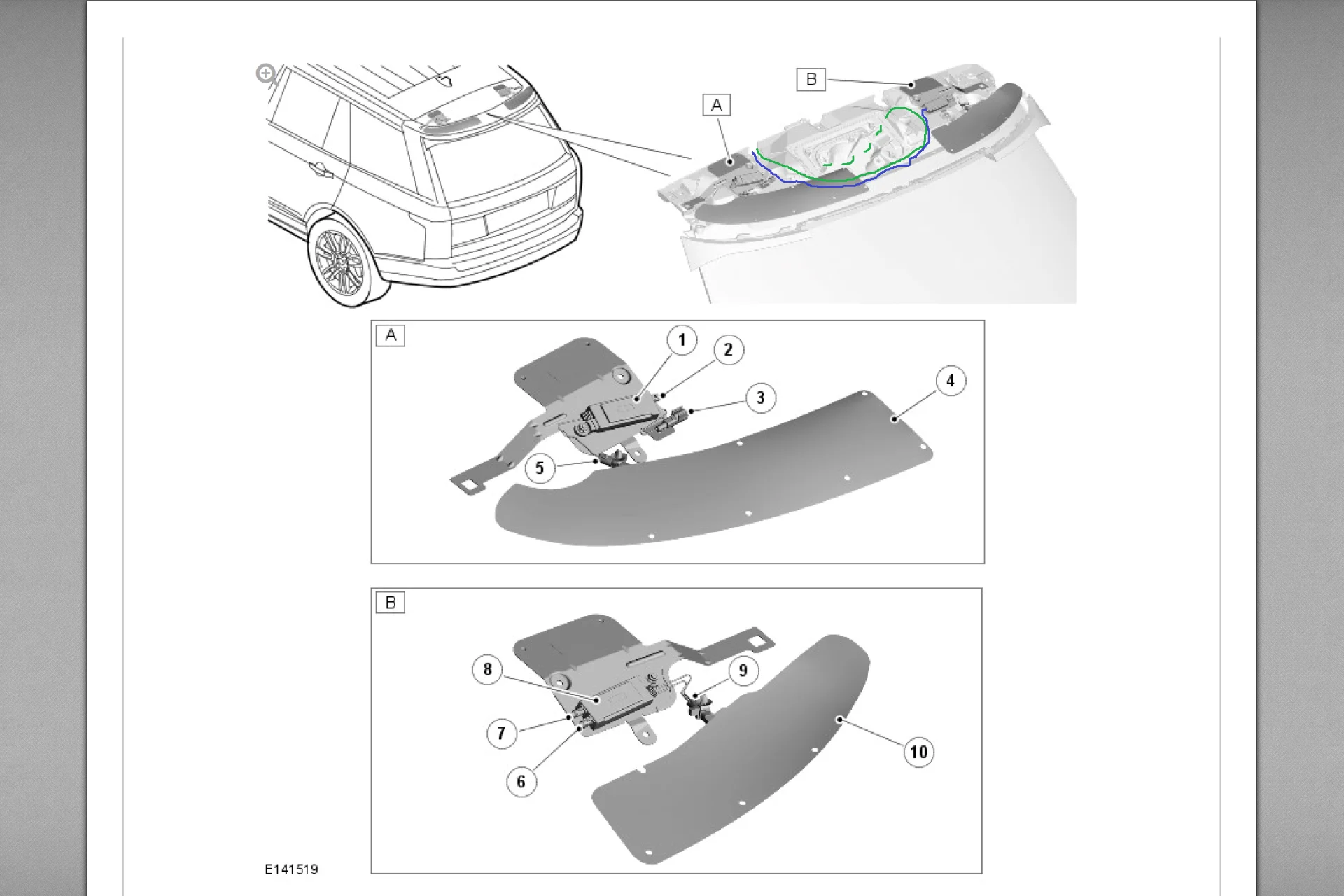
DAB & Camera cable route.webp
 
Do you have enough cable length at the rear to put in a loop or coil, perhaps several about 15cm apart?

I have put a Trifield EMF meter on a bench Vueroid S1 4K and the peak RF was 0.045. The average, resting was 0.007 mW/m(2)

I have a S1 4K on the rear glass of the Outback, powered from the front fuse panel. I will test it later today.
 
Last edited:
Do you mean ferrite cores? I can probably pull some through, there's about 300mm 'slack' without having to re-do the whole rear install.
Having thought about it some more, it is more likely to be the cable, or the proximity of it. I had the camera installed for 7-10 days with the cable looped across the liftgate closure seal.

I can only find the clip-on ferrite cores, I was taught that there should be a loop through for them to be effective - time to look a bit harder!
 
Oh no, not ferrite chokes, though you can give them a try. Sometimes, just taking the wire and putting a small loop in it will break up any 'crosstalk' or bleed-through.

The problem with the chokes, as you probably know, is that you have to know which frequency you are trying to suppress in order to get the correct core.

If you pull the cable from the rear camera, does the DAB receive better, or will it continue to drop off the cliff?
 
Last edited:
Do you mean ferrite cores? I can probably pull some through, there's about 300mm 'slack' without having to re-do the whole rear install.
Having thought about it some more, it is more likely to be the cable, or the proximity of it. I had the camera installed for 7-10 days with the cable looped across the liftgate closure seal.

I can only find the clip-on ferrite cores, I was taught that there should be a loop through for them to be effective - time to look a bit harder!

One of the important things about these clip on chokes, is the wire really needs to touch the inner surface of the choke. So if you have a 3mm wire, it should not be in a 7mm core. Now, as you say, it is good to 'take a turn' in them. So, on the 7mm core with a 3mm wire, you could take one turn thru the core. The other way is to have a 3mm core for a 3mm wire and do a single pass through the choke.


The chokes generally get placed 15 or so cm from the power or the device. Opinions vary on that.
 
Last edited:
Thanks - I've just been reading up on ferrite chokes / cores / whatever, as you say, they need careful selection! https://resources.altium.com/p/how-do-ferrite-beads-work-and-how-do-you-choose-right-one
Whilst that mainly related to PCB mounted devices, the principles are the same and (I'm assuming) there is one, maybe two DC components in the cable, specifically camera power & LED power - all in all, creating a bit of a problem. DAB band III is 174-240MHz so that would be my starting point.

I'm still minded to try additional shielding, coincidentally, copper is effective up to ~240MHz so a 20mm tape with 50% overlap is relatively easy to try, I'm not sure if that would aid or negate any benefits of adding loops.
I could re-route some of the camera cable, reducing the parallel route by ~350mm, although this would entail making an entry point into the liftgate rather than using the existing - the other benefit would be to increase the distance from the band III antenna by ~200mm.

I've yet to try disconnecting the camera with the cable connected to the main unit - one for tomorrow!
 
Often, you will see the chokes/cores referred to as a 'mix'. That 'mix' number is related to the materials used in the choke. Different mixes are for different frequencies and efficacy.

You can try a copper or aluminum wrap, which may help. The main issue with any DAB is that the signal is more or less direct and will fall off the cliff once you go into a valley or behind a building.

We saw this in 5g / mmWave spectrum where even passing a signal through a tree leaf would degrade the signal. No kidding. That is why those upper cell bands are primarily best for a sports arena, conference room, along interstates and motorways. They function best on line-of-sight transmission without physical interference.


I did go out and test the RF at the rear of the car. It was about the same there as in the house. Only difference was the front camera that is mounted beneath the rear view mirror would ramp up and down, for some reason. I rolled the front and the back and the same happened at the front. The rear cam held steady on RF. About 0.003 and max of 0.022.
 
Yep, I've got a RF SA at work I can borrow over the Easter weekend, I've used it before for diagnosing DAB & GSM 3/4/5G issues with antenna and third party device 'noise'.
I had a Thinkware Q850 installed using the exact same routing with no ill effects - I appreciate it's a different device with probably a different cable configuration, that had no impact upon DAB reception, the two other setups I've tried used a different cable route but the camera was always in, or close to, the current mounting position I'm using now.
Thanks for the composition info!

From what I remember, Aluminium doesn't shield fully in DAB band III frequency range, Copper does - just!
 
Yes, I believe the copper would be a better shield than aluminium, but either would work. I would fasten a 'drain' wire to the copper wrap and run the other end to a good ground point on the car; that drain lead is an important part of the process for mitigating EMF and RF. You will want to ground only one end of the wrap, not both. Grounding both ends can create a ground loop of sorts, which is best avoided.

The greatest issue with a copper or aluminium wrap is that they tend to be more fragile than a braided shield. On the other hand, the copper/aluminium will give you a 100 percent coverage, whereas braided might give you as low as 70 percent coverage. Foil shielding is better for higher frequencies, where the braided shield is better for lower frequencies. Always a trade-off somewhere it seems.
 
I was planning on soldering a drain wire to the copper at the car end - i.e. not the liftgate end, and attaching that to one of the many ground points available.
I'm very familiar with ground loops and the problems they can cause, thanks for the reminder though 👍
 
I managed to find time today to have a poke around with a RF SA,
With a wideband antenna connected, I firstly established a baseline by scanning away from the vehicle, you can see the DAB multiplex 'spikes'.

20260401_121441023_iOS.webp


Then did the same scan for >10s with the ignition on and DAB active but with the antenna pushed up between the spoiler & antenna / camera cables

20260401_121039987_iOS.webp


The following images show a spike at ~250MHz, this only occurs every few seconds and is stronger than the received DAB frequencies. This only occurred with the rear camera connected to the main unit. Disconnecting the camera cable with everything still energised caused the ~250MHz spikes to disappear, monitoring was for 5 minutes with the camera connected and 5 minutes with it disconnected.

20260401_121233509_iOS.webp
20260401_121341542_iOS.webp
20260401_121347844_iOS.webp


There also appears to be an increase in background noise from 200MHz upwards, not always though.

I think my next course of action is to cover the camera cable in Copper foil tape, with a drain wire connected to the car body and re-test.

What I think is happening, is there is some 'leakage' from the camera cable, which is being picked up by the antenna, as it's essentially just 'noise', it's causing the correctly formatted signal to 'drop frames', which then have to be re-synched once the noise is below the level of the DAB signal. The spikes are only of a brief duration, probably 200-300mS. Unfortunately we don't have measurement equipment, only indicative so I can't be more precise than that.

I don't think that disconnecting the camera from the cable will achieve anything as the end of the cable will be unterminated and probably just increase the amount of noise. I'm confident that the cable is the 'polluter' and not the camera as the camera (and it's predecessors) have been mounted in the same or very similar position with the cable looped between the aperture seal and the liftgate, it was only once the cable was fed through the containment and across the top of the liftgate (and the Mrs. wanted 'her' radio station on!) that the issue was noticable.
 
Well, that is very interesting. I do agree, you would need to fashion a terminator plug for the cable end, 50 ohm I suppose, for the cable end. But, I don't see any strong need to do that either. I wonder if the cable is shielded or not?

I reckon you could try a few folds of the copper at the power jack-dashcam connection. If there is leakage at that junction, taping it over may reduce the levels. In the past, I have found that often I had more leakage at those connection points than anywhere else. That long cable is an antenna, and if it is run parallel with the automobile antenna wiring to the radio, you may be able to mitigate some of that RF by making a loop or two in the dashcam cable. This should break up some inductance, if there is any.
 
Thanks - the plug is a four pole version, so in the absence of any pin-out diagram, I'm assuming there is:-
Ground
Video
Power, probably 5V
LED power, again probably 5V

Another guess is that the video is shielded and the two other cores laid outside the shielding - possibly a foil outer screen over the whole lot, but that may lead to ground loop issues... I can't see two power cores next to the video output being a good idea.

Given the awkwardness of access, I think I'll foil tape the length of cable from where it leaves the car body (and is in close proximity to the DAB/FM antenna co-ax cables) to within 100mm of the camera, plus add a couple of loops in that section, reassemble then re-test. Hopefully I'll find time over the Easter weekend.

Thanks for your thoughts and insight on the subject!
 
I managed to find time to whip the liftgate spoiler off and add copper tape, re-route and add loops to the rear camera cable

Unfortunately I got stuck in before remembering to take a photo, you can see the approximate route of the camera cable here

20260404_141324350_iOS.webp


Once I'd got it out of the grommet, pulled through into the car but leaving the plug sticking out of the flexible containment tube, I applied the copper tape. my original plan was to apply it lineralrly then 'just fold it over' the cable. Nope, very sticky and very fragile, so after cleaning off all the little bits of sticky copper, I spiral wound the tape onto the cable - not easy, but better than my first approach (there's probably some old bloke at NASA that used to wrap bits of Apollo spacecraft that could do it in his sleep better than I did in half the time!).

20260404_143854386_iOS.webp


I then pulled it back through the flexible containment, made another entry point (sealed with Butyl rubber tape) put a couple of loops in as advised by m'learned friend, soldered a drain wire to the copper tape and connected it to a ground stud, re-assembled everything....

20260404_145332721_iOS.webp


Then went for a drive - Success!

This of course got me thinking, where is the signal coming from?
It'd be unusual for a dashcam to be pumping out RF noise, I do remember reading about some memory cards giving out bursts of noise when being written to, if that's the case, then possibly it was/is using the cable as an antenna as the camera cables cross pretty close to the MicroSD card slot - I'd already removed the MicroSD extender to eliminate it as a cause, with no change.

I've also just noticed whilst typing, a couple of cracks in the copper tape to the right of the last photo above - I don't think they'll be a problem as the cable won't be moving and it's on the opposite side to the DAB antenna now - and as I said, DAB is now stable on 'her' stations.

Time for tea and medals all round!
 
Good work! You beat the issue into submission. 🙂 That copper wrap is good stuff and did the job for you. It is good that the missus will now have her station and have it static-free.
 
The strange thing is, I've fitted dashcams to the same model of car, using the same cable route, maybe four or five times - and no-one (including the two family members) have mentioned any DAB or FM issues.
I suppose the variables are the dashcam brand & model and the cable assembly...

I'm happy it's resolved, but inquisitive me will be wondering 'why' for some time yet! 😄
 
Back
Top