LTO (Lithium Titanate Oxide) – The Ultimate Battery for Dash-Cam parking mode (DIY)

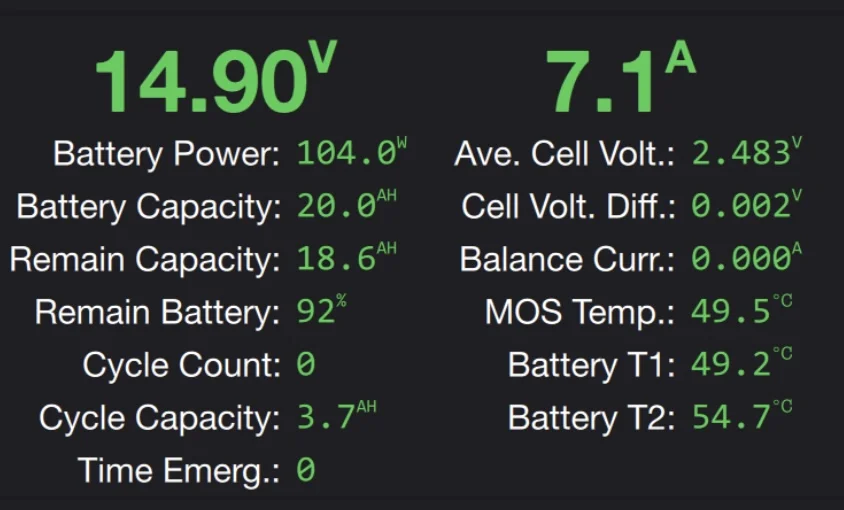
Still running strong at the end of a hot (50-54c in the trunk), sunny day! . Even my radar detector thermal protection function turned itself off shortly after I started the car…

IMG_4766.jpeg
 
For what it worth, I tested the Charger at 16A charging rate.
I completely discharged my 230Wh, 5S LTO Battery and then charged it from zero to full at 16A.
The average charge rate was about 195W.
The orange light stayed on from start to about 12.1V (2.42V per cell), then turned off.
The charger was 92% efficient from start to finish, regardless of the orange light state.
The temperature peaked at 105°C, the hottest part being the inductor, the grey box on the charger.
Unless I am missing something, I can confirm that the Fan doesn’t work, I even unplugged the fan and checked two pins with voltmeter to rule out bad Fan.
Conclusion:
The 16A/200W charging rate requires active cooling/fan, and possibly an additional heatsink, and even some baffling to direct hot air away from the battery cells.
I think that the more suitable maximum charging rate for this charger would be around 12A max/150-170W max, for 5S-6S LTO accordingly.
 
Last edited:
150 watts is still badass.
 
Thanks for the charging heat data! 105c is pretty hot! Bummer that the fan control doesn't seem to work (a previous suspicion). Given the configuration of this charger, it is supremely easy to attach a heat sink to the already drilled and flat aluminum cooling plate. I didn't think to check mine, but I'm presuming that the aluminum backer plate is electrically isolated from both the +V and the Ground power supply lines. If this is indeed the case (I suspect it is), all that is required is to cut a hole in the box that is the same size as the charger board, mount the charger directly to a larger heat sink with some thermal paste and a few screws, and affix the sink to the outside of the box with a new set of screws. This will allow for passive cooling on the outside of the box using a sink that is much larger than the size of the charger board. This should dramatically lower the thermal rise of the charger board.

For a forced-air cooling approach, I'd look for a small aluminum finned "heat tunnel" (hollow, aluminum, rectangular tube) so the charger could be mounted to the "side" of the tunnel and a fan can be mounted to one of the open ends of the tunnel forcing airflow through the tunnel and out of the box. The fan should be a 12v fan than runs from ACC power in the car, so it only runs while charging. Setting up the fan to "push" air through the tunnel (as opposed to pulling) should help mitigate impacts of overheating the fan while it runs.
 
I completely discharged my 230Wh, 5S LTO Battery and then charged it from zero to full at 16A.

Did you happen to capture the charge time at 16A? Curious to know how fast you went from flat to full…
 
JK just released a new app version for their BMS. Didn’t restore the auto smart sleep function 🙄
IMG_4769.webp
 
Did you happen to capture the charge time at 16A? Curious to know how fast you went from flat to full…
It took about 1 hour and 28 minutes.
However, since the charge voltage is set at 13.5V (2.7V per cell), which is the exact limit of the BMS charging cut off, the charger started to reduce the current from 16A to about 1A at the end, when the battery finally reached the cell limit of 2.7V and the BMS stopped the charging.
This current reduction time was for abut the last 20 minutes, and it actually took quite a long time for the last few fractions of the voltage at about 1A to reach the 13.5V limit.

So if we ignore those last fractions of the voltage at very low current, I would say the battery was fully charged in about 1 hour and 15 minutes.

BTW, the 14AWG wires I used for the test got to about 55°C at the terminal connections.
 
That’s pretty good time for a recharge! As you noted, I’m not sure that 16A of current is super compatible with 14g wiring. Not a surprise that the end terminals are where you saw the elevated temps - that’s where the impedance change happens for a crimped connector. I use a cheap crimper that I picked up years ago. Using a high quality ratcheting crimper likely gets a tighter and more mechanically sound crimp connection that may decrease temp build up at the crimp location.

When wire temps rise above body temp, I increase wire gauge. As someone that I have a great deal of respect for in the DIY community says, “I wear both a belt AND suspenders.”
 
I recently ordered and received three HK4s without the low voltage cut-off.
For this specific HK4 hardwire kit, the 12.4V setting, is changed to disable the low voltage cut-off.

I tested one of these HK4, with variable voltage power supply powering A229 Plus (2ch) in low-bit-rate parking mode.
I gradually lowered the voltage in 0.1V steps, waiting about 30 seconds at each voltage step for the dash cam to turn-off.
The dash cam eventually turned-off at about 5.1V ±0.1V, great!
(Note, that the 5.1±0.1V is the working limit for the HK4’s buck converter and not a clean cut-off setting)

This setting allows to use the full range of voltage available from the dedicated batteries, or DIY batteries, or power stations with unregulated 12VDC output, for the longest possible parking time.
So now, I can use my (DIY) 5S LTO battery down to 8.5V cut-off voltage as set by battery's BMS, and I can use my (DIY) 4S LFP battery down to 10.4V cut-off voltage as set by battery's BMS.

Special thanks to @VIOFO-Support for assisting with the purchase.
The process was smooth and strait forward.
Once again, @viofo customer service has proven itself to be one of the best in the industry.
There are some great dash cams on the market, but a great dash cam with great customer support is rare.
 
Man, you're gonna have to have a big sale when you are finished with all of these parts your are ordering and playing with 😉.

Your experiments with the HK4 shut-off voltage mirror my experience with bundling the red+yellow wires together on the HK3-C. It worked down to about 5.5v or so before turning off. I was contemplating getting one of the HK4s without the voltage cutoff myself, but discovered through testing that the BMS shut down about 10hrs after the regulator turned off the camera. This was after 75hrs of continuous use (1 channel), so I figured those 10 extra hours of BMS-only operation (at about 1.4w power draw) would have translated to about 1.5hrs of dashcam operation (at about 5-6w power draw). 75hrs vs 76h or 77h didn't really make a difference to me, so I didn't see the value of continued fiddling around and swapping out voltage regulators.

Glad to hear about your positive experience with @VIOFO-Support 👍
 
Looks like the supply of the Toshiba "prismatic" LTO batteries at Battery Hookup has dried up, but they have a new batch of cylindrical LTO cells with a bit more capacity (25Ah instead of 20Ah) for essentially the same price.

https://batteryhookup.com/products/2-3v-25ah-lto

LTO cells.jpg
 
Last edited:
I was just doing some calculations to fine tune the charge rate for my son's battery pack and I came across a fun little realization.

The 6S LTO battery pack uses 46Wh batteries for a total capacity of 276Wh.
A single camera in park mode draws about 3.5w/h and lasted for about 75h on a full battery = 262w used
After 75h, the viofo regulator turned the camera off, but the BMS drew 1.4w for another 10h = another 14w used

Total Capacity of 276Wh = 262w drawn by camera + another 14w drawn by BMS alone.

I suspect there was probably a little bit left in the battery when the BMS turned itself off. Anyhow, I was struck that the numbers "worked out" almost perfectly even. How often does a product (battery) deliver almost exactly to spec??? 😎
 
Just made a not-so-fun and dangerous discovery: I melted 😳😳 the EcoFlow car charging cable that has a 12v utility plug on one end and an XT60 plug on the other end!!

The cigarette adapter that plugs into the 12v utility port is not capable of handling anything more than 8A of charge current. I was using this to charge the LTO battery pack in my son's car and I discovered that it wasn't providing the level of charge that I was expecting each day (his battery was losing voltage instead of gaining voltage). As I unplugged things to check it all out, I discovered that the plastic end, just below the metal tip that hits the +12v contact at the bottom of the utility plug, had melted and it was no longer making consistent contact.

I am rather surprised and disappointed. The EcoFlow wire is 14g, so it can handle plenty of current. The fuse in the tip of the plug is rated at 15A, so it can also handle plenty of current, too. But the metal +12V spring loaded contact heats up the plastic tip to the point where it melted and deformed with a 9A current flow! The EcoFlow can be set to charge at rates of 4A, 6A, or 8A. So, at an 8A charge rate, it's fine, but at 9A charge rate, it melts?!?!?!

So, the bottom line is that the EcoFlow utility plug is protected by a 15A fuse, but melts with a 9A current flow👎 It serves their needs (seems to work with an 8A charge rate), but the plastic melts and deforms BEFORE the fuse blows... That's some bad engineering!
 
Last edited:
🙁 Good you cought that it it's current condition (no pun intended). Could have caused a lot more damage...
 
Just made a not-so-fun and dangerous discovery: I melted 😳😳 the EcoFlow car charging cable that has a 12v utility plug on one end and an XT60 plug on the other end!!

The cigarette adapter that plugs into the 12v utility port is not capable of handling anything more than 8A of charge current. I was using this to charge the LTO battery pack in my son's car and I discovered that it wasn't providing the level of charge that I was expecting each day (his battery was losing voltage instead of gaining voltage). As I unplugged things to check it all out, I discovered that the plastic end, just below the metal tip that hits the +12v contact at the bottom of the utility plug, had melted and it was no longer making consistent contact.

I am rather surprised and disappointed. The EcoFlow wire is 14g, so it can handle plenty of current. The fuse in the tip of the plug is rated at 15A, so it can also handle plenty of current, too. But the metal +12V spring loaded contact heats up the plastic tip to the point where it melted and deformed with a 9A current flow! The EcoFlow can be set to charge at rates of 4A, 6A, or 8A. So, at an 8A charge rate, it's fine, but at 9A charge rate, it melts?!?!?!

So, the bottom line is that the EcoFlow utility plug is protected by a 15A fuse, but melts with a 9A current flow👎 It serves their needs (seems to work with an 8A charge rate), but the plastic melts and deforms BEFORE the fuse blows... That's some bad engineering!
I think it is not the current itself that melted the plastic but a poor contact resulting in excessive heat.
That cigar lighter connector is really old and bad design.
Plug’s tip is spring loaded and due to vibrations it pushes the plug out of the socket, which in its turn, is a smooth cylinder without any real locking features.
Finding the good socket-plug combination is almost impossible, because socket is part of the car and because of dimensional tolerance of 70 year old design.

Here is what I do to improve the condition:
Start with quality plug with copper tip and copper spring. (replace the spring if not copper)
Slightly shorten the spring between the tip and the fuse (by cutting or deforming) so it doesn’t push out the plug as hard.
Abrade inside of the socket cylinder with rough sandpaper to create some friction.
I actually deformed one of my sockets out of cylindrical shape a bit, and even melted some solder inside the socket-the only solution that really helped.

On current:
Keep in mind that if charging current into the Battery is 8A, then current out of car would be higher due to charging efficiency and other losses, including bypass power to dashcam in my case.
So if charging efficiency is about 90% the current out of the car is about 8.9A (assuming the charging voltage and out of car voltage is roughly the same for LFP).
My Jeep cigar socket is rated to 13A, but I limited the current out of the car to 10A max and adjust my charging current accordingly. This is because of heat generated by the cigar connector and also, wires behind the connector look like 18AWG to me.
Most car cigar sockets are limited to 8A-10A, this is why dedicated batteries limit the current to about 5A, using the cigar socket.
 
I was wondering about an intermittent connection with the tip of the plug... I know it holds VERY tightly in my car, though it is not as tight in my son's car. Perhaps it did wiggle out a little, I'll never know. I was going to replace the plug in with a solder connection directly to the wires before the utility outlet. I already cut the wire to install the relay for the outlet so I'll just resolder this joint to add the voltage take-off point. I'm not sure what gauge the wire is that provides power to the utility outlet, but I wasn't impressed with its thickness. It's likely 16g at best, likely closer to 18g as you note. The manual for his car says no more than 180w. Amperage draw for the battery pack will be a bit higher than the number of "charging amps" as reported by the BMS because the voltages are different. It's presently set to about 8.8A charge current which is just shy of 10A out of the utility outlet.
 
These look like LISHEN or YINGLONG battery, and are really big (60 mm in diameter)
Yeah, that's a pretty large diameter. Six of them side by side is over 14 inches.
 
I was wondering about an intermittent connection with the tip of the plug... I know it holds VERY tightly in my car, though it is not as tight in my son's car. Perhaps it did wiggle out a little, I'll never know. I was going to replace the plug in with a solder connection directly to the wires before the utility outlet. I already cut the wire to install the relay for the outlet so I'll just resolder this joint to add the voltage take-off point. I'm not sure what gauge the wire is that provides power to the utility outlet, but I wasn't impressed with its thickness. It's likely 16g at best, likely closer to 18g as you note. The manual for his car says no more than 180w. Amperage draw for the battery pack will be a bit higher than the number of "charging amps" as reported by the BMS because the voltages are different. It's presently set to about 8.8A charge current which is just shy of 10A out of the utility outlet.
The 8.8A charging current for the 6S LTO is about 140W charge rate for a nearly fully charged battery at 16V.
Assuming an overall charging efficiency at about 85% (charger/relay/BMS/wires/DVR - as applicable), then the power out of car would be 165W, which is about 12.9A at about 12.8V out of car.
The 12.9A out of cigar lighter is too high, may be I am missing something.

For the 5S LTO, I use 8A charging current or about 106W charge rate for the nearly fully charged battery at 13.3V.
With the same estimated charging efficiency at about 85% the power out of car is 125W, which is 9.8A at about 12.8V out of car.

It's easy to check the car's output current/voltage with a clamp multi-meter and adjust the charging current as needed.
 
I have compared the "battery charge rate" as reported by the BMS with the "actual current draw" from the car's outlet. Actual amps drawn from the car are higher than amps reported by the BMS (as expected) because the voltage levels differ. But yes, BMS current of 8.8A represents ~140w of power draw. That's probably a bit much given the construction of the utility outlet. I had set the charge rate higher (about 8.8A), anticipating he would leave the battery powered up 24/7, yet only use the car 4 days per week. If he shuts the battery down at the end of each day when he gets home, I can back the charge rate down to about 5.5A and still keep the battery mostly full. I'm still going to hard wire the charge cord and skip the utility outlet. I'm not excited about 140w being drawn through 18g wiring for the utility outlet. It's within spec, but pushing pretty close to the 180w limit.

Edit to Add:
I think I'll look for some youtube videos to see how I can get a wire through the firewall. This way, I can get a direct 12g wire from the battery and use my ACC relay to switch that on and off. This way, it won't matter if I use a lower or higher charge rate.
 
Last edited:
Back
Top