
OP
OP

EricSan
Well-Known Member
- Joined
- Dec 28, 2023
- Messages
- 1,414
- Reaction score
- 1,066
- Location
- Central PA
- Country
- United States
- Dash Cam
- There are ALWAYS user serviceable parts inside!
File this one under "Because I Can." I decided to do some stress testing on the VP03(II) and VP05(II) hardwire kits to see how they perform. I have several decades worth of power supply design experience (mostly in the context of high-powered, Class-A audio amplifiers) so I thought this would be an interesting and revealing exercise. Power supplies need to be able to deliver both voltage and current, according to their specification. Poorly designed power supplies will exhibit a decreasing level of voltage as current demands are ramped up, whereas robustly designed power supplies will be able to maintain their rated voltage output as current demands are increased. Given my previous experience with Vantrue products, I had good expectations headed into this measurement exercise.
Spoiler: I was not disappointed.
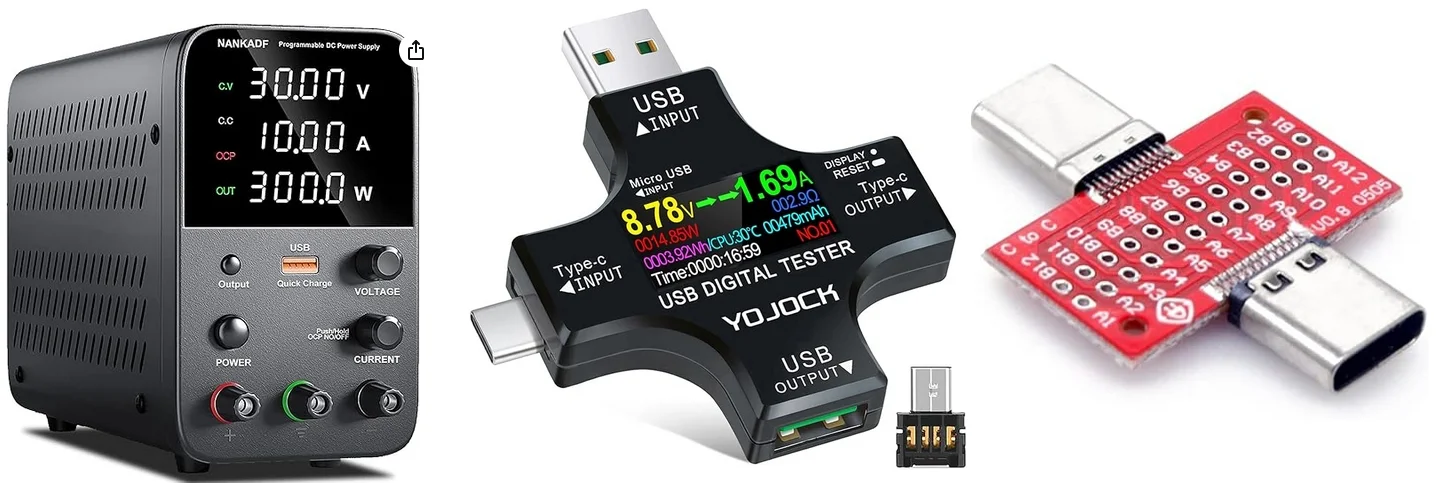
To perform this test, I connected the Vantrue hardwire kits a bench top 30v 10A switched mode variable power supply. I connected each of the Vantrue hardwire kits to the power supply (one at a time), connected a USB-C power meter, and a USB-C breakout board with wire leads soldered to the board's power supply pins. At the end of the chain was a series of Mills MRA-12 wire wound 12w power resistors left over from tube amp building and speaker crossover work I've done. I soldered them together in various parallel and series configurations to present suitable loads for the hardwire kits.
Here are the results:
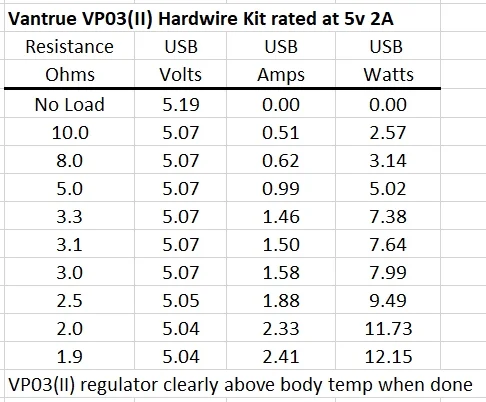
The VP03(II) kit delivers its highest voltage level with no load attached (no surprise there). Once a load is connected to the output, the voltage dropped to 5.07v and stayed there until the current draw hit about 1.6A. Above this level, the voltage dropped and held steady at 5.04v. This is excellent performance under load, with the regulator maintaining voltage above 5.0v at the end of the 2-meter long USB-C wire end! This is especially true given that the VP03(II) is only rated to 2.0A output current and I pushed it to 2.4A of output current. I didn't want to go much higher as I was already exceeding its design specification. At the end of a few minutes worth of testing, the plastic shell of the regulator was clearly (but not alarmingly) above body temperature when I picked it up.

Similarly, the VP05(II) kit delivers its highest voltage level with no load attached. Once a load is connected to the output, the voltage dropped to 5.00v and declined only slightly (by 0.02v) as I increased the current draw up to 2.44A. This, again, is excellent performance under load, with the regulator maintaining output voltage of 4.98v at the end of the 2-meter long USB-C wire end! I didn't want to go much higher with a the resistor load as my resistor sets were already getting rather warm. At the end of my set of measurements, the plastic shell of the regulator showed no discernible temperature rise.
Both the VP03(II) and VP05(II) power supplies performed very well during this test! The more robust design (2.5A current delivery capability) of the voltage display VP05(II) hardwire kit over that of the VP03(II) (2.0A current delivery capability) was readily apparent: the voltage output barely decreased as I increased the current draw and it exhibited no noticeable temperature rise throughout my increasing current stress tests. These results stand in pretty sharp contrast to an EcoFlow River 2 Power Station that I tested last year that barely provides 4.99v on its USB-A port with no load and after a 6-8 foot run for a USB power cord, voltage dropped to somewhere near 4.80v at the camera. This resulted in intermittent power issues because the camera was being starved for voltage. Rebooting and power cycling ensued...
Spoiler: I was not disappointed.
To perform this test, I connected the Vantrue hardwire kits a bench top 30v 10A switched mode variable power supply. I connected each of the Vantrue hardwire kits to the power supply (one at a time), connected a USB-C power meter, and a USB-C breakout board with wire leads soldered to the board's power supply pins. At the end of the chain was a series of Mills MRA-12 wire wound 12w power resistors left over from tube amp building and speaker crossover work I've done. I soldered them together in various parallel and series configurations to present suitable loads for the hardwire kits.
Here are the results:
The VP03(II) kit delivers its highest voltage level with no load attached (no surprise there). Once a load is connected to the output, the voltage dropped to 5.07v and stayed there until the current draw hit about 1.6A. Above this level, the voltage dropped and held steady at 5.04v. This is excellent performance under load, with the regulator maintaining voltage above 5.0v at the end of the 2-meter long USB-C wire end! This is especially true given that the VP03(II) is only rated to 2.0A output current and I pushed it to 2.4A of output current. I didn't want to go much higher as I was already exceeding its design specification. At the end of a few minutes worth of testing, the plastic shell of the regulator was clearly (but not alarmingly) above body temperature when I picked it up.
Similarly, the VP05(II) kit delivers its highest voltage level with no load attached. Once a load is connected to the output, the voltage dropped to 5.00v and declined only slightly (by 0.02v) as I increased the current draw up to 2.44A. This, again, is excellent performance under load, with the regulator maintaining output voltage of 4.98v at the end of the 2-meter long USB-C wire end! I didn't want to go much higher with a the resistor load as my resistor sets were already getting rather warm. At the end of my set of measurements, the plastic shell of the regulator showed no discernible temperature rise.
Both the VP03(II) and VP05(II) power supplies performed very well during this test! The more robust design (2.5A current delivery capability) of the voltage display VP05(II) hardwire kit over that of the VP03(II) (2.0A current delivery capability) was readily apparent: the voltage output barely decreased as I increased the current draw and it exhibited no noticeable temperature rise throughout my increasing current stress tests. These results stand in pretty sharp contrast to an EcoFlow River 2 Power Station that I tested last year that barely provides 4.99v on its USB-A port with no load and after a 6-8 foot run for a USB power cord, voltage dropped to somewhere near 4.80v at the camera. This resulted in intermittent power issues because the camera was being starved for voltage. Rebooting and power cycling ensued...
Last edited:

