70mai Dash Cam Battery Pack - Test & Review PP

Question:
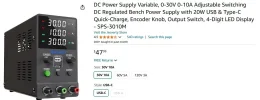
If I buy this one:

https://www.amazon.com/gp/B0CZ92WTQ3

what settings do I need to make on this DC power supply to safely charge a 70mai battery pack that is set to the hardwire fuse option?
 

Attachments

  • Screenshot_3.webp
    Screenshot_3.webp
    65.4 KB · Views: 121
If I buy this one:
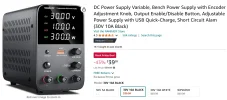
I recommend this one, (same as me, rcg530, vortex radar, safedrivesolutions);
https://www.amazon.com/gp/B09BFCF13Y
Only $40 on Black friday.
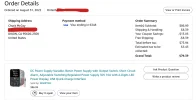
I paid $74 for mine August 2022.
Dang, maybe I should buy another one for spare.
what settings do I need to make on this DC power supply to safely charge a 70mai battery pack that is set to the hardwire fuse option?
14.2 Volts
10.2 Amps (max)
The battery pack’s BMS will take care of everything else.


Attachments

  • $74 .webp
    $74 .webp
    91.8 KB · Views: 120
  • $40 .webp
    $40 .webp
    125.8 KB · Views: 109
14.2 Volts
10.2 Amps (max)
The battery pack’s BMS will take care of everything else.
A fully charged LiFePO4 battery would have about 14.4 volts across its cells. Maybe the battery pack doesn't fully charge the cells for safety or lifetime reasons, but a charging voltage of 14.2 volts seems a little low.

The specifications say:
Charging Input
DC IN: 11.2V - 30V, up to 11A

So a charging voltage of 20V may be better; is there a good reason you have specified 14.2V?


Maybe this powerbank can charge its cells to a higher voltage than the charging input, or maybe it only gets partly charged if you only provide 11.2V.

Has anyone tested if the charging input voltage has any effect on the capacity of and charge time for the powerbank?
 
  • Like
Reactions: bhb
A fully charged LiFePO4 battery would have about 14.4 volts across its cells. Maybe the battery pack doesn't fully charge the cells for safety or lifetime reasons, but a charging voltage of 14.2 volts seems a little low.
I 'd be willing to bet donuts to dollars the BMS compensates for this.
Maybe @GPak knows the answer.
So a charging voltage of 20V may be better; is there a good reason you have specified 14.2V?
I remember reading the pack is 12V & 24V compliant for commercial vehicle applications.
That would explain the 30V limit.
Iu used to test at 14.4V but rcg530 convinced me to use 14.2V.
I can't remember why.
Has anyone tested if the charging input voltage has any effect on the capacity of and charge time for the powerbank?
No.
I have failed as a tester.
 
  • Like
Reactions: bhb
I used to test at 14.4V but rcg530 convinced me to use 14.2V.
I would suggest testing at 13.8V, since that is what most car alternators put out once they have run for 4 minutes, although I was watching my alternator the other day and it was only at 13.1V on the OBD data, turned out to be due to having the ventilation/demister fan on, went up to 13.6V when I turned it off! You should really test with simulated real life voltages, and maybe also test the specified range, starting at 11.2V, which seems very low to me.

No.
I have failed as a tester.
But you are listening, everyone has to learn, so that is not a failure.
 
  • Like
Reactions: bhb
The vehicle's electrical system charging voltage level will vary based on the charge level/state of the battery, battery type [lead acid, AGM] and the actual load on the electrical system [vehicle modules, accessories, headlamps, brake lights, etc]. Through the driver information center display in my 2014 Chevy Caprice, I've observed a "system voltage" level with the engine running between 12.5V and 14.8V depending on factors mentioned previously. The most commonly observed voltage level is between 13.8V and 14.6V which is why I selected the middle of that range at 14.2V for my charging tests of dash camera battery packs since that voltage level is what they will have available [on average] during their charging cycle in the car.

EGEN produced dash camera battery packs [as well as others] have BMS logic to not initiate charging of the battery pack until there is a minimum voltage level in the 12.1 to 12.6 range. I haven't run tests to exactly pinpoint the voltage level for each EGEN produced battery pack. Last weekend, I observed the BlackVue B-130X battery pack not charging [red and green LEDs blinking] when the system voltage level was 12.0V [ignition on, but vehicle was not "running" - 2006 Toyota Highlander Hybrid].

The two DC power inverters that @BlackboxMyCar sells for home charging of the PowerCell 8 battery pack, both have an output voltage level of 14.6V [one with a max of 5 amps and the other with a max of 8 amps]. The unit with a max of 5 amps was not well suited for charging battery packs using the battery pack's "low amp" charging mode [cigarette lighter adapter most commonly] because the actual amp draw by the battery pack well exceeded the 5A stated max by almost an amp [depending on the battery pack]. Exceeding the 5A max rating of the charger/inverter caused it to overheat and reboot. After feedback from myself and @Panzer Platform, BlackboxMyCar went searching for different charger/inverter. They sourced a unit which is capable of up to 8 amps with a charging voltage of 14.6V. The 8 amp unit works well charging any of the dash camera battery packs I've tested it with when the battery pack is configured for its low amp charging mode.

I've had zero problems charging the various dash camera battery packs I've tested using my DC power supply configured for 14.2V with a max amp output of 10.2A [max for the DC power supply].
 
Ok, here are the simplified basics.

In my DIY battery packs, the two main components are the Charge controller/(Charger) and the BMS.

All dedicated battery packs also have (or should have) these two main components, except that they are usually integrated into a single Printed Circuit Board (PCB).
All dedicated battery packs are 4S LFP configuration with a nominal voltage of 12.8V (4x3.2V) and a fully charged (and charging) voltage of ±14.4V (4x3.6V)

Charge controllers usually accept a wide range of voltages, say 11V-30V for example, and converts it to 14.4V to charge the battery.
So it doesn't matter if its 11V input or 30V input, the battery gets full 14.4V from the Charge controller either way.

The car is just a power source in this process.
And modern smart alternators adjust the output voltage based on engine RPM, battery charge level, etc., so the alternator voltage output range can be around ±12.4V to 14.8V or so.

The bottom line is that to charge these dedicated batteries, we only need a simple AC/DC power supply of, say between, 12-24V output, rated for a current (A) higher than the battery's maximum current for a given charging method. (not a full blown charger)

Finally, input voltage only matters because the Charge controller inside the battery pack is usually most efficient (produces less heat) when the input and output voltages are close, so a 14.4V power supply is recommended.
I think the biggest thing about this is that it also makes marketing sense to sell a simple power supply for around $50. 😉
However, a 12V power supply at only $18, will work just fine, especially with the Battery pack's included Cigar cable, which operates at a reduced current, unless the pack has a low charge voltage protection, which as far as know they don't. EDIT see post below.
 
Last edited:
Funny, 🙂 I was typing my post above and by the time I published it, rcg530's post came up explaining basically the same thing, but with one interesting detail: it looks like the EGEN batteries have a low charge voltage protection set at about 12V, so a 12V power supply won't work with these batteries.
Not sure if the 70mai battery has the same protection?
 
@Panzer Platform, @Nigel, @rcg530 and @GPak: thank you for your answers. I appreciate this very much. Where would I be with all my questions since I have beginners electrical knowledge. I'm learning every day.
I recommend this one, (same as me, rcg530, vortex radar, safedrivesolutions);
https://www.amazon.com/gp/B09BFCF13Y
I did some research for a dc power supply and also came across the one you mentioned. And now the price for Black Friday on US Amazon is very tempting indeed. But I make use of the dutch Amazon and unfortunately no offer on this site yet. Sometimes US Amazon sends to Holland but import fees make prices comparable. I probably make the choice for the Jesverty power supply because there are good reviews for it and is now available with reduced price Black Friday. Although I mainly want to use it to test bicycle lights, it is a nice bonus that I can also use it to charge the battery pack. I have already discovered that the temperature specifications of the battery pack are accurate. Even though it was 4 degrees Celsius outside, it takes time for the car to warm up enough before the battery pack starts charging. Then it is handy that I can charge the battery pack at home.

14.2 Volts
10.2 Amps (max)
The battery pack’s BMS will take care of everything else.
I would suggest testing at 13.8V, since that is what most car alternators put out once they have run for 4 minutes, although I was watching my alternator the other day and it was only at 13.1V on the OBD data, turned out to be due to having the ventilation/demister fan on, went up to 13.6V when I turned it off! You should really test with simulated real life voltages, and maybe also test the specified range, starting at 11.2V, which seems very low to me.
and:
rcg530:
"I've had zero problems charging the various dash camera battery packs I've tested using my DC power supply configured for 14.2V with a max amp output of 10.2A [max for the DC power supply.

I'll be safe to set the power supply to 14.2V with output of 10A, this is the maximum indeed.
 
Last edited:
My bad, I forgot the battery pack has it's own charger.
Even better, all we need is AC to 12VDC converter, not a charger!!! battery pack will limit the current to 5.6A when using supplied cigar cable.
Here is one for only about $18:
https://www.amazon.com/gp/B0CRPBFSCK
Sorry to dig up an old topic. Would this be safe to charge this as well?
 
According to @rcg530 , EGEN batteries have a low voltage protection for charging set at around 12.1-12.6V, so a 12V power supply will not work with these batteries.
I haven't seen any information yet, does the 70mai battery have the same protection?
Maybe @rcg530 or @Panzer Platform can test the 70mai battery pack to see what the minimum voltage level is that it will charge at.
If it's around 11.5V or less, then the above linked 10A/12V power supply will work, otherwise you'll need a power supply that can provide 10A/13V+
 
This 70mai or the Viofo battery will be my next purchase after I exhaust the current Cellink NEO Ext batteries. After the terrible experience with all the BBMC batteries, the Bi-750, Be-750 Extension battery and the one year old, now dead Powercell 8, no more BlackBoxMyCar batteries for me. I'm done with the company. Speaking from my own personal experience, I can't trust a BBMC battery. Three batteries failing is not a good record.

My research begins. I wonder if 70mai intends to open up a store in Canada? If not, I can deliver to the US and pick it up. Reliability and a company that stands behind their product is what I'm looking for.
 
Last edited:
Hopefully even more dashcam companies will get into the battery market. This will encourage good old fashioned competition. Prices will fall and companies won't have you over a barrel because there will be other choices.
 
well for us living in cold territories i hope ALL that make power packs will put a heater in it, CUZ otherwise in winter, at least in my case with pack in glove box, the damn thing heat up so slow that to do a full charge i have to drive over 2 X as far to get a full charge VS on a day with 2 digit + degrees where the battery will quick charge at once.
I am thinking if i can divert the passenger side footwell heater into my glove box to at least get going a little faster.

AND ! this is just in a few degree C minus temperatures, if it had been -10 - 15 deg C i am sure it would take even longer.

@DashCamUser123 i sort of fear that your issue stem from the winter temperatures, well at least that is my guess VS summer temps CUZ after all as north as we live, summers do not get that " super "

It might be better for you having a #2 car battery of the AGM type, and then get a charge splitter so you can use that extra battery for the camera and not risk depleting the main car battery.

Im on my first power pack, and Denmark dont get as bad winters,,, far from it, maybe next weekend we will go as low as -8 deg C, these days with global heating that is rare here.
 
I would like to know if there is any evidence we should avoid below freezing temperatures for extended periods without long term reliability issues.
I know batteries don't last forever and are more consumable than most expensive items but these things are not cheap.
What long term reliability tests do we have for LiFePO4 technology at very cold temps?
 
Last edited:
All quality LFP batteries have or should have sub-freezing charging protection (google to help)
Adding a heater to a battery is not an ideal solution, with some drawbacks.

The ideal solution is an LTO battery.
The LTO battery design is exactly the same as the LFP, except that LTO cells are slightly more expensive, but the cells are only a small portion of the overall cost of the battery.
 
This 70mai or the Viofo battery will be my next purchase after I exhaust the current Cellink NEO Ext batteries. After the terrible experience with all the BBMC batteries, the Bi-750, Be-750 Extension battery and the one year old, now dead Powercell 8, no more BlackBoxMyCar batteries for me. I'm done with the company. Speaking from my own personal experience, I can't trust a BBMC battery. Three batteries failing is not a good record.
My research begins. I wonder if 70mai intends to open up a store in Canada? If not, I can deliver to the US and pick it up. Reliability and a company that stands behind their product is what I'm looking for.
I would not expect a long life from dedicated batteries for the following reasons:
Most dedicated batteries have a limited energy capacity of 96Wh or 7.5Ah at 12.8V.
Because of the limited capacity, they are often cycled in the full SoC range of 0%-100%.
These batteries charge at about 8A+ or at a rate of about 1.07C, which is higher than the maximum 1C charge rate recommended for LFP cells under ideal conditions.
This high 1.07C charge rate combined with a full charging range of 0%-100%, and combined with often extremely high or extremely low near freezing temperatures and vibrations in the car will result in a relatively short life for very expensive dedicated batteries.
 
I am thinking if i can divert the passenger side footwell heater into my glove box to at least get going a little faster.
I've always wanted a heated glove box, would be much more useful than heated seats or heated steering wheel, don't like cold gloves.

It might be better for you having a #2 car battery of the AGM type, and then get a charge splitter so you can use that extra battery for the camera and not risk depleting the main car battery.
AGM batteries are fine charging in the cold, and also reasonably cheap, although they should not last as long. Some of them do seem to last much longer than some LiFePo4 batteries though!

All quality LFP batteries have or should have sub-freezing charging protection (google to help)
Agreed, charging in freezing temperatures is dangerous and they should have protection against doing so. People using standard USB powerbanks need to remember that these do not normally have the required protection for charging in sub-freezing temperatures.

Adding a heater to a battery is not an ideal solution, with some drawbacks.
I tried that once, came to the conclusion that the centre of the cells was not going to be warm before my normal journey was complete, and so it was a waste of effort! Furthermore, the temperature sensor is never in the centre of the cells, it is always on the outside, so if you heat them too fast, the sensor will allow charging to start while the centres of the cells are still at dangerously low temperatures. They need to be pre-heated.

I would not expect a long life from dedicated batteries for the following reasons:
All your reasons are good reasons why the cells will lose capacity relatively quickly, but losing capacity doesn't mean that they are dead, cells are normally rated for lifespan based on replacement when they drop to 80% original capacity, but for dashcam use, many people will continue using them long past that, cells tend to only die after dropping below 60% original capacity (Not sure if that is correct for LFP?)

Most of the dead power banks people report appear to have component failure in the charging circuits rather than failure of cells, possibly due to inadequate cooling while charging, or maybe they are cheapish components being pushed too hard. They are handling a lot of power to achieve the high charging rates, so that would not be surprising.

These dashcam powerbanks don't spend much time at 100%, I suspect most people almost never reach 100% on their normal commute with the larger capacity batteries. They can spend a lot of time empty, but if you use a HWK with 11.8V cutoff then the "empty" condition is not too bad for lifetime either. LFP is able to cope with a bit of charging abuse. Overall, the cells are not being treated too hard.
 
Last edited:
All of GPak’s reasons posted above are the reasons why I copied his LTO parking battery. I built two of them for about $600 total (and probably spent $75-100 that I didn’t really need to as I experimented) and I expect that each will last a decade or two (batteries rated to 20,000 cycles). If any of the electronics die, I can easily replace them myself. There are really only five components: batteries, charger, battery management, 5v regulator clipped from the hardwire kit, and an anti-backflow diode). Having said that, I am also aware that I have a few decades of experience and capabilities with electronics that are not shared by everyone.
 
Last edited:
Back
Top