70mai Dash Cam Battery Pack - Test & Review PP

This diagram needs to be added to the PC8 and B-130X manuals as the preferred wiring method.
This is a sensitive subject.
It means thousands of packs have been installed, and wired up in "less than ideal" configurations.
I notified BBMC, and BlackVue when I reviewed their packs;

 
In this post I will perform a 2nd discharge capacity test using my DROK USB load tester adjusted to 5 Watts connected to the USB Output with the included Type-C to Type-C cable.
The pack’s claimed capacity is 96Wh.
96Wh Γ· 5 Watts = 19.2 hours run time
Before performing this discharge test I fully charged the pack to 100%, and let the pack stabilize for 30 minutes after full charge status was indicated by the 4 green LEDs just to make sure it’s fully charged.
I set up a home security camera to monitor the test to make it easy to document, and interpret the results.
Here are the results;

100% Start
75% 5 Hours 10 Minutes
50% 4 Hours 17 Minutes
25% 4 Hours 16 Minutes
0% 3 Hours 34 Minutes
Total 16 Hours 17 Minutes

16.28 Hours x 5 Watts = 81.4Wh
The first discharge test with DROK was;
16.22 Hours x 5 Watts = 81Wh capacity
Q: Why am I getting diminished capacity results with my DROK tester?
I think I know why.
I have used my DROK load tester on various devices for the past 2 years, and it has always proven accurate.
Why is it now pulling approximately 5.9 Watts when adjusted to 5 Watts?
A: All previous tests where performed using the Type-A input.
This the very first time I have ever used the Type-C input.
It appears the Type-C input is not calibrated correctly.

Type-C .webp
 
Hack_man said:
I figured the third pin was adding constant +12V with respect to the Powercell 8.
Panzer Platform said:
What 3rd pin on the PC8?
My poor wording, I did not mean to imply the PC8 had a 3d pin.

Hack_man said:
It would be interesting to understand the benefits of constant +12V that make it worthy of adding that extra external wire.
Panzer Platform said:
The BBMC PowerCell 8, and BlackVue B-130X use a 2-Pin XT60 connector for power, and ground.
The power cable is connected to an ACC β€œswitched” fuse.
When the switched fuse is energized current flows to the pack to begin charging.
The Thinkware BAB-95, and IROAD Power Pack Pro use a 3-Wire strategy.
The power cable is connected to constant battery voltage.
The 3rd ACC switched wire is connected to an ACC switched source.
Basically the Thinkware BAB-95, IROAD, and 70mai have a built-in relay inside the pack, and it only allows current flow when it gets β€œsignal” from the 3rd wire even though the main power wire is connected to constant battery voltage.
This is part of the reason the 70mai is able to delay charging for 20 seconds, after getting an ignition signal.
The question I should have asked (and meant to ask now that I understand your post #22) is "what are the benefits of adding the third pin that the PC8 and BlackVue B-130X do not need?" If it's just delayed charging, this could have been accomplished without the need for a third pin (just use a simple counter). I'm sure there is a good reason, I'm just curious.

The important part of your post that I missed was that the PC8 gets its charging power from an ACC "switched" fuse but the other supplies that use 3 input pins get their charging power from constant battery voltage. Both schemes would benefit by implementing the recommended external relay.

Panzer Platform said:
The current draw on the 3rd pin signal wire was 15mAh.
OK so the ACC wire only has 15 mA current draw, that makes sense.

Hack_man said:
The Powercell 8 reports approx. 7- 9 mA discharge current when the dashcam is powered off as a reference point, which it would need for Bluetooth operation at the very least.
Panzer Platform said:
Can you provide a link to this specification?
When I stated "the Powercell 8 reports 7-9 mA..." I was referring to what the PC8 app reports for discharge current when I power off my dashcam.
Purely an empirical data point.

screenshot_96.png
 
Both schemes would benefit by implementing the recommended external relay.
Thanks for the clarification.
The 70mai, IROAD, and Thinware packs already have the relay built-in.
That’s why it has a 3-pin connector, or signal wire to accept signal from switched power.
Only the PC8, B-130X, and similar packs with only power & ground wires would benefit from installing with external relay.
When I stated "the Powercell 8 reports 7-9 mA..." I was referring to what the PC8 app reports for discharge current when I power off my dashcam.
The battery life percentage, and current / amperage values in the APP are inaccurate.
I have tested with my Fluke Multimeter on the actual wires, and compared with APP in real time.
The BlackVue APP is the worst for accuracy.
 
Panzer Platform said:
The 70mai, IROAD, and Thinware packs already have the relay built-in.
That’s why it has a 3-pin connector, or signal wire to accept signal from switched power.
Only the PC8, B-130X, and similar packs with only power & ground wires would benefit from installing with external relay.
Panzer Platform said:
Have you ever installed an aftermarket car audio amplifier for a sound system?
You would NEVER run power wire from an amplifier to the fuse box, ALWAYS directly to the positive battery terminal, or dedicated junction.
So I would hope the instructions for installing the 70mai, IROAD and Thinkware packs all state to run the +12V constant power to a fused wire directly to the positive battery terminal, otherwise they may as well have gone with the two input-pin approach like PC8. I'm running my PC8 on the low current setting using the Cig lighter socket so less of a concern.
 
1.) Pulling 11-14 Amps through the fuse box either β€œpiggybacking” on a circuit already being used for vehicle operations, or on a β€œvacant” circuit not being used is borderline dangerous because that amount of current may damage existing vehicle wiring, or start a fire.
If you pull 14 amps from a 20A circuit, that is perfectly safe. With piggyback fuses, you do need to make sure that the fuse tap is the correct way around, so that the total draw from the circuit cannot be more than 20A, and if the fuse was not an unused one, don’t be surprised if you blow the fuse when using both devices!

The good reason for connecting straight to the battery using thick cable, or preferably the alternator connection in the main engine compartment fuse box, is that you will get less voltage drop than if you go via thinner cables to the cabin fuse box and a fuse tap, and charging speed will be very dependent on voltage.

Google to help:

A high-pitched sound from a power supply, also known as coil whine, is usually caused by vibrations in the electrical wiring inside a computer. This can be caused by a number of issues, including:

Inductors: A change in the current through an inductor causes a change in the magnetic field around it, which can cause the inductor's coils to vibrate and make a sound.

Most likely to be from ceramic capacitors rather than inductors. Most people have difficulty hearing the high frequency sound of ceramic capacitors, need to make a recording using a decent microphone, and then check the recording for high frequencies using an audio analysis app to be sure that a unit is actually silent, although if it is a noise that you can’t hear, there is not much need to worry about it, unless you are testing/reviewing.
 
The pack has a claimed output specification of 2 Amps @ 14.2 Volts = 28.4 Watts.
How about some abusive torture testing?
What if I connect a 38.8 Watt load, and attempt to perform a charge cycle?
For my load I will be using a 12 Volt automotive 3157 bulb.
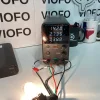
I measured the power consumption of both filaments to be 2.7 Amps @ 14.2 Volts = 38.8 Watts.
See attached photo.
Specifications for charge time:
Hardwire Cable: 60 Minutes (up to 11 Amps)
Cigarette Lighter Cable: 90 minutes (up to 7 Amps)

0% Start
25% 23 Minutes
50% 22 Minutes
75% 21 Minutes
100% 21 Minutes
Total: 1 Hour 27 Minutes

What a trooper, the pack made it through the charge cycle without any adversity.
The 38.8 Watt load extended the charge time by 27 minutes.
The maximum amperage draw was 8.6 Amps @ 14.2 Volts (123 Watts).
Same high pitched whine during charging.
Now that the pack is fully charged I will perform a discharge cycle with the same 38.8 Watt load, (bulb) to see what will happen.
 

Attachments

  • Screenshot 2024-10-02 7.23.31 AM.webp
    Screenshot 2024-10-02 7.23.31 AM.webp
    71.2 KB · Views: 110
  • 3157 Bulb .webp
    3157 Bulb .webp
    287 KB · Views: 115
  • 38.8 Watts @ 14.2 Volts .webp
    38.8 Watts @ 14.2 Volts .webp
    194.7 KB · Views: 109
The pack has a claimed output specification of 2 Amps @ 14.2 Volts = 28.4 Watts.
How about some abusive torture testing?
What if I connect a 38.8 Watt load, and attempt to perform a discharge cycle?
For my load I will be using a 12 Volt automotive 3157 bulb.
I measured the power consumption of both filaments to be 2.7 Amps @ 14.2 Volts = 38.8 Watts.
See attached photo.

100% START
75% 42 Minutes
50% 44 Minutes
25% 45 Minutes
END: 39 Minutes
TOTAL: 2 Hours 50 Minutes
96Wh Γ· 38.8 = 2 Hours 28 Minutes

What a trooper, the pack made it through the discharge cycle without any adversity.
 

Attachments

  • 38.8 Watts @ 14.2 Volts .webp
    38.8 Watts @ 14.2 Volts .webp
    194.7 KB · Views: 118
  • 3157 Bulb .webp
    3157 Bulb .webp
    287 KB · Views: 111
  • Screenshot 2024-10-02 7.23.31 AM.webp
    Screenshot 2024-10-02 7.23.31 AM.webp
    71.2 KB · Views: 119
Based on the 1 Hour 27 Minutes charge time with load, ref. Post#47, we can conclude that this is a pass-through and not a bypass power to the dashcam.
With a bypass, the charge time will be independent of the load, approximately 60 minutes.
The high-pitched sound is most likely due to the coils/inductors or ceramic capacitors as @Nigel mentioned, but it could also be due to some bad or loose component or a poor assembly process.
If I were @70mai, I would replace your unit with a new one ASAP and pay to send yours back for inspection to find and fix the source of this sound before large-scale production.
 
Last edited:
70mai battery pack now for $159,99 Fuse box solution or $151,99 cigarette solution in their online shop, (only US store, not Europe)..
 
Last edited:
$150 is the price @70mai has been targeting since the beginning to make a strong inroad into the parking battery market.
The battery itself looks basically identical with some improvements compared to most Korean 96Wh batteries.
With that price it should be able to push Korean batteries out of the market, why would anyone buy a similar battery for twice the price?
 
$150 is the price @70mai has been targeting since the beginning to make a strong inroad into the parking battery market.
The battery itself looks basically identical with some improvements compared to most Korean 96Wh batteries.
With that price it should be able to push Korean batteries out of the market, why would anyone buy a similar battery for twice the price?
Good question. I had a really hard time justifying the cost of the Powercell 8 battery but after getting hit twice in a parking lot on a brand new car in 6 months I held my nose and payed up.
I wish the 70mai was more compatible (2 wire input vs 3 wire) so that if my PC8 goes south it's an easy replacement.
It would be nice to understand why there is a >X2 difference in similar size battery packs. I don't mind paying for quality/reliability but that is a huge difference.
 
Last edited:
Hardwire charge cycle no loads.
Specifications for charge time:
Hardwire Cable: 60 Minutes (up to 11 Amps)
Cigarette Lighter Cable: 90 minutes (up to 7 Amps)

0% Start
25% 15 Minutes
50% 15 Minutes
75% 14 Minutes
100% 15 Minutes
Total: 58 Minutes

The maximum amperage draw was 8.6 Amps @ 14.2 Volts (123 Watts).
Same high pitched whine during charging.
 
$150 is the price @70mai has been targeting since the beginning to make a strong inroad into the parking battery market.
The battery itself looks basically identical with some improvements compared to most Korean 96Wh batteries.
With that price it should be able to push Korean batteries out of the market, why would anyone buy a similar battery for twice the price?
If the BBMC PowerCell 8 was $150 instead of $350 would you have bothered making your own DIY battery pack, or would you have just bit the bullet for $150?
 
It would be nice to understand why there is a >X2 difference in similar size battery packs.
This is generally referred to as "willingness to pay." Once the market is established at whatever price point and people purchase your product, why would you ever lower the price? That would only erode profits πŸ˜‰.

Same high pitched whine during charging.
I'm guessing that the whine is analogous to the sound an external camera flash makes while it recharges/recycles. I suspect there is an oscillator in the battery circuit that manages the DC-DC voltage step up as the batteries are charged. The frequency of oscillation is likely somewhere in the 10kHz to 15kHz range, thus it is audible.
 
Hack_man:
It would be nice to understand why there is a >X2 difference in similar size battery packs.
This is generally referred to as "willingness to pay." Once the market is established at whatever price point and people purchase your product, why would you ever lower the price? That would only erode profits πŸ˜‰
We will see how this plays out. If the high priced guys immediately drop their price to closely match 70mai, then they were pricing to the "ouch point" of consumers and setting themselves up extremely well for good old fashioned competition.

Otherwise I would expect the quality of the product to direct many consumers to the higher priced units. @Panzer Platform already noticed a difference in quality of the input connectors.

Kind of like why many consumers historically were willing to buy Toyota over American cars.
 
Last edited:
It will indeed be interesting to see how things play out in the market...

By the time I'm done fiddling with my LTO battery pack, I will have probably spent $350 on each one. DIY doesn't always save money, but it does allow you to build to suit your own specific use case. In this case, thanks to @GPak, I have a battery with LTO chemistry that is not yet available on the commercial market, and I have the ability to repair it myself. Plus, I got to choose each of the included components according to temperature ratings so they won't burn up in the heat of the car during summer like my EcoFlow box did.
 
Back
Top