VIOFO Horizontal FOV Database

First (just my opinion):
It should be AOV (angle of view), not FOV.
FOV without corresponding depth of field (DOF) is meaningless to me.
FOV should be measured in meters, feet, yards….., and with reference to respective DOV.
The AOV is measured in degrees (°) and is not dependent on distance/depth
...

That's not your opinion - it's a fact!

From Gemini (just one of many resources) -

Field of View (FOV)

  • Definition: The area of a scene that is visible through a lens at a given moment.

  • Measurement: Expressed as a linear distance (e.g., feet, meters)
  • Factors:Depends on the lens's focal length, sensor size, and the distance to the subject.
Angle of View (AOV)

  • Definition: The angular extent of a scene captured by a lens.
  • Measurement: Expressed in degrees (e.g., 40°, 90°)

  • Factors: Primarily determined by the lens's focal length.
Key Differences

  • FOV changes with distance: As you move closer or farther from a subject, the FOV changes, while the AOV remains constant for a given lens.
  • FOV depends on sensor size: A wider sensor will capture a larger FOV with the same lens compared to a smaller sensor.
  • AOV is a lens property: The AOV is fixed for a particular lens and doesn't change with distance or sensor size.
 
Last edited:
It should be AOV (angle of view), not FOV.
100% correct.
AOV is the correct term, FOV is incorrect.
However, I grew up hunting, and fishing before I got into cameras.
So I have been accustomed to using FOV for binoculars, spotting scopes, rifle scopes, etc.
I also use FOV because that’s what Viofo uses. Lol

Tomato Potato .webp
 
That's not your opinion - it's a fact!

From Gemini (just one of many resources) -

Field of View (FOV)

  • Definition: The area of a scene that is visible through a lens at a given moment.

  • Measurement: Expressed as a linear distance (e.g., feet, meters)
  • Factors:Depends on the lens's focal length, sensor size, and the distance to the subject.
Angle of View (AOV)

  • Definition: The angular extent of a scene captured by a lens.
  • Measurement: Expressed in degrees (e.g., 40°, 90°)

  • Factors: Primarily determined by the lens's focal length.
Key Differences

  • FOV changes with distance: As you move closer or farther from a subject, the FOV changes, while the AOV remains constant for a given lens.
  • FOV depends on sensor size: A wider sensor will capture a larger FOV with the same lens compared to a smaller sensor.
  • AOV is a lens property: The AOV is fixed for a particular lens and doesn't change with distance or sensor size.
Ever since @Dashmellow has been MIA for over a month it feels like you have inherited the task of keeping me in check.
I'm OK with that because I need to be kept in line. lol
 
AOV is the correct term, FOV is incorrect.
However, I grew up hunting, and fishing before I got into cameras.
So I have been accustomed to using FOV for binoculars, spotting scopes, rifle scopes, etc.
I also use FOV because that’s what Viofo uses. Lol
Incorrect!

FoV just refers to what you can see, it can be measured in different ways, including as an angle (AoV), and as a distance width at a distance forward from the lens. The width is traditionally used for binocular lenses, especially military ones, the angle is traditionally used for camera lenses.

So while you can't measure AoV as a distance, you can measure FoV as an angle.

If you look up the specifications for any M12 dashcam lens, it will be given as an angle and described as FoV, which is why Viofo also use FoV.

Should it be FoV or FOV?
Or FV in the USoA?
 
...
I also use FOV because that’s what Viofo uses. ...
VIOFO is wrong (but I'll cut them a little slack as it could be a matter of translation from their suppliers specifications) - no different than if they said the sun rose in the west and set in the east. Echoing them just perpetuates the incorrect usage.

If you insist on using FOV instead of the correct AOV then at least use the term Angular Field of View (AFOV).

 
If you insist on using FOV instead of the correct AOV then at least use the term Angular Field of View (AFOV).

Field of view (FOV) is the maximum area of a sample that a camera can image. It is related to two things, the focal length of the lens and the sensor size.

That is not the figure that Viofo give, they give the FoV of the lens, the sensor size is not taken into account.

At the end, they explain how to calculate the FoV from the Angular FoV:
FOV=AOV(d/D). Where D is the full display image dimensions (either horizontal or vertical), and d is the target dimensions (either horizontal or vertical).


It might be helpful if PP used the term HFoV (Horizontal Field of View) so that it is clear that it is a different measurement from Viofo's figures.
 
Last edited:
VIOFO is wrong (but I'll cut them a little slack as it could be a matter of translation from their suppliers specifications) - no different than if they said the sun rose in the west and set in the east. Echoing them just perpetuates the incorrect usage.

If you insist on using FOV instead of the correct AOV then at least use the term Angular Field of View (AFOV).
This is like Round 2 of my debate with Dashmellow. lol
 
It might be helpful if PP used the term HFoV (Horizontal Field of View) so that it is clear that it is a different measurement from Viofo's figures.
I will continue to use the term that is most widely incorrectly accepted by "people of the land". lol


Nobody calls it "Hook & Loop Enclosure" they just say Velcro (Brand Name).
Nobody calls it "R-134A" they just say Freon (Brand Name).
Nobody calls it "Open End Adjustable Wrench" they just say Cresent Wrench (Brand Name).
Nobody calls it "prophylactic" they just say Magnum (Brand Name)
 
I will continue to use the term that is most widely incorrectly accepted by "people of the land". lol
As long as all the figures in your list are comparable and give the reader a good idea of the differences between cameras, that is all that matters. They are useful information 🙂
 
The reason I chose this method is because anyone that disputes the accuracy of my data can check my measurements without any specialized equipment.
I like how you keep saying my data is incorrect, without saying it's incorrect. lol
 
That is not the figure that Viofo give, they give the FoV of the lens, the sensor size is not taken into account.

At the end, they explain how to calculate the FoV from the Angular FoV:


It might be helpful if PP used the term HFoV (Horizontal Field of View) so that it is clear that it is a different measurement from Viofo's figures.
Field of view (FOV) is the maximum area of a sample that a camera can image. It is related to two things, the focal length of the lens and the sensor size.
By this definition the lens by itself should not have any FOV due to there is no sensor yet.

Here is the web page for M12 lens, all I see is Angle Of View (76 times) and not a single FOV, I couldn't find any specific dashcam M12 lens, maybe I am missing something.
https://www.m12lenses.com/category-...erRating=&page=1&show=100&sort=3#product-grid

If we add a sensor, we can use either AOV or AFOV to measure angle.
(H/V/D can be added for clarity, but to me it's clear, it's a measurement of horizontal angle)

The terms AOV, FOV and others are used interchangeably and often incorrectly.
That's why I said "In my opinion", because I don't want to convince anyone to change their "religion".

If we measure angle, then to me it's AOV.
Field can't be measured in angles without the distance from which it is measured, if the distance is known, then it should be AFOV, as @DT MI mentioned.
 
Last edited:
By this definition the lens by itself should not have any FOV due to there is no sensor yet.
Yes, by that definition, but lenses do have a FoV, it is a different figure to FoV as specified in that definition.

Here is the web page for M12 lens, all I see is Angle Of View (76 times) and not a single FOV, I couldn't find any specific dashcam M12 lens, maybe I am missing something.
They have calculated an AOV for your sensor, based on an assumption of your image sensor size, and since image sensors vary in size, their AOV is likely to be a little inaccurate for your camera. Seems quite helpful, but most lens websites do not do this.


as @DT MI mentioned.
If you look at the diagram on DT MI's link, it shows that FOV (if measured as an angle) and AOV are different angles, you can only calculate AOV if you have a sensor, while FOV, unlike in the above definition, can be measured without a sensor, they are different values when measuring a lens:

FOV-fig-2-1536x1103.png


The terms AOV, FOV and others are used interchangeably and often incorrectly.
That's why I said "In my opinion", because I don't want to convince anyone to change their "religion".
As I said earlier, FoV can be measured as an angle or a distance, it is a correct term either way. AoV must be an angle.

The FoV given by PP is the camera FoV, not the lens FoV. It may not even be the Sensor FoV, since Viofo don't always use the full sensor area to produce the image. If you are choosing a dashcam, this is the useful value.

The FoV given by Viofo is the lens FoV, calculated without knowing the sensor size.
 
Field can't be measured in angles without the distance from which it is measured, if the distance is known, then it should be AFOV, as @DT MI mentioned.
As I said earlier, FoV can be measured as an angle or a distance, it is a correct term either way. AoV must be an angle.
I challenge thee to a dual.
GPak vs. Nigel

Paulus_Hector_Mair_Tjost_fig2.webp
 
No need for dual we can agree to disagree 😉

@Nigel, the diagram in your post shows what the AFOV is (measured in angle, as shown by the dotted arc) and what the FOV is, just a line.

I think the industry originally intended to use the AOV or AFOV to refer to the camera's angle of view, but over time the "A" somehow got dropped and FOV began to be used interchangeably with AFOV, which I think is incorrect.

Regardless of this discussion, I agree that @Panzer Platform tests are useful helping to see the difference in viewing angles between different cameras.
 
Q: What is the measured Horizontal FOV of the A329S (front & 4 remote cameras)?
A:
..25° FOV Telephoto
..94° FOV Waterproof Rear
105° FOV Rear
111° FOV Front
179° FOV IR Interior (Fisheye Mode Off)
203° FOV IR Interior (Fisheye Mode On)
105° FOV IR Interior (Fisheye Mode Off) LED’s On
105° FOV IR Interior (Fisheye Mode On) LED’s On

Front
1.) Front .webp


Rear
2.) Rear .webp


Waterproof Rear
3.) Waterproof Rear .webp


Telephoto
4.) Telephoto .webp


Interior - Fisheye Mode Off
5.) Interior - Fisheye Mode Off .webp


Interior - Fisheye Mode On
6.) Interior - Fisheye Mode On .webp


Interior - Fisheye Mode Off - LEDs On
7.) Interior - Fisheye Mode Off - LEDs On .webp


Interior - Fisheye Mode On - LED's On
8.) Interior - Fisheye Mode On - LED's On .webp


FOV Rig
9.) FOV Rig .webp
 
Q: What is the measured Horizontal FOV of A229 Ultra, and all its remote cameras?
A:
112° Horizontal FOV Front
112° Horizontal FOV Rear
104° Horizontal FOV Waterproof Rear
194° Horizontal FOV IR Interior Fisheye
108° Horizontal FOV IR Interior Fisheye (LED’s on in darkness)

1.) Front .webp

2.) Rear .webp

3.) Waterproof Rear .webp

4.) IR Interior Fisheye .webp

5.) IR Interior Fisheye LED’s On .webp
 
A119M Pro (received 8/12/25)
112.26° FOV

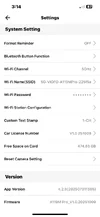
A119M Pro .webp
 

Attachments

  • Firmware .webp
    Firmware .webp
    49.1 KB · Views: 132
  • Test Rig 1 .webp
    Test Rig 1 .webp
    173.6 KB · Views: 154
Last edited:
  • Like
Reactions: gse
That was a real job making that chart your 45 degree mark needs to be 20.71 cm from the center. And the 90 degree mark at 50 cm from center. But each progressive degree mark must be ever so slightly more distance than the one before. Great job.

Field of view equals the width of what you are seeing at a set distance.

Binoculars might have a FOV of 365 feet at 1000 yards as example.

A rifle scope might have a FOV of 35 feet at 100 yards as example.

Your Angle of View results are probably very accurate as long as your markings measure out correctly.
 
Back
Top