ECOFLOW and Viofo

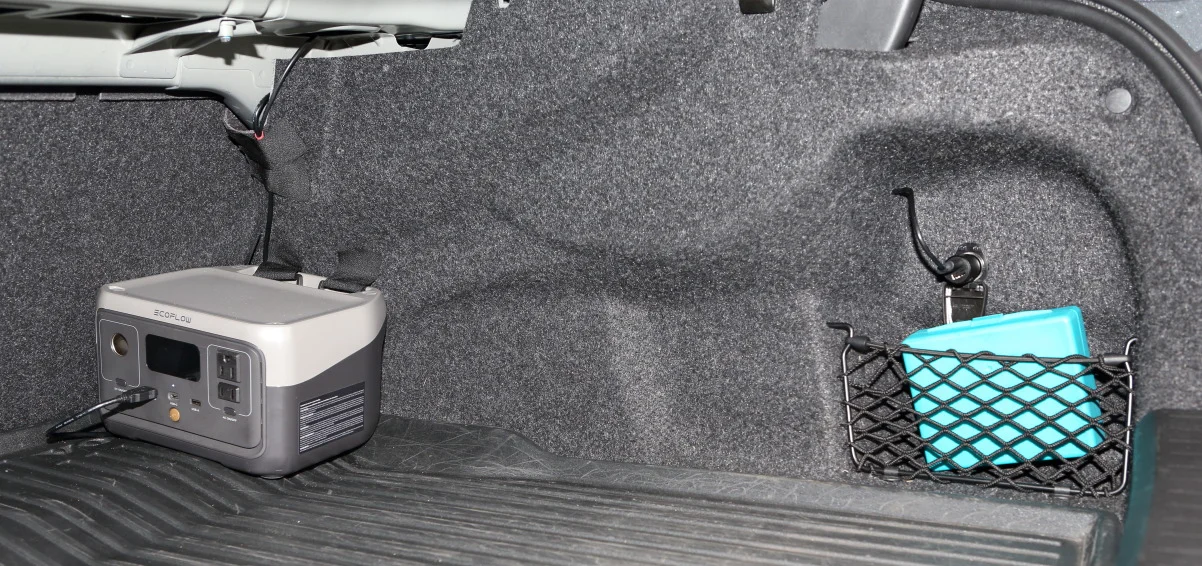
I’ve done the same thing with a 2” wide velcro-like strips. The stuff I have grips well to the trunk liner fabric. Earlier, I used my dremel and cut slits in the trunk liner and passed the velcro through the slits, so it is very securely mounted. I just wrapped the velcro around the handle. I used the River2 before making my own battery, following the instructions from @GPak.
IMG_4362.webp
 
Good idea, but missing a small detail.
Bypassing the red 5V wire is fine.
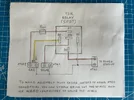
But in order for the HK4 regulator to work (convert the yellow 12V to 5V), you need to make a jumper between the yellow 12V input (labeled on the board as ACC) and the input terminal that was for the red wire you bypassed (labeled on the board as B+)

im not very knowledgeable in circuit boards
..
does jumping the yellow acc input means adding a wire to acc input and B+?

i am thinking of going this route to add an ecoflow.
i havent searched alot of the threads about this but is it possible to add a on/off switch to the between the fuse tap i did and ecoflow to stop charging just in case i have to turn the car on with the engine off?
or do i have to add a relay for the switch?
im
 
i havent searched alot of the threads about this but is it possible to add a on/off switch to the between the fuse tap i did and ecoflow to stop charging just in case i have to turn the car on with the engine off?
or do i have to add a relay for the switch?

This all depends on how your utility outlets in the car behave. If the outlets are always on, then you need to add a relay that is controlled by the ignition switch (power for the relay is tapped from the fuse box). Just replace the "car battery" in the image below with a plug that goes into the 12v utility port in your car. The "LTO Battery" becomes your EcoFlow power station. Here is a link to the parts that I used for this installation:
https://dashcamtalk.com/forum/threa...reliable-for-battery-hookup.52539/post-635048

LTO Hardwire Schematic.webp


If your utility outlets turn on and off with the ignition, then installation is more simple. @GPak already drew up a diagram to this type of install:
Battery Wiring Diagram.webp
 
This all depends on how your utility outlets in the car behave. If the outlets are always on, then you need to add a relay that is controlled by the ignition switch (power for the relay is tapped from the fuse box). Just replace the "car battery" in the image below with a plug that goes into the 12v utility port in your car. The "LTO Battery" becomes your EcoFlow power station. Here is a link to the parts that I used for this installation:
https://dashcamtalk.com/forum/threa...reliable-for-battery-hookup.52539/post-635048

View attachment 83847


If your utility outlets turn on and off with the ignition, then installation is more simple. @GPak already drew up a diagram to this type of install:
View attachment 83846
thank you for the clarification.

i am not trying to use the 12v car socket since passengers use it sometimes.
the bypass suggested the other user might be better for me.

charging the ecoflow:
since my fuse tap(20amps and not used ) turns off and on with the ignition, i could just add a switch rated for atleast 10a in between the fuse and the ecoflow right?
i would have the wire coming out of the fuse tap to the switch then a wire with positive and negative ends to the switch to the xt60 of ecoflow.

ecoflow to viofo:
i would make a 5v usb-a for the hk4 and then the 'bypass' straight to my viofo.

i know there is voltage drop due to 5v and its amps vs 12v and smaller amps.

i just wanted to reduce the conversion of 12v to 5v and the voltage regulator.
 
For a switch in the wire that charges the EcoFlow, use this relay:

40A 10s Time delay relay: https://www.amazon.com/gp/B0744HSF8P

Do NOT pull any more than 5-6A out of your fuse box, especially if you have a “newer” car. Most cars from the last 5-6 years have “smart” fuseboxes. The car’s electronics monitor the current draw and start doing strange things when too much power is drawn from the fusebox. If you go any higher than 5A of charging current, go straight to the battery as my diagram shows.

My initial setup used the EcoFlow and the USB-A worked fine with the Viofo provided USB cable. There will be voltage drop due to the length of the wire, but the A139 Pro is definitely compatible with the River2.
 
Last edited:
Do NOT pull any more than 5-6A out of your fuse box, especially if you have a “newer” car. Most cars from the last 5-6 years have “smart” fuseboxes. The car’s electronics monitor the current draw and start doing strange things when too much power is drawn from the fusebox. If you go any higher than 5A of charging current, go straight to the battery as my diagram shows.

i have a late 2nd gen tundra. so its over 10 years old lol.
im sure the ecu still checks for things. im just worried about either fires caused by sudden short circuit or frying the fusebox then a fire lol

i have hardwired the egen pc8 to my viofo and it has been charging at 7amps for a while. i try to charge less than 1C than the battery.

i needed more recording time so i got the ecoflow
 
....does jumping the yellow acc input means adding a wire to acc input and B+?
Yes, use the same gauge short wire to connect (solder) ACC and B+ as shown on the image as bold yellow line.
Bench test your setup before installing.

As Eric pointed out, it's better to add a relay as an on/off switch for the power station.

If you add a 10A switch directly to the power wire, you'll have to run power wires to the driver and back.
With a relay, you only use relatively thin control wires and small switch.
 
Last edited:
There is another hands free solution, like shown here:

 
im just worried about either fires caused by sudden short circuit or frying the fusebox then a fire lol
This is why the first element in my hand drawn diagram is a fuse. When working with this kind of current, ALWAYS use an appropriate fuse.
 
There is another hands free solution, like shown here:

this is why i need to look at more threads here.
there is ton of info. and this is such a great idea.
 
I have read many posts regarding the powerstation and wiring to the dashcam.

i am not going to pursue the bypass because I need to do long wire runs and i see that there is significant voltage drop for long runs esp for 5v.

im thinking of doing the 15v usb-c cable to hk3-c.
what is the awg of the red and black of that 15v wire?
also in GPak's Power Station 12v Wiring Option,
i noticed the wires that is from hk4 seem thicker. is that the original wires or you soldered thicker wires?

Another question is about the negative/ground wires. Can the negative of the charging cable for car to powerstation and the relay ground be grounded at the same point with grounds of cars electronics?
or
should i ground the charging cable to the battery negative terminal and ground the relay to the common ground of car elctronics?
 
.......im thinking of doing the 15v usb-c cable to hk3-c.
what is the awg of the red and black of that 15v wire?
The USB-C/15V cable is rated at 3Aaccording to spec, the wires are unmarked but feel like 22AWG.
(I use it to drain an Anker Solix C200 DC at 15V/3A/45W since it doesn't have a 12VDC output, no issues.)
For dash cams we generally stay within 12V/1A current so this isn't a problem.

also in GPak's Power Station 12v Wiring Option,
i noticed the wires that is from hk4 seem thicker. is that the original wires or you soldered thicker wires?
The latest HK4 uses 20AWG wires for both 12V and 5V side according to wire markings, although the 12V wires have a much thicker insulation/jacket, I assume for durability, since they are not bonded into a single jacket.
I don't modify the HK4 for 12V system.
If you need to extend the wires I recommend using 18AWG.
For my DIY LTO battery pack I use 18AWG wire on the dash cam side.

Another question is about the negative/ground wires. Can the negative of the charging cable for car to powerstation and the relay ground be grounded at the same point with grounds of cars electronics?
or
should i ground the charging cable to the battery negative terminal and ground the relay to the common ground of car elctronics?
Do not ground anything to the negative battery terminal, ground the relay and the power station to the common chassis ground of the vehicle.
 
Last edited:
The USB-C/15V cable is rated at 3Aaccording to spec, the wires are unmarked but feel like 22AWG.
(I use it to drain an Anker Solix C200 DC at 15V/3A/45W since it doesn't have a 12VDC output, no issues.)
For dash cams we generally stay within 12V/1A current so this isn't a problem.


The latest HK4 uses 20AWG wires for both 12V and 5V side according to wire markings, although the 12V wires have a much thicker insulation/jacket, I assume for durability, since they are not bonded into a single jacket.
I don't modify the HK4 for 12V system.
If you need to extend the wires I recommend using 18AWG.
For my DIY LTO battery pack I use 18AWG wire on the dash cam side.


Do not ground anything to the negative battery terminal, ground the relay and the power station to the common chassis ground of the vehicle.
Thank you so much.

I do want to change the wiring on the dashcam side but i have to learn how to make a new jacket on the wires and the usb c.
im gonna have to lookup stuff how to make it look clean.
 
Can.someone help me. I'm at a total loss.

I purchased this power bank.

https://www.amazon.com/gp/B0D62GMQ3F
I bought the USB C cable recommended in this thread and spliced it into the Viofo hardwire kit. I attached the ACC wire to my fuse box where it usually works.

Nothing.

I bought that voltage regulator recommended in the thread, cut out the low voltage cut off module from the Viofo hardwire kit, and wired in the voltage regulator.

Nothing.

I don't know what I'm doing wrong. Thanks.
 
Can.someone help me. I'm at a total loss.
I purchased this power bank.
https://www.amazon.com/gp/B0D62GMQ3FI bought the USB C cable recommended in this thread and spliced it into the Viofo hardwire kit. I attached the ACC wire to my fuse box where it usually works.
Nothing.
I bought that voltage regulator recommended in the thread, cut out the low voltage cut off module from the Viofo hardwire kit, and wired in the voltage regulator.
Nothing.
I don't know what I'm doing wrong. Thanks.

- Which USB-C cable did you order? USB-C/12V or USB-C/15V.
- If 12V, did you lower the low voltage cut-off to 11.8V in the HK kit?
- How do you charge the Solis? 12VDC via the XT60 solar input or via USB-C PD?
- Either way, make sure the Solix C300 AC is connected to the car via the charging cable, this is to connect the car ground to the Solix ground to complete the ACC circuit.

I recently tested the Anker Solix C200 DC and it works with a USB-C/15V no problem.
Here is the link:
https://dashcamtalk.com/forum/threa...options-extra-functionality.49972/post-648759

Ask your question there, some members have the Solix C300 AC.
 
- Which USB-C cable did you order? USB-C/12V or USB-C/15V.
- If 12V, did you lower the low voltage cut-off to 11.8V in the HK kit?
- How do you charge the Solis? 12VDC via the XT60 solar input or via USB-C PD?
- Either way, make sure the Solix C300 AC is connected to the car via the charging cable, this is to connect the car ground to the Solix ground to complete the ACC circuit.

I recently tested the Anker Solix C200 DC and it works with a USB-C/15V no problem.
Here is the link:
https://dashcamtalk.com/forum/threa...options-extra-functionality.49972/post-648759

Ask your question there, some members have the Solix C300 AC.
Thanks for the response. I didn't have the 12 volt attached. I figured it would work with just the battery station. I attached the 12 volt and it works now.
 
One way to extend the parking time is to charge Power Station from the car when driving and from a small portable Solar Panel while parked.
It is quite simple by using 5 pin automotive Relay
Here is a video to show how it works on the bench.

And short follow up video to show the same in real car and portable solar panel

And a link to some more photos for the similar design I made for the LTO battery.
https://dashcamtalk.com/forum/threads/lto-lithium-titanate-oxide-–-the-ultimate-battery-for-dash-cam-parking-mode-diy.50484/post-631316
 

Attachments

  • IMG_8620.webp
    IMG_8620.webp
    195.6 KB · Views: 138
Nice implementation, GPak! I’ve been meaning to ask a question about the R3: is the USB-C plug flush mounted, or is it recessed like it is in the R2? The recess on the R2 prevents me from plugging lots of things into it because the USB-C male plug is too large to fit within the oval recess on the face of the R2. It’s a real design flaw for the R2…
 
The USB-C and USB-A ports on the R3 are flush-mounted on the same level, but on a slightly angled surface that highlights the LCD screen.
There is no recess, and the angle of noted surface is so slight that I don't think it'll interfere with plugging anything into the USB-C.

BTW, the USB-C ports on the Anker Solix C200 DC are also recessed, but not as deep as the ones on the R2.
 
GPak…. Need your help.
I have the thinkware U3000 and the Ecoflow river 3. Watching your video (thank you!) I’ve got it wired up as you instructed for the Viofo… power and black wire to the Ecoflow USB-C and then the accessory wire run to the appropriate ACC fuse location in the truck. Despite having confirmed good voltage coming off the ACC fuse with the truck turned on the U3000 enters parking mode as soon as a 30 second timer elapses. It’s as if the cam does not sense the ACC voltage for some reason. Have you by chance ever tested the U3000 with the Ecoflow set up? I’m currently at a loss as to what to do.
 
Back
Top