LTO (Lithium Titanate Oxide) – The Ultimate Battery for Dash-Cam parking mode (DIY)

That’s a nice deal to get 24 batteries for twice the cost of only 6 cells! I’d go for 24 and find something to do with the rest. It’s a shame that global shipping is so screwed up, it doesn’t need to be that way…. I’m contemplating a battery power supply for my turn table and turn table preamp.
Yes, I was thinking to buy 24, and use 12 for a 2P6S configuration (so it's 20Ah total, like your prismatic cells). Then I can do something else with the other 12, or make a second pack.
 
I think the 10Ah LTO cells are good for the 6S1P configuration for 140Wh, however, going to the 6S2P configuration means more DIY work, and it will require larger Box compare to 6 Toshiba cells.
If 140Wh is not enough, here is a link for the 22Ah LTO Toshiba SCiB cells.
$153 for 6x cells including bus-bars and nuts plus free shipping, which is slightly more expensive than the 12x 10Ah cells, but you get 303Wh or 10% more capacity than the 20Ah version, if we trust 22Ah claim.

LTO-22Ah Toshiba SCiB Cell
 
Last edited:
That's the same price that I paid for my Toshiba LTO cells. I think working with the rectangular cells (both terminals on same edge) is easier that working with round cells that have terminals on opposite ends. Way less construction to deal with 6 rather than 12 cells. Plus, you don't have to engineer your own physical layout, just copy ours 😉 (I shamelessly copied GPak's layout).

It seems that I'm doing some more dash cam testing, so I need to add another three-conductor terminal to my LTO box to get the 12-16v output so I can connect different brand 12v to 5v regulators. Darn companies have the nerve to each use a DIFFERENT pin on the USB-C connector to toggle parking mode🙄. This keeps you from using one company's camera with another company's hardwire kit.
 
I think the 10Ah LTO cells are good for the 6S1P configuration for 140Wh, however, going to the 6S2P configuration means more DIY work, and it will require larger Box compare to 6 Toshiba cells.
If 140Wh is not enough, here is a link for the 22Ah LTO Toshiba SCiB cells.
$153 for 6x cells including bus-bars and nuts plus free shipping, which is slightly more expensive than the 12x 10Ah cells, but you get 303Wh or 10% more capacity than the 20Ah version, if we trust 22Ah claim.

LTO-22Ah Toshiba SCiB Cell
I do want the SCiB, but 24x of the 10Ah cylindrical is about the same price as 6x 20Ah SCiB
That's the same price that I paid for my Toshiba LTO cells. I think working with the rectangular cells (both terminals on same edge) is easier that working with round cells that have terminals on opposite ends. Way less construction to deal with 6 rather than 12 cells. Plus, you don't have to engineer your own physical layout, just copy ours 😉 (I shamelessly copied GPak's layout).

It seems that I'm doing some more dash cam testing, so I need to add another three-conductor terminal to my LTO box to get the 12-16v output so I can connect different brand 12v to 5v regulators. Darn companies have the nerve to each use a DIFFERENT pin on the USB-C connector to toggle parking mode🙄. This keeps you from using one company's camera with another company's hardwire kit.
Are you going to build more battery packs for each one? Or just have a normal 12v or usbc out
 
My trunk has both a utility outlet and the main start battery for the car. A temporary and lower current connection to the utility port is just two feet away, and the battery is also right there for a high current hardwire connection. I think I posted a few images of the hardwire connection earlier in this thread. I used 11g wire controlled with an inline relay that is powered from the fusebox which is also in the trunk. My son’s battery pack sits on the rear passenger floor and is directly connected to the start battery under the hood. We had to push that same 11g wire through the firewall for that install.
Do you think a subwoofer wiring kit could work for running from engine bay (car battery) to trunk? Something like https://www.amazon.com/gp/B08FRT6CL9
 
Are you going to build more battery packs for each one? Or just have a normal 12v or usbc out
At this point, I'm just going to add a 4-pin connector to the box. This will give me a connection point for ground, +12v switched acc trigger, and a +12-16v power source that goes directly to the batteries. This will provide a place to connect the hard wire kit for other brands and be able to toggle park/drive mode. I've ordered this one - it's a 4-pin connector (for 12v) so I don't get it mixed up with my 3-pin connector that provides 5v. This will keep me from making a dumb and expensive mistake while connecting wires to my box. Both cameras will draw from the same battery.

https://www.amazon.com/gp/B0B1DC19MX
Do you think a subwoofer wiring kit could work for running from engine bay (car battery) to trunk?

That wiring kit will work well, provided 16 feet is long enough for your car. This will depend on whether the battery is closer to your front grille or closer to the windshield. You'll need to tuck it along body under the hood, find the rubber grommet that goes through the firewall, along the footwell to the bottom door trim, across the B-pillar, then into the trunk. Measure carefully before you order. The cable that I linked earlier is presently on sale, so you get 20ft for $24. You really only need a single wire to hit the battery positive connection. The ground connection can be shorter and tied to a closer grounding point in the trunk. That should be easy.

https://www.amazon.com/gp/B0CX56S7QF
 
Here is my newly updated LTO box with an additional 12v output port installed. I chose a 4-position terminal. In retrospect, I should have gone with a 2-position terminal as the smaller 3-position male end fits into the 4-position female terminal. Oops. Anyhow, my main goal was to have a visual cue to prevent mixups. Since a number of hardwire kits come with a spade terminal on the ground wire, I added an additional ground point using a spare screw I had in my parts bag and put some thread locker on the nut that holds it in place. Now I can run my regular Viofo camera at the same time as a new camera for review and both will go in and out of parking mode with the vehicle ignition.

After all of my years of DIY, I still haven't learned to build things the first time around with maintenance/future changes in mind. Thus, the outside panel looks a bit like a hack job now (because the green connectors are not level and straight), but it has the functionality that I need.
IMG_14885.webp


Before I reinstall my LTO hardwire charging cable, I wanted to change out the inline fuse holder that I used the first time around. I initially used a 12g fuse holder and noticed the holder and adjacent wire heating to above body temp while it was charging at 8-9A. This suggests that wire to fuse clip interface is too thin for my comfort. Not knowing which alternative I should choose, I ordered both an 8ga maxi fuse holder and a more "normal" 10g ATO fuse holder.

The 8g maxi holder is ENORMOUS! This one definitely won't overheat while charging my battery pack!
IMG_14886.webp


IMG_14888.webp


By contrast, the 10g one (bottom in image below) looks rather puny next to the behemoth 8g one (top in the image below).
IMG_14887.webp


Now I'm ready for testing other cameras more easily. The next one, a Vantrue 4NS, arrived this afternoon. I started a review thread for it that I'll add to over time.
 
Last edited:
Here is my newly updated LTO box with an additional 12v output port installed. I chose a 4-position terminal. In retrospect, I should have gone with a 2-position terminal as the smaller 3-position male end fits into the 4-position female terminal. Oops. Anyhow, my main goal was to have a visual cue to prevent mixups. Since a number of hardwire kits come with a spade terminal on the ground wire, I added an additional ground point using a spare screw I had in my parts bag and put some thread locker on the nut that holds it in place. Now I can run my regular Viofo camera at the same time as a new camera for review and both will go in and out of parking mode with the vehicle ignition.

After all of my years of DIY, I still haven't learned to build things the first time around with maintenance/future changes in mind. Thus, the outside panel looks a bit like a hack job now, but it has the functionality that I need.
View attachment 81144

Before I reinstall my LTO hardwire charging cable, I wanted to change out the inline fuse holder that I used the first time around. I initially used a 12g fuse holder and noticed the holder and adjacent wire heating to above body temp while it was charging at 8-9A. This suggests that wire to fuse clip interface is too thin for my comfort. Not knowing which alternative I should choose, I ordered both an 8ga maxi fuse holder and a more "normal" 10g ATO fuse holder.

The 8g maxi holder is ENORMOUS! This one definitely won't overheat while charging my battery pack!
View attachment 81145

View attachment 81146


By contrast, the 10g one (bottom in image below) looks rather puny next to the behemoth 8g one (top in the image below).
View attachment 81147

Now I'm ready for testing other cameras more easily. The next one, a Vantrue 4NS, should arrive later this afternoon.
It does not look like a hack job at all! And constantly itterating is always fun regardless.

I received my N4S today, with hardwire kit - I'll probably plug it in for now (testing) and wire up the hardwire when I get some free time. Looking forward to your stats so I can figure out what kind of battery I want (cylindrical vs prismatic, 10Ah, 20Ah, 30Ah?)
 
I am not at all versed in 3D design, but it seems the prismatic cells take up more space (well, it's wider, but narrower) than 12x cylindrical. Due to the price difference, I'm still torn in which to buy.

For the cell costs, I could make 2x packs with the 24x cylindrical 10Ah cells versus 1 pack with 6x 20Ah prismatic.
cylinder vs prismatic.webp

 
Nice mock up! I tend to do most of my work with physical samples in hand, but it's not so easy in this case... The real challenge is finding parts that all "fit" together well. Your chassis needs to hold: batteries (including bus bars and accounting for the threaded terminals, the charger, the BMS, an anti-backflow diode, a few fuses & holders, a battery meter, and provide room for power input and output connections. Your choice about whether you build the 12v to 5v regulator into your box as I did, or keep it external to your box (as I intend with the newly added 12v connector on my box). A bigger box is easier to work inside of, but you'll need to work a little harder to strap things down and keep them from sloshing around as you drive. It's all a fun balance 🙂
 
The Boost Charger only works for 7S (7 in series) Battery, with the lower end of the Battery voltage range is always set above the car voltage.
For the original HK4 hard wiring kit to work properly, the upper end of the range should be limited to 18V

The Buck Charger only works for 4S (4 in series) Battery, with the upper end of the voltage range is always lower than the car voltage.
However, I do not recommend the 4S configuration due to the BMS operating at its limit.

The operating voltage range of the 5S and 6S (preferred) configurations may be lower or higher than the car voltage (depending on the charge stage), so a Buck/Boost Charge Controller is required.

The more expensive Buck/Boost Charge Controller is preferred for the following reasons:
-Less heat is generated at higher current settings (you may need this due to your driving/parking durations)
-Does not require a reverse current protection Diode
-Has an adjustable low voltage protection setting to protect the car‘s battery when the ignition is On but the engine is not running (the smaller Charger has this too, but it is in form of a permanently soldered resistor set somewhere below 12V, I think)
-Larger terminals – easier to work with.

The price difference is about $11, and even less if you include the cost of the reverse current protection diode.
Do any of the buck/boost charge controllers require soldering of resistors to adjust the low voltage protection?

Does the TZT YF-BKT60V25A (larger more expensive) have built-in reverse current protection - I don't need a separate diode? But the smaller TZT 9-56V/2-20A DC Automatic Buck Boost Converter will require a diode?
 
Both charger boards have two adjustment pots, one that controls the charging cutoff voltage, and one that controls the current for the charge rate. You shouldn’t need to alter the boards, just adjust the pots with a micro screwdriver.

The smaller charger requires an anti-backflow diode for sure. I recommend the little rectangular black one that I linked earlier in this thread. I thought @GPak indicated that the larger charging board has a built in diode, but I would wait for his confirmation.
 
As @EricSan pointed out, the 20A version (the smaller one) requires an additional reverse current protection diode.
It has kind of low voltage protection, but it is fixed to 10.8V, which is too low.
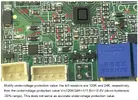
You can either ignore it or modify it (solder a different resistor) to get a low voltage protection value of around 12.4V (see image)

The larger 25A version has built-in reverse current protection, so the extra diode is not needed.
It has a third adjustable resistor pot to set the low voltage protection as desired, so no modifications are needed.
This 25A version also runs noticeably cooler.
Larger terminals are easy to work with.
Based on the above, I recommend the 25A version.

Finally, I just discovered that the low voltage protection setting also works as a "fake MPPT", allowing solar charging!
I originally thought it wouldn't work for solar input based on my bench testing using a variable current power supply, this is because the charger current was fighting the power supply current causing overload.
But when I tested it with a real Ecoflow 45w solar panel, it worked! The solar panel voltage settles to slightly above the low voltage protection setting, and the current is whatever it can supply.
 

Attachments

  • TZT 9-56V2-20A DC Automatic Buck Boost Converter CC CV for Battery Charging.webp
    TZT 9-56V2-20A DC Automatic Buck Boost Converter CC CV for Battery Charging.webp
    142.2 KB · Views: 128
For the 24x cells, I'm thinking to just build 2 batteries. I can (find a way to) charge one at home, so I can swap it out if needed. I can use it to power a 12v freezer cooler for extended drives.

It'd be nice if I could charge both batteries in the car at the same time - the semi-permanent one for cameras, and the 2nd pack to bring along with the cooler.

To make use of the 'Summer Sale' coupons, I just ordered:
ItemLinkPrice (in CAD)
JK-BD4A8S4P 1x $31.18
24PCS High Power Grade a 10C 20000 Cycles+ 32145 Cylindrical Lithium Titanate 2.3v 10ah LTO 1x $201.68
DC 8V~100V Lithium Battery Electricity Indicator High Precision Voltmeter Electricity Tester Real Time Voltage Monitoring [Color and Temp Alarm] 2x $2.80 + $5.71 shipping
85W PD Type C/QC 3.0 USB Car Charger with Switch Fast Charge Socket Power Outlet Adapter Waterproof For 12V 24V Car Truck Boat [Green with lines] 2x $9.48
TZT YF-BKT60V25A 25A 9-60V Automatic Buck Boost Module Buck Boost Converter Step up down Converter 2x $77.99 + $10.76 shipping

Now to shop for connectors and enclosures, and play the waiting game (batteries/BMS ETA Aug 23!). I need another BMS for the 2nd pack - apparently there was only 1 left (lies!) 🙁
 
It’s been my experience that stuff I purchased from AliExpress arrived within 10-12 days. But that was last summer…. Happy building!
 
Here's the updated schematic for my LTO Parking Battery. I added a second set of outputs that will directly feed any brand's hardwire kit so I can test the parking function. The new outputs connect directly to the LTO batteries (after passing through a fuse, of course) and will provide 11-16vDC, depending on the state of charge for the battery.

Edit: Now that I'm running several cameras in my car simultaneously (for testing and comparison purposes), I'm wondering if I should have just installed a barrier strip 😉

LTO Schematic Scan 12v 5v Full Size.webp
 
Last edited:
Any pics of your wiring? Trying to visualize/figure out what gauge to run in the pack, how to tap things, like the volt meter.
 
Any pics of your wiring?

It's a bit of a rat's nest. The best images are from when I built it, on page 4 of this thread. The key is leaving enough wire length to be able to remove panels and lay them on the table next to the box so you can work on it later. There's ALWAYS later work, so plan ahead.

For wires that go to the battery, use 12g for EVERYTHING between your 12v charging input and the battery. Because my battery has screw terminals, I crimped everything to round ring terminals. Depending on several factors, you might want to crimp several wires together into the same eyelet. The terminals are only so tall, your bus bars will take up thread and that might not leave much room for ring terminals and then a nut on top. With one exception, all wire joints are made at the ring terminal. The single exception is the fused wire coming from the battery +v terminal which connects to the +v input for each regulator and the +v for the battery meter. This is a solder connection that is covered with shrink wrap. I used nuts with nylon inserts for the battery terminals to resist vibration in the car. Everything else can be smaller gauge wire, 16-18 should be fine for tapping the battery for dashcam connections.

One key for wiring is that the BMS is the "switch" that sits between the charger and the battery, on the negative leg of the wiring. The BMS should have 8-10ga wiring. Connect your ring terminals directly to the BMS wires without needing to extend them. This means you need to do a bit of planning for physical layout. The charger board will generate the most amount of heat. The inside of my box had a textured powder coat applied to it, so I wet sanded it smooth and applied thermal paste and held it in place with screws. This will help (a little) with cooling the charger. The BMS is just stuck onto the same sanded panel with double sided adhesive thermal tape. I was a bit nervous about this, but after a year and a half, it's still stuck in place quite firmly. Don't skip the fuses!

Depending on how you plan to charge the battery, you might want a time delay relay inside the box (if you plan to use a utility outlet charger at 4-5A). If you charge at a rate greater than 5A, go with a direct to battery connection and put your timed relay inline with your battery connection. I posed a schematic of this some time ago as well.
 
Last edited:
Here is the direct-to-battery hardwire diagram that I made a little while ago. You can find the shopping list at this link:
https://dashcamtalk.com/forum/threa...reliable-for-battery-hookup.52539/post-635048

All wires are 11g, except for the relay coil and the dashcam connections. The solar wire is expensive, but is heat resistant and comes with three layers of insulation, so I'm pretty confident it will stand the test of time.

LTO Hardwire Schematic.webp
 
Back
Top